
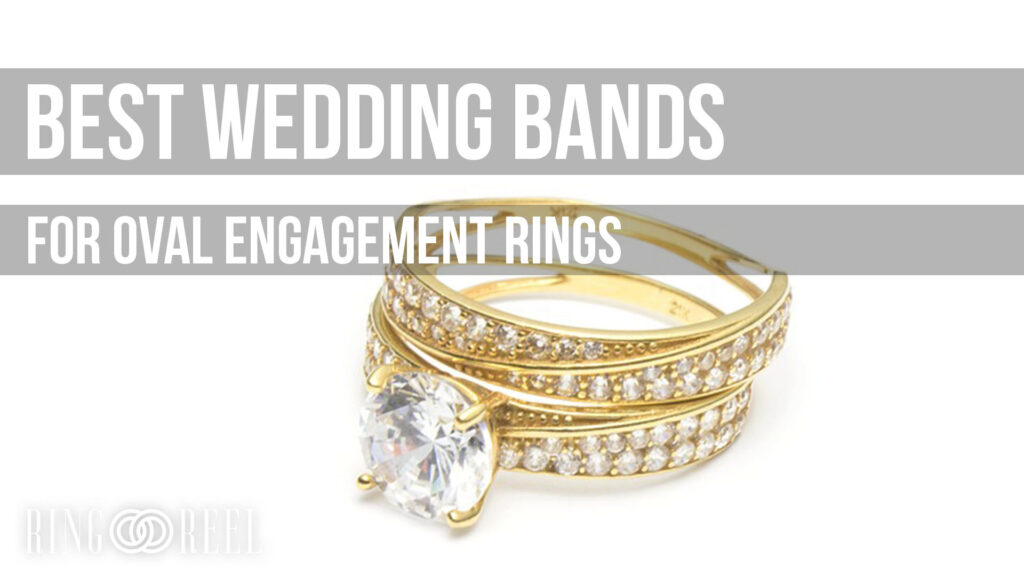
The wedding bands for oval engagement rings that sit flush are decided by your engagement ring’s setting height, not by the fact that the center stone is an oval: Brilliant Earth’s 2026 stacking guide says higher-profile settings typically allow a straight band to align easily, while lower-profile settings may require a curved, contoured or open band to prevent gaps. Our top pick is the Brilliant Earth Olivetta Contoured band, the one curve here whose maker states it is crafted to sit flush; for a plain curve at the lowest price choose the Brilliant Earth 1.5mm Curved Wedding Ring, and for a high-set oval on a straight shank the Angara Sleek comfort fit band.
Our Top Picks
- Brilliant Earth Olivetta Contoured Lab Diamond Ring (1/2 ct. tw.)
Best overall contour
The one contour band that names the most settings it fits and states it sits flush.
- 14K or 18K white or yellow gold, 14K rose gold, platinum
- From $1,990 (14K gold) to $2,290 (platinum), checked 2026-09-11
- Brilliant Earth 1.5mm Curved Wedding Ring
Best plain contour
A contour at the price of a plain band, when the engagement ring should do all the talking.
- 14K or 18K white or yellow gold, 14K rose gold, platinum
- From $490 (14K gold) to $790 (platinum), checked 2026-09-11
- Angara Standard Comfort Fit Sleek Wedding Band
Best straight band
A high-set oval on a straight shank, where a contour would create the gap it is meant to close.
- 14K or 18K white, yellow or rose gold, platinum
- From $602 (14K white gold) to $971 (platinum), checked 2026-09-11; the 18K yellow gold default showed $1,241 at 10% off a $1,379 was price
- Angara Comfort Fit Curved Plain Wedding Band
Best width choice
Matching the band width to the engagement ring shank, which is what makes two rings look like one.
- 14K or 18K white, yellow or rose gold, platinum
- From $602 (14K white gold) to $782 (platinum), checked 2026-09-11; the 18K yellow gold default showed $1,097 against a was price of $1,219 at 10% off
- Rare Carat Ouvre Marquise Wrap Pave Lab Band
Best open band
An awkward setting, where an open band avoids the fit problem instead of solving it.
- 14K or 18K white, yellow or rose gold, platinum
- From $745 (14K gold) to $1,005 (18K gold), platinum $980, checked 2026-09-11. Labor Day sale prices against a comp value of $1,380
- Rare Carat Marquise Vine Lab Diamond Enhancer Band
Best stated spacing
The reader who wants to measure before buying rather than hope.
- 14K or 18K white, yellow or rose gold, platinum
- From $1,435 (14K gold) to $2,030 (18K gold), platinum $1,905, checked 2026-09-11. These are Labor Day sale prices shown against a comp value of $2,650
Key Takeaways
- Setting height decides the flush fit, per Brilliant Earth’s 2026 guide: straight bands for higher-profile settings, curved or open bands for lower-profile ones.
- GIA publishes oval length-to-width ranges of 1.30:1 to 1.40:1, 1.41:1 to 1.50:1 and above 1.50:1, and your grading report already carries yours.
- No band changes a bow tie. GIA says some degree is always present, and Rare Carat says that once present it cannot be removed.
- Brilliant Earth puts the practical resizing limit at about two sizes, and says eternity bands may not resize at all.
- Two sellers here will resize free, then treat the ring as non-returnable, without saying so where they advertise both.
Wedding Bands for Oval Engagement Rings Compared
Six bands, picked so that a straight, a curved, an open and an enhancer option are all here, because the right answer changes with your setting.
| Ring | Price range | Material | Widths | Sizes | Fit, in the maker's words |
|---|---|---|---|---|---|
| Brilliant Earth Olivetta Contoured Lab Diamond Ring (1/2 ct. tw.)Best overall contour | From $1,990 (14K gold) to $2,290 (platinum), checked 2026-09-11 | 14K or 18K white or yellow gold, 14K rose gold, platinum | 2mm | Less than 3 to greater than 12, quarter sizes | Arched to sit flush against a center stone; the maker names solitaire, tapered and halo settings, and the band's own stones are round and pear shaped |
| Brilliant Earth 1.5mm Curved Wedding RingBest plain contour | From $490 (14K gold) to $790 (platinum), checked 2026-09-11 | 14K or 18K white or yellow gold, 14K rose gold, platinum | 1.5mm | Less than 3 to greater than 12, quarter sizes | A plain curved band with no stones; the maker says the subtle curve helps it sit closely against a matching engagement ring |
| Angara Standard Comfort Fit Sleek Wedding BandBest straight band | From $602 (14K white gold) to $971 (platinum), checked 2026-09-11; the 18K yellow gold default showed $1,241 at 10% off a $1,379 was price | 14K or 18K white, yellow or rose gold, platinum | 2mm, 2.5mm or 3mm (selectable) | 5 to 9 in half sizes only | A low-domed plain band that sits flush against a straight-shank solitaire, but the page makes no pairing claim and this product's size range is far narrower than the rest of Angara's |
| Angara Comfort Fit Curved Plain Wedding BandBest width choice | From $602 (14K white gold) to $782 (platinum), checked 2026-09-11; the 18K yellow gold default showed $1,097 against a was price of $1,219 at 10% off | 14K or 18K white, yellow or rose gold, platinum | 4.1mm, 4.6mm, 5.23mm or 5.79mm (selectable) | 3 to 15 in quarter sizes | Contoured and plain, and the only curved band found with a band width selector, so the width can be matched to the engagement ring shank rather than accepted as given |
| Rare Carat Ouvre Marquise Wrap Pave Lab BandBest open band | From $745 (14K gold) to $1,005 (18K gold), platinum $980, checked 2026-09-11. Labor Day sale prices against a comp value of $1,380 | 14K or 18K white, yellow or rose gold, platinum | Not stated (gap width is stated as 4.5mm) | Not stated | A sculptural open design crafted to frame engagement rings, with a published gap width of 4.5mm; because it is open it cannot clash with a center stone's gallery |
| Rare Carat Marquise Vine Lab Diamond Enhancer BandBest stated spacing | From $1,435 (14K gold) to $2,030 (18K gold), platinum $1,905, checked 2026-09-11. These are Labor Day sale prices shown against a comp value of $2,650 | 14K or 18K white, yellow or rose gold, platinum | Not stated (2.8mm of spacing between the bands is stated instead) | Not stated | The only enhancer in this research that publishes the gap it leaves for the engagement ring: 2.8mm of spacing between the bands, which is the figure a buyer can check their own shank against |
Price ranges from the makers' sites, checked September 2026. Prices change; the maker's site has the current one.
Two numbers there are rarer than they look. Rare Carat publishes no band width and no ring sizes, yet it is the only seller here that publishes the gap: 4.5mm across the opening of its open band, and 2.8mm of spacing on its enhancer. That gap is what your engagement ring has to fit into, so measure the widest part of your own shank before ordering either.
The Best Wedding Bands for Oval Engagement Rings, Reviewed
Best overall contour
Brilliant Earth Olivetta Contoured Lab Diamond Ring (1/2 ct. tw.)
by Brilliant Earth
Best for: The one contour band that names the most settings it fits and states it sits flush.
Arched to sit flush against a center stone; the maker names solitaire, tapered and halo settings, and the band's own stones are round and pear shaped.
What we like
- The maker states it is arched to nestle and crafted to sit flush, not just that it is curved
- Names solitaire, tapered and halo engagement rings on the product page
- Width published in the spec block and repeated in the description
Keep in mind
- Among the more expensive contours here
- The page does not name an oval center stone, so that pairing is our read, not theirs
- Price range
- From $1,990 (14K gold) to $2,290 (platinum), checked 2026-09-11
- Material
- 14K or 18K white or yellow gold, 14K rose gold, platinum
- Widths
- 2mm
- Sizes
- Less than 3 to greater than 12, quarter sizes
- Guarantee
- Free lifetime warranty, one free resizing within 60 days (or 1 year within sizing range) with free shipping both ways, 30-day returns
Best plain contour
Brilliant Earth 1.5mm Curved Wedding Ring
by Brilliant Earth
Best for: A contour at the price of a plain band, when the engagement ring should do all the talking.
A plain curved band with no stones; the maker says the subtle curve helps it sit closely against a matching engagement ring.
What we like
- The cheapest contour in this research, at a fraction of any diamond-set curve
- Suits curved or contoured shanks, low-profile settings and slim bands, per the maker
- Nothing on the band to date or compete with the center stone
Keep in mind
- No stones, so it adds no sparkle
- Named for shank types, not for center stone shapes
- Price range
- From $490 (14K gold) to $790 (platinum), checked 2026-09-11
- Material
- 14K or 18K white or yellow gold, 14K rose gold, platinum
- Widths
- 1.5mm
- Sizes
- Less than 3 to greater than 12, quarter sizes
- Guarantee
- Free lifetime warranty, one free resizing within 60 days (or 1 year within sizing range), 30-day returns. Engraved or modified rings can be resized within one year but may incur a fee
Best straight band
Angara Standard Comfort Fit Sleek Wedding Band
by Angara
Best for: A high-set oval on a straight shank, where a contour would create the gap it is meant to close.
A low-domed plain band that sits flush against a straight-shank solitaire, but the page makes no pairing claim and this product's size range is far narrower than the rest of Angara's.
What we like
- Three widths, so it can be matched to the engagement ring shank
- Low domed profile, which sits closer than a flat band
- Cheapest Angara band in 14K white gold
Keep in mind
- Sizes run only 5 to 9 in half sizes, unlike every other Angara band here
- No pairing claim on the page; the flush fit is our read
- Price range
- From $602 (14K white gold) to $971 (platinum), checked 2026-09-11; the 18K yellow gold default showed $1,241 at 10% off a $1,379 was price
- Material
- 14K or 18K white, yellow or rose gold, platinum
- Widths
- 2mm, 2.5mm or 3mm (selectable)
- Sizes
- 5 to 9 in half sizes only
- Guarantee
- Lifetime warranty covering cleaning, re-polishing, stone tightening and re-rhodium plating, $35 per service; one free resizing in the first year, then $50; 30-day returns
Best width choice
Angara Comfort Fit Curved Plain Wedding Band
by Angara
Best for: Matching the band width to the engagement ring shank, which is what makes two rings look like one.
Contoured and plain, and the only curved band found with a band width selector, so the width can be matched to the engagement ring shank rather than accepted as given.
What we like
- Four selectable widths on a curved band, which no other seller offers
- Plain, so it works under any center stone shape
- The cheapest contoured band here in 14K white gold
Keep in mind
- Angara will not confirm fit on the page: a customer question about a specific ring was answered by offering to have a jeweler make contact
- Every price on the site is currently a 10% sale price
- Price range
- From $602 (14K white gold) to $782 (platinum), checked 2026-09-11; the 18K yellow gold default showed $1,097 against a was price of $1,219 at 10% off
- Material
- 14K or 18K white, yellow or rose gold, platinum
- Widths
- 4.1mm, 4.6mm, 5.23mm or 5.79mm (selectable)
- Sizes
- 3 to 15 in quarter sizes
- Guarantee
- Lifetime warranty covering cleaning, re-polishing, stone tightening and re-rhodium plating, with a $35 shipping label per service; one free resizing in the first year, then $50; 30-day returns with two free labels
Best open band
Rare Carat Ouvre Marquise Wrap Pave Lab Band
by Rare Carat (marketplace; the retailer behind this listing is not named on the page)
Best for: An awkward setting, where an open band avoids the fit problem instead of solving it.
A sculptural open design crafted to frame engagement rings, with a published gap width of 4.5mm; because it is open it cannot clash with a center stone's gallery.
What we like
- Publishes a gap width, which is the one measurement that matters on an open band
- Still reads as a deliberate ring worn on its own, which a contour band does not
- Among the cheapest open bands found
Keep in mind
- The page served at one numeric id declares a different id as its canonical group, so the link may not survive
- No band width and no ring sizes published
- Price range
- From $745 (14K gold) to $1,005 (18K gold), platinum $980, checked 2026-09-11. Labor Day sale prices against a comp value of $1,380
- Material
- 14K or 18K white, yellow or rose gold, platinum
- Widths
- Not stated (gap width is stated as 4.5mm)
- Sizes
- Not stated
- Guarantee
- Defect guarantee at delivery; free 30-day returns with no restocking fee; one free resize within the first year. Sending a ring for resizing forfeits the right to return
Best stated spacing
Rare Carat Marquise Vine Lab Diamond Enhancer Band
by Rare Carat (marketplace; the retailer behind this listing is not named on the page)
Best for: The reader who wants to measure before buying rather than hope.
The only enhancer in this research that publishes the gap it leaves for the engagement ring: 2.8mm of spacing between the bands, which is the figure a buyer can check their own shank against.
What we like
- Publishes a spacing figure, which almost nothing else in this research does
- An enhancer frames the ring instead of having to match its curve
- Seven metals
Keep in mind
- Rare Carat is a marketplace and does not name the retailer behind the listing
- No ring size range and no band width published, and the URL carries a numeric id that may go dead
- Price range
- From $1,435 (14K gold) to $2,030 (18K gold), platinum $1,905, checked 2026-09-11. These are Labor Day sale prices shown against a comp value of $2,650
- Material
- 14K or 18K white, yellow or rose gold, platinum
- Widths
- Not stated (2.8mm of spacing between the bands is stated instead)
- Sizes
- Not stated
- Guarantee
- Defect guarantee at delivery; free 30-day returns with no restocking fee; one free resize within the first year. Sending a ring for resizing forfeits the right to return
What We Left Out
- Blue Nile’s ring inserts. The Pointed, Crown, Crescendo and Curved Baguette inserts each carry the line “This ring cannot be resized” on the product page, and Blue Nile is the only seller here that states that limitation in writing on a shaped band. Its own Crescendo curved wedding ring carries no such line.
- With Clarity’s contoured bands. One names a single engagement ring in its description while the matching module on the same page offers a different ring, and a second product carries the identical sentence at another price, so no fit claim from that product copy could be relied on.
- Larson Jewelers and Rockford Collection. Neither sells a curved, contoured, chevron, notched or open band at all, measured across their sitemaps, though both sell oval engagement rings.
- Eternity bands. They are the one style Brilliant Earth says may be difficult or impossible to resize without compromising the design.
How We Chose
- The shape stated by the maker, as straight, curved, contoured or open, not guessed from a photograph.
- One of each kind, because a high-set oval and a low-set oval need opposite answers.
- Widths published in millimeters, with one slim pick, one with presence and two that let you choose.
- Return and resizing terms readable before you pay.
- No eternity band recommended without the resizing warning attached.
- No star ratings and no review counts, only what each seller commits to in writing.
Straight, Curved or Open: Which Band Actually Fits

The band that fits your oval is decided by your engagement ring’s setting height and profile, not by the stone’s shape. Brilliant Earth’s 2026 stacking guide is explicit: “Higher-profile settings typically allow a straight band to align easily. Lower-profile settings may require a curved, contoured, or open band to prevent gaps.” That is the opposite of the received wisdom, and the only version with a jeweler’s name attached.
Here is the check. Stand the ring on a table and look at it from the side, at eye level. Daylight between the top of the shank and the underside of the head means a straight band has room; a head sitting down on the shank, or a halo or side stones reaching over it, means a straight band stops there and leaves a wedge of daylight.
| What your engagement ring looks like from the side | Band that usually fits | Why |
|---|---|---|
| High-profile setting, daylight between the shank and the head | Straight band | Brilliant Earth: higher-profile settings typically allow a straight band to align easily |
| Low-profile or low-set head sitting close to the shank | Curved or contour band | Brilliant Earth: lower-profile settings may require a curved, contoured or open band |
| Halo or hidden halo that extends past the shank | Curved, notched or open band | Nekta New York: a flat band hits the halo’s lower edge before it can sit flush |
| Bezel-set oval | Straight or gently curved, by how far the rim overhangs | A bezel wraps the stone in a thin rim of metal (GIA); the rim is what the band meets |
| Cathedral setting | Straight band often clears | Nekta New York: cathedral settings can provide the clearance a band needs |
| Oval with side stones or a three-stone design | Open or contour band | Side stones extend the obstruction along the shank on both sides |
| East-west set oval | Straight band, usually | GIA: the stone sits horizontally across the finger, not along the shank |
How Setting Height Decides the Gap
A wedding band is a circle, and anything hanging below or beside the head stops that circle before it reaches the shank. Nekta New York, a jeweler writing in 2025, describes the halo version: halos are usually set high above the finger to maximize sparkle and presence, so the base of the halo sits on top of the finger while the band tries to fit beside it, and most standard bands hit the bottom edge of that elevated setting before they can sit flush.
The counterintuitive part is that a low profile oval engagement ring is the harder case, because a low setting closes the channel a straight band would have used while a tall cathedral or basket leaves it open.
What a Curved or Contour Band Does
A curved band and a contour band are the same thing under two names, and a chevron or V band is the sharper-angled version of the same idea, not a third category. Brilliant Earth describes the effect: a curved band emphasizes the contour of the oval, its gentle arc mirroring the center stone’s outline.
A curved wedding band for an oval engagement ring buys that seamless line and costs you flexibility, because the arc is cut for one ring at one orientation. It will not nest against another ring later, looks unfinished worn alone, and complicates resizing. Brilliant Earth makes the styling case both ways: curved bands reinforce the oval’s softness and straight bands create contrast, and both work when chosen deliberately.
When an Open Band Is the Better Answer
An open band is the most forgiving option. Brilliant Earth describes it as a band designed with a gap that accommodates the base of the oval center stone, letting it sit close to the engagement ring and keeping the stack aligned, whether set with diamonds or left in polished metal.
Its advantage over a contour is that it still reads as a deliberate ring alone, and its gap only has to clear an obstruction rather than match a curve. A wedding band enhancer for an oval engagement ring goes further: a two-sided frame around the ring, bulkier, and it commits you to wearing both together.
How Your Oval’s Length-to-Width Ratio Changes the Pairing
The number that predicts how a band will sit is printed on your grading report. GIA publishes length-to-width ranges for ovals and says many people prefer a ratio between 1.30:1 and 1.50:1. The logic: the longer the oval, the further its tips reach along the finger, and the likelier a straight band shows daylight at the sides. GIA issues no cut grade for fancy shapes, so a ratio is a preference, never a grade. Our guide to how the oval compares with other engagement ring shapes covers the other outlines.
1.30:1 to 1.40:1, the Rounder Oval
GIA calls this range a gently elongated look that flatters most fingers and works well in a variety of settings. It is the closest an oval gets to a round outline, so the tips are shallow and a straight band often sits fine, if the side view shows the clearance.
1.41:1 to 1.50:1, the Classic Oval
GIA says these longer ovals are often chosen for their slimming effect on the finger or for a more dramatic appearance. This is the most common oval and the one where the answer genuinely depends on the setting, because the tips reach far enough to matter but not far enough to rule a straight band out.
Above 1.50:1, the Long Oval
GIA notes that long, narrow ovals above this ratio are rarely seen, since it is impractical to cut them from diamond crystals, and that some show a more pronounced bow tie, a dark shadow across the center common in elongated fancy cuts. The tips reach furthest here, so a contour or open band is the safer pairing.
Halos, Baskets and Cathedral Settings

GIA says a halo of smaller diamonds surrounding an oval center stone enhances brilliance, makes the diamond appear larger and emphasizes the shape of the oval. Everything that makes a halo work visually also makes it wider and taller than the shank underneath.
Why a Halo Blocks a Flat Band
The halo’s elevated base occupies the space a flat band wants, so the band stops at its lower edge, the mechanism Nekta New York sets out. A wedding band for an oval halo engagement ring needs a curve that dives under it, a notch, or an open shape that steps around it. A hidden halo is still a halo: the accent stones sit beneath the center stone, which keeps the outline narrow, but the metal holding them is what your band meets.
Notched and Custom Bands
Nekta New York describes the notched solution plainly: a notch cut into the band lets it slide under or wrap around part of the halo setting, and cathedral settings can provide the clearance on their own. The trade is a contour’s, only sharper: cut to one ring in one orientation, the band can never be worn with anything else or rotated.
Bezel-Set and Side-Stone Ovals
GIA says a bezel setting encircles the diamond with a thin band of metal, offers excellent protection, suits active lifestyles and complements the soft curves of an oval. The pairing consequence is easy to miss: your band meets the bezel rim, never the stone, so what matters is how far that rim overhangs the shank. Our bezel setting guide covers how the rim is built.
GIA says half-moon or oval side stones mirror the oval shape while tapered baguettes give geometric contrast, and advises keeping diamond side stones within one to two color grades of the center. Either way, a wedding band for an oval ring with side stones meets an obstruction running further along the shank, which points to an open or contour band.
Band Width and Proportion Against an Elongated Stone
Width is a look decision, not a fit decision. Brilliant Earth says oval diamonds elongate the finger, which gives flexibility with band width: slim bands maintain a delicate profile, while wider or chunky bands create contrast against the tapered ends of the oval. GIA agrees that broader bands give a bold look enhancing the ring’s presence while thinner bands look more delicate.
What the Standard Widths Are in Millimeters
Blue Nile’s 2026 guide says there is no single standard width and that most rings run from about 1.5 mm to 6 mm. Its labels for the ranges in general use are thin or dainty at 1.5 to 1.9 mm, standard women’s at 2 to 4 mm, standard men’s at 4 to 6 mm and wide or statement above that, with a common engagement ring width of 1.8 mm to 2.5 mm. That is one retailer’s description of what it sells, not an industry rule. Blue Nile adds that slimmer bands contain less metal, so they may be more susceptible to bending or wear over time.
Does a Thinner Band Make the Oval Look Bigger?
Yes, as an optical effect. Blue Nile says a thinner band can make a diamond appear larger by creating more visual contrast around the center stone, because slim bands draw attention to the gemstone and leave more visible space around it. The stone does not change; what changes is how much metal your eye compares it against.
Matching or Contrasting Your Engagement Ring’s Width
Blue Nile says an engagement ring and a wedding ring do not have to be the same width, though many people choose bands that look balanced together, matching widths reading as cohesive and different widths adding contrast. A band wider than the engagement ring is a style choice, not an error.
Wedding Bands for East-West Oval Settings
In an east-west setting the oval is set horizontally across the finger instead of vertically, and it is the one case where this page inverts. GIA describes the orientation as a modern design, particularly striking in minimalist or bezel-set styles, that can make even a modestly sized diamond appear larger. It is an orientation, not a cut.
What follows is our reasoning from that description rather than anything a jeweler has published. Because the stone’s length now runs across the finger, the setting occupies far less of the shank on either side, so a straight band usually sits flush. A wedding band for an east west engagement ring is the easy pairing, the opposite of what the same stone demands set north-south. Height still governs, so run the side-view check.
Metal and Finish: Matching or Mixing
Metal is a look decision and never a fit decision, so choose it last. Yellow gold, white gold and rose gold all pair with an oval, and mixing two metals across the two rings is deliberate rather than a mistake. The practical inputs are upkeep and resizing: our platinum vs white gold comparison covers the first, and white gold vs yellow gold covers the difference in color and maintenance.
The Bow Tie: What a Band Can and Cannot Fix
No wedding band, setting or metal hides, fixes or reduces a bow tie. It is the most repeated question on this topic and it deserves a plain no.
GIA explains the cause: the effect occurs when part of the light reaching the diamond is blocked, specifically by your own head and shoulders, as you look at it. A well-cut oval minimizes it by dispersing light more evenly, but due to the nature of the shape and faceting pattern, some degree of bow tie is always present, and GIA adds that it can add character when subtle and balanced.
Rare Carat, in a guide updated in 2026, closes the door on fixing it afterwards: once present, the bow-tie effect cannot be removed. It traces the cause to the pavilion facet pattern, noting that more facets in the middle reflect more light back and lower the chance of one, and advises judging the stone in a 360 degree video rather than a still image. So what to avoid in an oval diamond is a bow tie you never looked at, before the stone is bought.
Should You Solder the Rings Together?
Soldering is what a jeweler offers when a band still will not sit right, and no competing page on this topic mentions it. Brilliant Earth’s 2026 guide defines it: soldered rings are two or more rings joined using a metal alloy known as solder, permanently bonded into a seamless piece by a jeweler who uses heat to melt the solder and fuse the rings without damaging their integrity or any featured gemstones.
What Soldering Fixes
Brilliant Earth names two benefits. Soldering minimizes friction between rings, which can otherwise cause scratches, dents or even gemstone damage over time, and it keeps the rings in place, reducing the chance of accidental loss, since a soldered set has more weight and stability on the finger. Its timing advice: soldering is typically done after the wedding, and many jewelers recommend wearing the rings separately for a few weeks first.
What It Costs You Later
The same guide lists four costs. Separating the rings afterwards can be challenging and potentially damaging to the original pieces. Resizing becomes more complex and could cost more, because the jeweler must separate the rings, resize them individually and re-solder them. Soldered rings cannot be worn individually. And separating them means cutting the solder joint and refinishing, which may leave slight marks. No authoritative price for soldering turned up in this research, so ask your own jeweler for a quote.
Resizing a Curved, Contour or Eternity Band

Brilliant Earth’s 2026 sizing guide gives the limit: rings can generally be sized up or down by about two sizes, and beyond that the ring’s structure and design may be compromised. It puts the cost at $50 to $200 on average and the wait at up to two weeks, and names the exception: eternity bands, with stones all around, can be difficult or impossible to resize without compromising the design. GIA adds the metal limits, that gold can be resized, titanium is challenging because of its hardness and tungsten cannot be resized because of its brittleness.
What resizing does to a curve is specific to this page. A contour band is cut to one ring at one diameter; change the diameter and the arc moves relative to the head it was shaped to clear, which is why a shaped band is the worst ring to buy in a size you are unsure of. Our guide to the average ring size for women explains how to measure.
The Free Resize That Costs You the Return
Sellers advertise a free resize and a free return without mentioning that taking the first cancels the second. With Clarity and Rare Carat both state in their policies that sending a ring in to be resized forfeits the right to return it, and neither puts that sentence where the two offers appear together. So the order is fixed: wear the ring, decide whether you are keeping it, then send it in.
Which Band Should You Choose?
| What you want | What usually works | Why |
|---|---|---|
| A seamless, no-gap look with a low-set oval | Curved or contour band | Its arc is shaped to nest against the head (Brilliant Earth) |
| A no-gap look you can still wear alone | Open band | The gap accommodates the base of the center stone (Brilliant Earth) |
| Freedom to re-pair the band later | Straight band | Nothing is cut to one ring, so it suits any future stack |
| To make the oval read larger | Slim band, 1.5 to 1.9 mm | A thinner band creates more visual contrast around the stone (Blue Nile) |
| To balance a large oval | Wider band, 2.5 to 4 mm | Wider bands contrast with the tapered ends of the oval (Brilliant Earth) |
| A set that never spins or rubs | Soldered rings | Soldering minimizes friction and keeps the rings in place (Brilliant Earth) |
| A ring size that may still change | Not soldered, not eternity | Resizing runs to about two sizes at best (Brilliant Earth) |
| An east-west set oval | Straight band | The stone sits across the finger rather than along it (GIA) |
| A ring you work with your hands in | Bezel-set oval, flat band | A bezel protects the stone and suits active wear (GIA) |
| An oval solitaire on a tall setting | Straight band matched to the shank | Higher-profile settings usually leave the band room (Brilliant Earth) |
The same side-view test decides the band for every other outline, and each one has its own page: a round solitaire is the easiest case, a pear adds the question of the point, a princess cut brings its corners into it, and a halo is the hardest fit of the five.
Frequently Asked Questions
What Wedding Band Goes Well With an Oval Engagement Ring?
Any of three shapes, depending on how high your setting sits. Check the side profile first: a tall head leaves room for a straight band, a low one calls for a curve, and a halo or side stones usually need an open or notched shape. Width and metal are style choices you make afterwards.
What Is a Curved Wedding Band Called?
A curved band is also sold as a contour band, a contoured band or a shaped band, and the four names describe one thing. Sharper-angled versions are marketed as chevron or V bands. Retailers use the terms interchangeably, so compare the actual profile in the product photographs rather than trusting the label.
Do Oval Diamonds Always Have a Bow Tie?
Yes, to some degree, according to GIA, which says the effect is inherent to the shape and its faceting pattern and that a well-cut stone only minimizes it. How visible it is varies enormously between stones. Rare Carat’s advice is to judge each diamond in a rotating video, where the shadow shows up honestly.
What to Avoid in an Oval Diamond?
Avoid buying one you have only seen as a still photograph. The features that disappoint buyers afterwards, a heavy bow tie above all, show up in a rotating video and can be lit out of a product shot. Ratio is a preference rather than a fault, since GIA issues no cut grade for fancy shapes.
Should a Wedding Band Be Wider Than an Engagement Ring?
It can be, and Blue Nile says the two rings do not have to match in width at all. A wider band reads as a deliberate pair; a narrower one keeps the engagement ring dominant. The real constraint is comfort, because two rings on one finger take up more space than either does alone.
What Is the Best Length to Width Ratio for an Oval Diamond?
There is no best ratio, only a popular range. GIA reports that many buyers prefer 1.30:1 to 1.50:1 and describes what each part of that range looks like, but it issues no cut grade for fancy shapes, so no ratio is graded above another. Choose the outline you prefer on your own hand.
What Does East West Engagement Ring Mean?
It means the stone is set horizontally across the finger rather than pointing along it. GIA describes the look as modern and fashion-forward, particularly striking in minimalist or bezel settings, and says it can make a modest diamond appear larger. The stone itself is unchanged; only its orientation in the setting differs.
What Are the Pros and Cons of Soldering Rings Together?
Brilliant Earth names points on both sides. In its favor: less friction between the rings and a more secure fit on the finger. Against: the rings can no longer be worn separately, resizing becomes a multi-step job, and undoing it means cutting the joint and refinishing, which may leave marks behind.
Sources
- GIA 4Cs, Oval Cut Diamond Guide, 2025.
- GIA 4Cs, The Best Ring Material for Everyday Wear, 2025.
- Brilliant Earth, How to Stack an Oval Engagement Ring with a Wedding Band, 2026.
- Brilliant Earth, Soldered Rings: Pros, Cons, and Alternatives, 2026.
- Brilliant Earth, What to Do if Your Ring Is Too Big, 2026.
- Blue Nile, Choosing Your Ring Band Width: The Complete Guide, 2026.
- Rare Carat, Bow Tie Effect In Ovals And How To Avoid Them, 2026.
- Nekta New York, Why Some Wedding Bands Never Sit Flush with Halo Rings, 2025.
- Brilliant Earth, Olivetta Contoured Lab Diamond Ring and 1.5mm Curved Wedding Ring, undated, accessed 11/09/2026.
- Angara, Standard Comfort Fit Sleek Wedding Band and Comfort Fit Curved Plain Wedding Band, undated, accessed 11/09/2026.
- Rare Carat, Ouvre Marquise Wrap Pave Lab Band, Marquise Vine Lab Diamond Enhancer Band and FAQ, undated, accessed 11/09/2026.
- Blue Nile, Crescendo Curved Diamond Wedding Ring and Pointed Diamond Insert, undated, accessed 11/09/2026.
- With Clarity, Refund Policy, undated, accessed 11/09/2026.

