

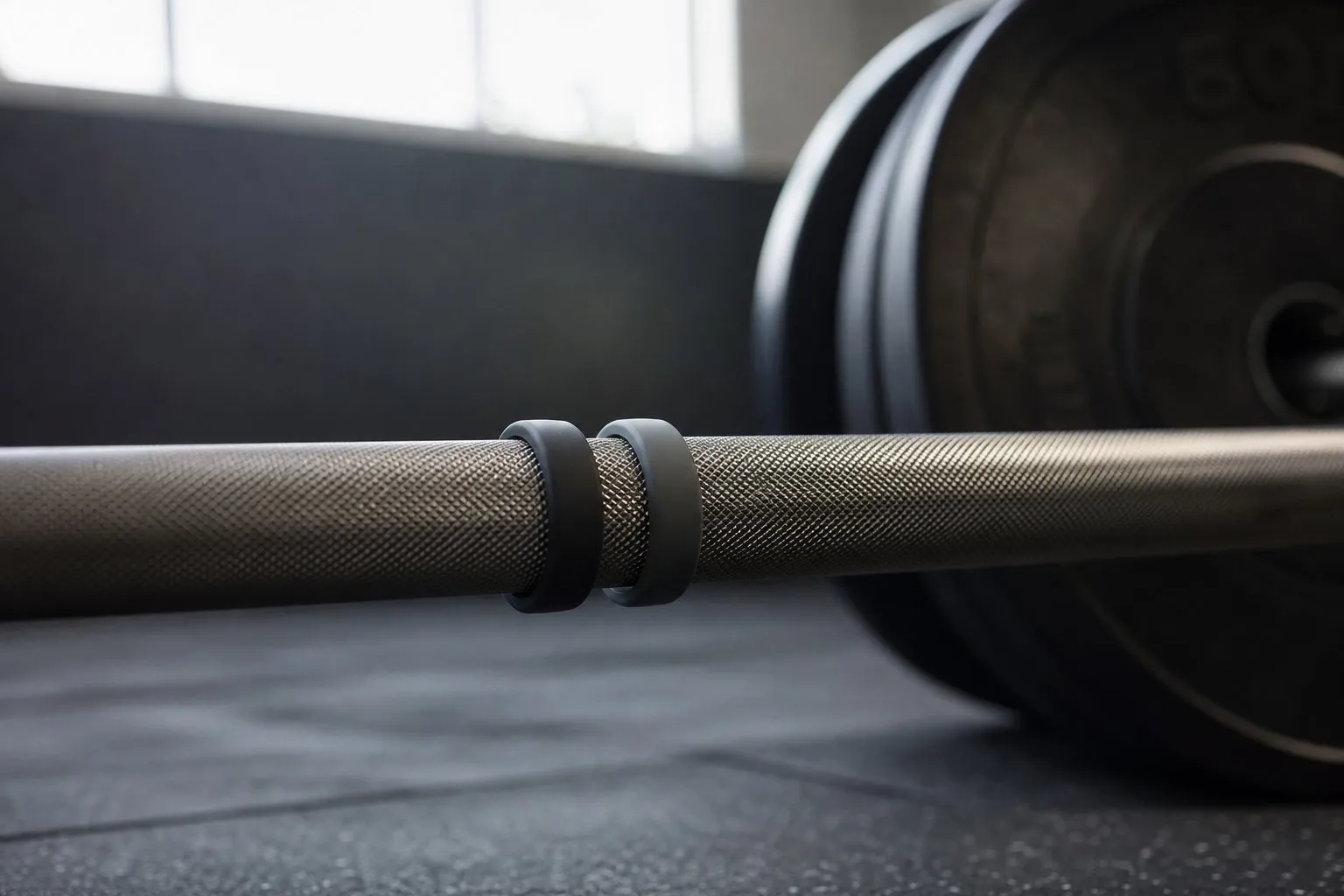
The best wedding ring for working out is a silicone band that gives way before your finger does, and the honest starting point is that nobody has ever tested one in a gym. Our top pick is the Groove Life Groove Ring, because it is the only ring here whose maker publishes a break force at all. The rest of this page is about what that number does and does not tell you, and about the two things that change while you train: your hands swell, and the band loosens.
Our Top Picks
- Our top pickGroove Life Groove Ring (Solid, Original)
Best overall for the gym
The one ring to train in: it is the only band here with a published break force, and the only maker that says in writing how the ring moves sweat off your finger.
- Medical-grade silicone
- $25 to $30
- QALO Men's Classic Q2X Silicone Ring
Best for heavy lifting
Heavy sessions and dirty gyms: a published 2.5mm thickness, a 575F heat figure, and the broadest chemical resistance claim on this page.
- QALO Q2X silicone, described as a "reinforced" take on the Classic
- $25 to $30
- Enso Rings Infinity Thin Silicone Ring
Best thin profile for barbell work
Barbell and pull-up work, where the thing you feel is the ring pressed between the bar and your finger: 1.72mm thick is the least there is here.
- "High performance, medical-grade silicone that is non-toxic and hypoallergenic"
- $18 to $22
- Groove Life Thin Ring (Solid)
Best for contact sport
Grappling, basketball and anything where a hand gets grabbed: the lowest published break force here, so it lets go soonest.
- Medical-grade silicone
- $25 to $30
- Rinfit ActiveFit Ring Protector (set of two, 4mm and 9mm)
Best guarantee
The lifter who will not swap bands: it covers the ring you already wear so the bar scuffs the sleeve instead of your metal.
- Not stated. The page calls it a "metal ring protector" and a "ring guard" and never names the material.
- $22 to $28
What is on this page15 sections
Key Takeaways
- No study we could open tests a ring on a barbell, a dumbbell, a kettlebell, a pull-up bar or a weight plate. A search of Europe PMC in September 2026 for ring avulsion alongside any of those returned zero records.
- The force figure that matters in a gym is not the one everybody quotes. Jewett and colleagues measured silicone rings failing at 53.0 N on a relaxed cadaver hand and at 99.9 N with the fist clenched, and a hand on a bar is a clenched fist.
- Your hands swell while you exercise. Post ambulatory swollen hands is a named condition, the swelling is proportional to how long you go on, and it resolves in about two hours.
- The sports that ban rings are the collision sports. Powerlifting, weightlifting and CrossFit rulebooks either do not mention finger rings or mention jewelry only to exempt it from inspection.
- Only one maker on this page publishes a break force, and no independent party has ever tested a commercial silicone ring.
Wedding Rings for Working Out Compared
| Ring | Price range | Material | Break force, per the maker | Width and thickness | Sizes | Guarantee |
|---|---|---|---|---|---|---|
| Groove Life Groove Ring (Solid, Original)Best overall for the gym | $25 to $30 | Medical-grade silicone | "The Original breaks at ~32 lbs of pressure"; the maker also calls it a "Safe breakaway design" with "engineered breaking points" | The maker's own page states it two ways: ~8mm in one answer, 7mm in another. Thickness is not published. | 7 to 15 in the size selector. Whole sizes only: "No we do not offer half sizes for our silicone collections." If you wear a half size the maker says to size down. | "94-Year No BS Groove Guarantee": "If you break it, lose it, stretch it, or even if you just don't like the color anymore, we will replace it. Fees may apply." No registration needed if bought direct. |
| QALO Men's Classic Q2X Silicone RingBest for heavy lifting | $25 to $30 | QALO Q2X silicone, described as a "reinforced" take on the Classic | The maker publishes two different figures on the same page, and we are not going to reconcile them for it: the Details section says Q2X products "can handle up to 23lbs of force", while the Fit and Sizing section says "Tensile Strength: 49lb". Neither is labeled a breakaway force. | "Dimensions: 8.5mm wide, 2.5mm thick", the only pick here where the maker publishes both figures in one line | 8 to 16 in the size selector. No half sizes offered. | "30 days for a full refund and 60 days for an exchange." No replacement guarantee and no lifetime term on this page. |
| Enso Rings Infinity Thin Silicone RingBest thin profile for barbell work | $18 to $22 | "High performance, medical-grade silicone that is non-toxic and hypoallergenic" | "Engineered with Anti Ring Avulsion Technology to break away under pressure and protect your finger." No force in pounds is published. | "Width: 4.50mm | Thickness: 1.72mm", the thinnest published profile of any pick here | 4 to 9 in this color. No half sizes. | "Every Enso ring comes with a lifetime guarantee. If your ring breaks, stretches out, or fades, we'll replace it for the lifetime of the buyer." |
| Groove Life Thin Ring (Solid)Best for contact sport | $25 to $30 | Medical-grade silicone | "The Thin at ~15 lbs", the lowest published break force of any ring on this page, under the same "engineered breaking points" claim as the Original | "~5.5mm-6mm" per the maker. Thickness is not published. | 4 to 10 in the size selector. Whole sizes only, and the maker tells half sizes to size down. | The same "94-Year No BS Groove Guarantee": broken, torn, stretched, lost or even a color you no longer like gets replaced, and "Fees may apply" |
| Rinfit ActiveFit Ring Protector (set of two, 4mm and 9mm)Best guarantee | $22 to $28 | Not stated. The page calls it a "metal ring protector" and a "ring guard" and never names the material. | Not stated, and not the point: this is a sleeve over your own band, so the band underneath is still rigid and still has to be cut off in an emergency | Sold as a set of two, 4mm and 9mm. Thickness is not published. | 4 to 10 in the size selector. No half sizes. | The same Rinfit terms as the rings: lifetime free replacement if it fails to perform, free size exchange, and a full refund within 30 days, subject to the warranty policy |
Price ranges from the makers' sites, checked September 2026. Prices change; the maker's site has the current one.
The Best Wedding Rings for Working Out, Reviewed
Best overall for the gym
Groove Life Groove Ring (Solid, Original)
by Groove Life
Best for: The one ring to train in: it is the only band here with a published break force, and the only maker that says in writing how the ring moves sweat off your finger.
Groove Life says the rings are "non-conductive, medical-grade silicone" and "100% medical-grade silicone", hypoallergenic and safe for a latex allergy.
What we like
- Publishes an actual break force, ~32 lbs, instead of a vague breakaway claim
- The only maker on this list that makes a published sweat and airflow claim
- The guarantee covers a stretched, torn or lost ring, not just a factory defect
- The maker says in writing the silicone is non-conductive
Keep in mind
- Whole sizes only, so half-size fingers have to size down
- Width is given as both 7mm and ~8mm on the maker's own page, and thickness is never published
- "Fees may apply" on replacements, and the page does not say what they are
- The grooves need rinsing, and the maker suggests taking it off in the shower
- Price range
- $25 to $30, listed at $29.95 when we checked in September 2026
- Material
- Medical-grade silicone
- Conducts electricity
- No
- Heat rating
- "Silicone has high heat resistance and won't melt like plastic, but it is not fireproof", no temperature published
- Breakaway
- "The Original breaks at ~32 lbs of pressure"; the maker also calls it a "Safe breakaway design" with "engineered breaking points"
- Widths
- The maker's own page states it two ways: ~8mm in one answer, 7mm in another. Thickness is not published.
- Sizes
- 7 to 15 in the size selector. Whole sizes only: "No we do not offer half sizes for our silicone collections." If you wear a half size the maker says to size down.
- Guarantee
- "94-Year No BS Groove Guarantee": "If you break it, lose it, stretch it, or even if you just don't like the color anymore, we will replace it. Fees may apply." No registration needed if bought direct.
- Made in
- Not stated
Best for heavy lifting
QALO Men's Classic Q2X Silicone Ring
by QALO
Best for: Heavy sessions and dirty gyms: a published 2.5mm thickness, a 575F heat figure, and the broadest chemical resistance claim on this page.
The page lists Q2X products as "non-conductive" alongside their chemical and heat claims.
What we like
- Publishes width and thickness together, 8.5mm by 2.5mm, so you know exactly what sits under a bar
- The only ring here with a published temperature figure, 575F
- Maker states it is "10x more resistant to gasoline" and resistant to oil, solvents and household chemicals
- Sizes run to 16, the largest in this group
Keep in mind
- Two contradictory force figures on one page, 23lbs and 49lb, and neither is called a breakaway force
- Returns only: 30 days to refund, 60 days to exchange, with no replacement cover for a torn ring
- Nothing published about sweat, airflow or loosening
- 8.5mm is the widest band in this group, and there are no half sizes
- Price range
- $25 to $30, listed at $26.95 when we checked in September 2026
- Material
- QALO Q2X silicone, described as a "reinforced" take on the Classic
- Conducts electricity
- No
- Heat rating
- "Tolerant to temperatures up to 575F", the only published temperature figure on this page
- Breakaway
- The maker publishes two different figures on the same page, and we are not going to reconcile them for it: the Details section says Q2X products "can handle up to 23lbs of force", while the Fit and Sizing section says "Tensile Strength: 49lb". Neither is labeled a breakaway force.
- Widths
- "Dimensions: 8.5mm wide, 2.5mm thick", the only pick here where the maker publishes both figures in one line
- Sizes
- 8 to 16 in the size selector. No half sizes offered.
- Guarantee
- "30 days for a full refund and 60 days for an exchange." No replacement guarantee and no lifetime term on this page.
- Made in
- Not stated
Best thin profile for barbell work
Enso Rings Infinity Thin Silicone Ring
by Enso Rings
Best for: Barbell and pull-up work, where the thing you feel is the ring pressed between the bar and your finger: 1.72mm thick is the least there is here.
Enso makes no conductivity claim on this page, so treat it as unknown rather than safe near live electrical work.
What we like
- 1.72mm thick and 4.50mm wide, both published, the lowest profile in this group
- Lifetime guarantee that names a stretched-out ring, not just a defect
- The maker states it is engineered to break away under pressure
- Cheapest ring on this page
Keep in mind
- Sizes stop at 9, so most men's fingers are out
- No break force published, only the breakaway claim
- No conductivity, heat, or sweat statement at all
- No half sizes
- Price range
- $18 to $22, listed at $19.99 when we checked in September 2026
- Material
- "High performance, medical-grade silicone that is non-toxic and hypoallergenic"
- Conducts electricity
- Not stated
- Heat rating
- Not stated. No temperature or flame claim on the page.
- Breakaway
- "Engineered with Anti Ring Avulsion Technology to break away under pressure and protect your finger." No force in pounds is published.
- Widths
- "Width: 4.50mm | Thickness: 1.72mm", the thinnest published profile of any pick here
- Sizes
- 4 to 9 in this color. No half sizes.
- Guarantee
- "Every Enso ring comes with a lifetime guarantee. If your ring breaks, stretches out, or fades, we'll replace it for the lifetime of the buyer."
- Made in
- Not stated
Best for contact sport
Groove Life Thin Ring (Solid)
by Groove Life
Best for: Grappling, basketball and anything where a hand gets grabbed: the lowest published break force here, so it lets go soonest.
Same statement as the Original: "non-conductive, medical-grade silicone", 100% medical grade and latex free.
What we like
- ~15 lbs published break force, the lowest figure any maker on this page publishes
- Same published sweat and airflow claim as the Original
- Same guarantee, which covers a stretched or lost ring
- Narrow enough to sit beside a second band
Keep in mind
- Sizes stop at 10
- Thickness is never published, only the 5.5mm to 6mm width
- Costs the same as the wider Original despite less material
- Whole sizes only
- Price range
- $25 to $30, listed at $29.95 when we checked in September 2026
- Material
- Medical-grade silicone
- Conducts electricity
- No
- Heat rating
- "Silicone has high heat resistance and won't melt like plastic, but it is not fireproof", no temperature published
- Breakaway
- "The Thin at ~15 lbs", the lowest published break force of any ring on this page, under the same "engineered breaking points" claim as the Original
- Widths
- "~5.5mm-6mm" per the maker. Thickness is not published.
- Sizes
- 4 to 10 in the size selector. Whole sizes only, and the maker tells half sizes to size down.
- Guarantee
- The same "94-Year No BS Groove Guarantee": broken, torn, stretched, lost or even a color you no longer like gets replaced, and "Fees may apply"
- Made in
- Not stated
Best guarantee
Rinfit ActiveFit Ring Protector (set of two, 4mm and 9mm)
by Rinfit
Best for: The lifter who will not swap bands: it covers the ring you already wear so the bar scuffs the sleeve instead of your metal.
This is a cover over a metal ring, so the metal ring underneath still conducts; take the whole thing off near live electrical work.
What we like
- Two widths in the box, 4mm and 9mm, so it fits a narrow or a wide band
- Patented design, per the maker, and sold in six colors
- Carries the same lifetime replacement and free size exchange as the Rinfit rings
- The only pick here that lets you keep your actual wedding ring on
Keep in mind
- It protects the ring, not the finger: your rigid band is still on your hand, with no breakaway anything
- The maker never states what it is made of, or how thick it is
- Sizes stop at 10
- Adds bulk in exactly the place a barbell presses
- Price range
- $22 to $28, listed at $24.99 when we checked in September 2026
- Material
- Not stated. The page calls it a "metal ring protector" and a "ring guard" and never names the material.
- Conducts electricity
- Not stated
- Heat rating
- Not stated.
- Breakaway
- Not stated, and not the point: this is a sleeve over your own band, so the band underneath is still rigid and still has to be cut off in an emergency
- Widths
- Sold as a set of two, 4mm and 9mm. Thickness is not published.
- Sizes
- 4 to 10 in the size selector. No half sizes.
- Guarantee
- The same Rinfit terms as the rings: lifetime free replacement if it fails to perform, free size exchange, and a full refund within 30 days, subject to the warranty policy
- Made in
- Not stated
How We Chose
We opened every maker’s own product page in September 2026 and recorded only what the maker publishes there. Where a maker states a break force, a width or a thickness, that figure appears in the table with its wording. Where the maker publishes nothing, the cell says so, because a cell that says nothing is published describes the maker’s page and not the ring.
We did not test any ring. Nobody has, in anything we could find: no independent laboratory, no consumer body and no journal has published a measurement of a commercial silicone wedding ring. Every force figure on this page either comes from a cadaver study that used its own specimens or from a maker describing its own product.
No Study Has Ever Tested a Ring in a Gym
This is the finding that shapes everything else, so it goes first.
We searched Europe PMC on 13 September 2026 for ring avulsion alongside barbell, dumbbell, kettlebell, weight plate, pull-up, chin-up, CrossFit and monkey bar. The search returned zero records. A second search for ring avulsion with sport, weightlifting, gym or athlete returned eleven, of which three concern sport at all and none concerns weight training.
The nearest thing to a sport-specific publication is a single case report from 1997, in the British Journal of Sports Medicine, describing a ring avulsion in an adolescent attempting a slam dunk. Its full text sits behind a publisher block we could not pass, so we can tell you the case exists and no more than that.
The newest review of ring avulsion injuries, published in the Journal of Hand Surgery in 2026, discusses epidemiology, classification and the biomechanical work that has pushed ring makers to redesign. Its abstract does not mention sport, athletes, the gym or weightlifting anywhere.
So when a product page tells you its ring is made for the gym, understand what is behind that: a design intention and a market, not a measurement. Cleveland Clinic is the named authority that states the position most carefully. On silicone rings it writes that “there’s some evidence” they can prevent ring avulsions, that they have “become more popular in the last few years”, and that “because this is a relatively new trend, experts are still studying it.”
The Force That Matters Is the One for a Closed Fist
Almost every page that cites the research quotes one number: silicone rings failed at an average of 53.0 N against 495.2 N for metal, from the cadaver study by Jewett, Uppuganti and Desai in the Journal of Hand Surgery in 2021.
That study measured something else too, and it is the figure a lifter needs. The authors used a fifth cadaver forearm to test silicone rings on a clenched fist, and there the average failure force rose to 99.9 N. Your hand on a barbell, a dumbbell handle, a pull-up bar or a kettlebell is a clenched fist. The ring is being asked to break at roughly twice the force it needs on an open hand.
For scale, the older cadaver work by Kupfer and colleagues, published in 1999, found that the least severe class of ring avulsion happened at an average of 80 N, and that a class III injury, the kind that takes the soft tissue off the finger, happened at 154 N, which the authors themselves described as “surprisingly minimal”.
Those two studies are twenty-two years apart, used different rings and different protocols, and cannot be subtracted from one another. What can fairly be said is that the two published numbers sit close together, that nobody has compared them directly, and that nobody has run either test with a hand gripping gym equipment. Jewett’s own clinical recommendation names heavy labor, not sport: “the use of silicone rings should be encouraged in professions where ring avulsion injuries are more likely, such as heavy labor.”
Your Hands Swell While You Train, and That Is Measured
Here is the mechanism the roundups skip, and it is the one with real evidence behind it.
Post ambulatory swollen hands, abbreviated POTASH, is a documented condition: painless swelling of the hands and fingers during sustained activity. In a 2024 case report in AME Case Reports, a runner’s hands began to swell after the first hour and kept swelling for the rest of the race, then resolved completely within about two hours of stopping. The clinical sign is that the person cannot close the fingers into a fist.
Read that against the ring on the finger. A band that fitted at the start of a session is on a bigger finger by the end of it, and a ring that will not come off a swelling finger stops being jewelry and becomes a constriction. That is not hypothetical: in a 2023 series of finger entrapments in the Indian Journal of Orthopaedics, rings were 60 percent of all the objects involved, and 37 percent of the cases had reduced blood flow beyond the constriction.
The honest limit on this: every POTASH report we could open is in walkers, hikers and runners, mostly by one author, and nobody has measured finger circumference during a lifting session. Nobody has published what exercise swelling does to a ring. We are joining two documented things that nobody has joined in print, and you should know that is what we are doing.
If a ring is already stuck, the technique matters more than force. We cover it in how to get a ring off a swollen finger.
The Sports That Ban Rings Are Not the Lifting Sports
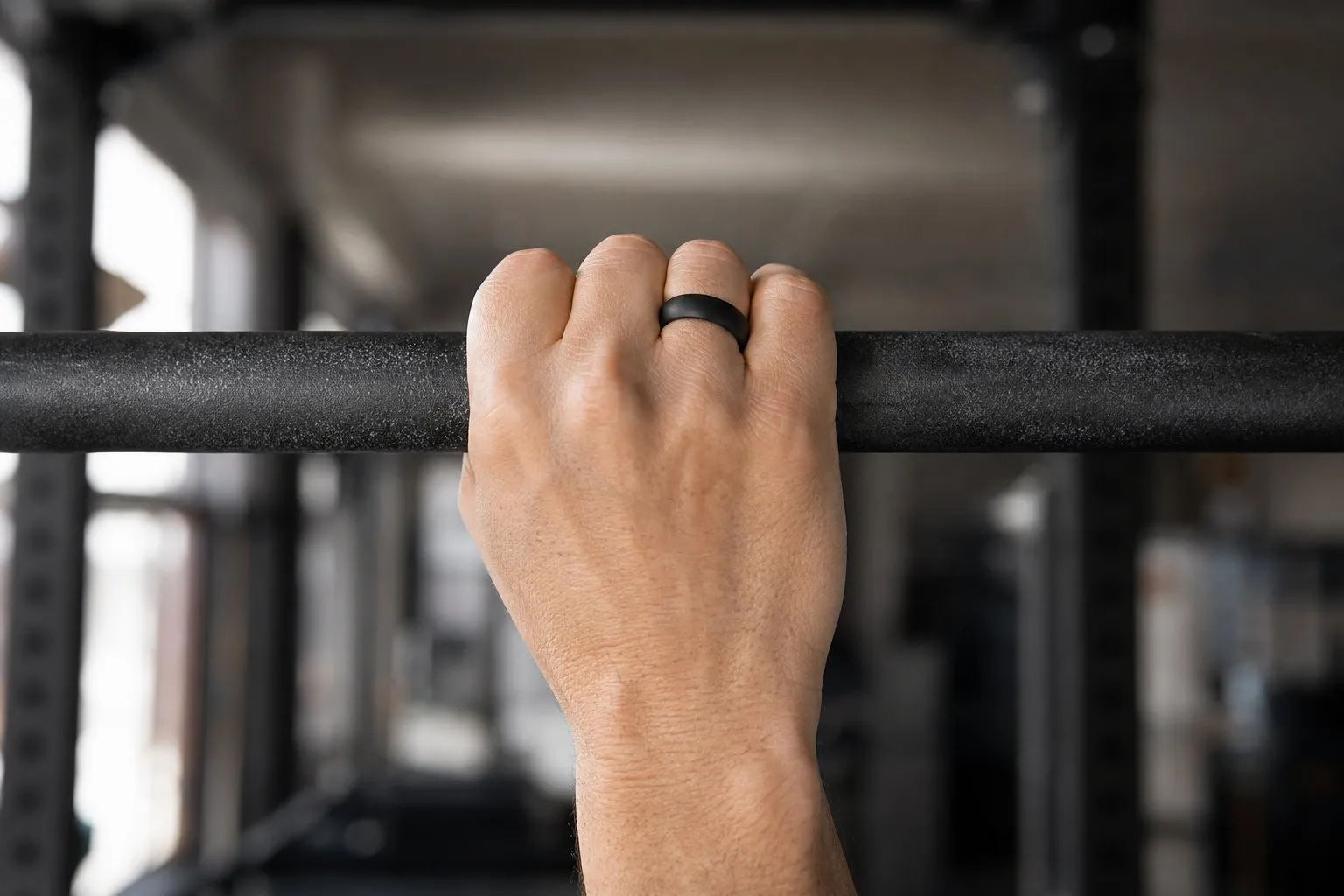
We read the rulebooks. The pattern is clean, and nobody seems to have pointed it out.
Collision sports ban jewelry outright. The sports built entirely around lifting heavy metal do not.
| Governing body | What its rulebook says about jewelry |
|---|---|
| NCAA wrestling | Bans it, and the referee’s inspection names “finger rings” outright |
| NCAA men’s basketball | ”Head decorations, headwear, headgear and jewelry are illegal” |
| FIBA | Lists “hair accessories and jewellery” among what players may not wear |
| High school soccer and volleyball | Not permitted, even if taped |
| International Powerlifting Federation | Mentions jewelry once in 45 pages, only to exempt it from inspection; expressly allows necklaces and chalk |
| USA Powerlifting and the USPA | Same inspection exemption, no rule on finger rings |
| International Weightlifting Federation | Lists “jewelry / accessories” among permitted athlete kit |
| CrossFit Games rulebook | Read in full; does not mention jewelry at all |
The International Powerlifting Federation’s technical rulebook is the clearest case. It uses the word jewelry once in forty-five pages, to say that watches and costume jewelry “need not be inspected”, and it goes on to write a considered rule about necklaces, complete with a safety override for the referee. It says nothing whatsoever about the ring on the hand that holds the bar.
Two cautions on how to read that. First, a rule that exempts jewelry from inspection is not a safety ruling about training with a ring on, and a permission for necklaces is not a permission for finger rings. Second, no governing body publishes a reason for any of this, so the contrast is real but its cause is not documented.
The same shape appears in workplace rules. The US federal hand protection standard, 29 CFR 1910.138, does not mention rings or jewelry anywhere. Rings appear in the federal rules only in the electrical standard.
What the Makers Publish, and Where They Contradict Themselves
| Maker | Break force published | On loosening | On sweat |
|---|---|---|---|
| Groove Life | Yesabout 32 lbs for the Original, about 15 lbs for the Thin, no method given | ”Silicone naturally relaxes after a few days of wear”, and separately “a rigid inner band to prevent excessive stretching" | "Air in, moisture out. Less sweat. No clammy fingers” |
| QALO | Two figures on the same page: “can handle up to 23lbs of force” and “Tensile Strength: 49lb” | Not publishedgradual stretching is excluded from the warranty by name | Not published |
| Enso Rings | Not publishedthe page claims “Anti Ring Avulsion Technology” | The lifetime guarantee names a ring that “stretches out” | Not published |
| Rinfit | Not publishedwhich is not a breakaway product | Not published | Not published |
| SafeRingz | Not published | Not published | Not published |
Three things are worth pulling out of that table.
Only one maker publishes a number, and it publishes it without a method: we do not know how Groove Life loaded the ring, in what direction, or on what. QALO publishes two figures on one page that do not reconcile, and neither is labelled a breakaway force. We are not going to average them or pick the one that suits the page.
Groove Life states, on the same page, that its silicone “naturally relaxes after a few days of wear” and that the ring has “a rigid inner band to prevent excessive stretching”. Both may be true of different parts of the ring, but the maker does not explain how, and no independent measurement of silicone ring creep exists.
Absolute claims should be read as claims. SafeRingz says its rings are “designed to break when stretched”. Groove Life markets a “safe breakaway design”. The study those claims lean on concluded that silicone rings “may help prevent ring avulsion injuries”, which is a different sentence.
Sweat, Chalk and the Skin Under a Band
A dedicated review of hand skin conditions in athletes, published in Cureus in 2023 and covering gymnastics and weightlifting by name, describes weightlifter’s calluses and the moisture problems that come with occlusion. Its twenty-condition table has no entry for rings, and the words ring and jewelry do not appear in the paper. A 2025 cross-sectional survey of gym users in the Eastern Province of Saudi Arabia found that 33.2 percent reported an exercise-related skin complaint, most often dryness, and it does not mention jewelry either.
What is documented about skin under a ring comes from healthcare, not the gym. The World Health Organization’s 2009 hand hygiene guidelines state that “several studies have shown that skin underneath rings is more heavily colonized than comparable areas of skin on fingers without rings”, and that in one intensive care study rings were the only significant risk factor for carrying certain bacteria.
Chalk is a genuine blank. The published measurements of whether magnesium carbonate even improves grip disagree with each other, and no source we could open looks at chalk against skin, let alone chalk trapped under a band. The one full paper we read on grip powders measured rosin on a baseball, which is a different substance on a different surface. What that paper did measure on its own account is that wet skin was significantly less grippy than dry skin under higher loads, which is at least the direction everyone assumes.
The Safest Ring to Wear While Training
Put together, the published evidence supports a narrow claim and not a broad one.
Silicone fails at a fraction of the force metal needs, and in the cadaver work no silicone ring caused a degloving injury. That is meaningful, and it is why hand surgeons recommend silicone for heavy labor. It is not a guarantee, it was not measured on a gym floor, and the number roughly doubles when the fist is closed.
Fit does more work than material. Cleveland Clinic’s advice is that a loose ring is the dangerous one, because “the looser a ring fits, the more wiggle room it has to get caught on something”. A silicone band that has relaxed over a season is looser than the one you bought, which puts loosening and breakaway on the same axis pulling in opposite directions. Nobody has published where that crossover sits.
And the broadest advice from a named authority is not about material at all. Cleveland Clinic’s own summary says to remove rings and jewelry “before working with tools, equipment or doing anything that might tug on your fingers and hands”. A pull-up bar tugs on fingers and hands.
If You Train in the Metal Band
Plenty of people do, and the research has one specific warning for the hard metals rather than for gold.
Quinto and colleagues, publishing in the Journal of Bone and Joint Surgery in 2025, compressed tungsten carbide rings to failure and cut others with a diamond grinding bit. The rings cracked at a mean of 3.7 kN, and the contact point reached an average of 160.2 degrees Celsius even when the cut was cooled with saline. The same group had already reported a case in which a man cut a tungsten carbide ring off his own finger with a high-speed burr and lost the finger to thermal necrosis two days later, not to the original injury.
That work is about tungsten carbide and nothing else. It says nothing about ceramic, titanium, gold, cobalt chrome or steel, and we are not going to pretend otherwise. What it does establish is that the removal itself carries risk with a hard ring, which is an argument for taking the band off before the session rather than for choosing a different metal.
Where to Put the Ring You Take Off
The answer many lifters land on is not a ring at all. Threaded onto a shoelace, clipped to a carabiner on the bag, on the key ring, on a chain around the neck, or left in a dish at home: these are the routes people actually use, and they carry no snag risk on the bar whatsoever.
There is a small piece of published support for the neck option. The International Powerlifting Federation’s rulebook expressly permits a competitor to wear a necklace with a pendant, subject to the referee’s judgement on safety. If the goal is to keep the ring on your body while you lift, a chain is the one place a strength federation has written a rule allowing.
For the days the metal band stays home, the silicone options above cost less than a month of most gym memberships. For everything else your hands do at work, we compare the same materials by trade in bands built for hands-on work, and the full silicone category sits in the best silicone wedding bands.
Frequently Asked Questions
Do You Wear a Wedding Ring When Working Out?
Many lifters do not. No study measures the risk either way, so this is a judgement call rather than a settled question. The published guidance from Cleveland Clinic is to remove rings before anything that might tug on your fingers and hands, which describes a pull-up bar fairly well.
What Are the Best Wedding Rings for Working Out?
Silicone bands, because they fail at a small fraction of the force metal needs and caused no degloving in the cadaver research. Among the five here, Groove Life is the only maker publishing a break force, Enso publishes the thinnest profile at 1.72mm, and Rinfit offers the strongest replacement terms.
How Do You Protect a Wedding Ring When Lifting Weights?
Take the metal band off and put it somewhere fixed: a shoelace, a carabiner, a key ring, a neck chain or a dish at home. A silicone ring is the substitute for your finger, not for the band. A ring protector sleeve guards the metal but leaves the finger inside a rigid band.
Are Silicone Rings Actually Safer?
Safer than metal in the one cadaver study that measured it, where silicone failed at roughly a tenth of the force metal needed and caused no degloving. Cleveland Clinic calls this “some evidence” and notes experts are still studying it. No test has been run in a gym, and no maker’s absolute safety claim is independently verified.
What Is the Safest Wedding Ring to Wear?
By published force data, a silicone band. But fit matters as much as material: a loose ring has more room to catch, and silicone relaxes with wear. The safest ring on a barbell is the one that is not on your finger, which is why the shoelace answer keeps coming up.
Do Your Fingers Swell When You Lift?
Hands and fingers swell during sustained exercise. The condition has a name, post ambulatory swollen hands, and the reported swelling is proportional to how long the activity lasts and resolves in about two hours. It is documented in runners and hikers rather than lifters, and nobody has measured a ring on a swelling finger.
Sources
- Jewett CA, Uppuganti S, Desai MJ, Avoiding Ring Avulsion Injuries With Silicone Rings: A Biomechanical Study, Journal of Hand Surgery (Am), 2021.
- Kupfer DM, Eaton C, Swanson S, McCarter MK, Lee GW, Ring avulsion injuries: a biomechanical study, Journal of Hand Surgery (Am), 1999.
- Smith L, Immerman I, Schroeder N, Shapiro LM, Current Concepts in Ring Avulsion Injuries, Journal of Hand Surgery (Am), 2026.
- Pynn BR, Bartkiw TP, Clarke HM, Ring avulsion injuries and the basketball player, British Journal of Sports Medicine, 1997.
- Cleveland Clinic, Ring Avulsion (Injury): What It Is, Causes and Prevention, 2022.
- Cohen PR, Post ambulatory swollen hands (POTASH): a case report, AME Case Reports, 2024.
- Jerome JTJ, Retrospective Analysis of Finger Entrapments, Indian Journal of Orthopaedics, 2023.
- Hoyt DW, Cohen PR, Pull-Up Palms (PUP): A Case of Exercise-Associated Palmar Callosities and Review of Sports-Related Hand-Associated Skin Conditions in Athletes, Cureus, 2023.
- Alzoabi NM et al., Exercise-related skin complaints of Saudi gym users in the Eastern Province of Saudi Arabia, Journal of Family and Community Medicine, 2025.
- Yamaguchi T, Yamakura N, Murata S, Fukuda T, Nasu D, Effects of Rosin Powder Application on the Frictional Behavior Between a Finger Pad and Baseball, Frontiers in Sports and Active Living, 2020.
- World Health Organization, WHO Guidelines on Hand Hygiene in Health Care, 2009.
- International Powerlifting Federation, 2026 IPF Technical Rulebook, effective 1 March 2026.
- USA Powerlifting, Rulebook Version 2026.2, 2026.
- NCAA, 2025-26 and 2026-27 NCAA Men’s Wrestling Rules, 2025.
- FIBA, Official Basketball Rules 2026, 2026.
- OSHA, 29 CFR 1910.138, Hand protection, 1994.
- Groove Life, Groove Ring Original and Groove Guarantee, accessed September 2026.
- QALO, Men’s Classic Q2X Silicone Ring, accessed September 2026.
- Enso Rings, Infinity Thin Silicone Ring, accessed September 2026.
- Rinfit, ActiveFit Ring Protector, accessed September 2026.