

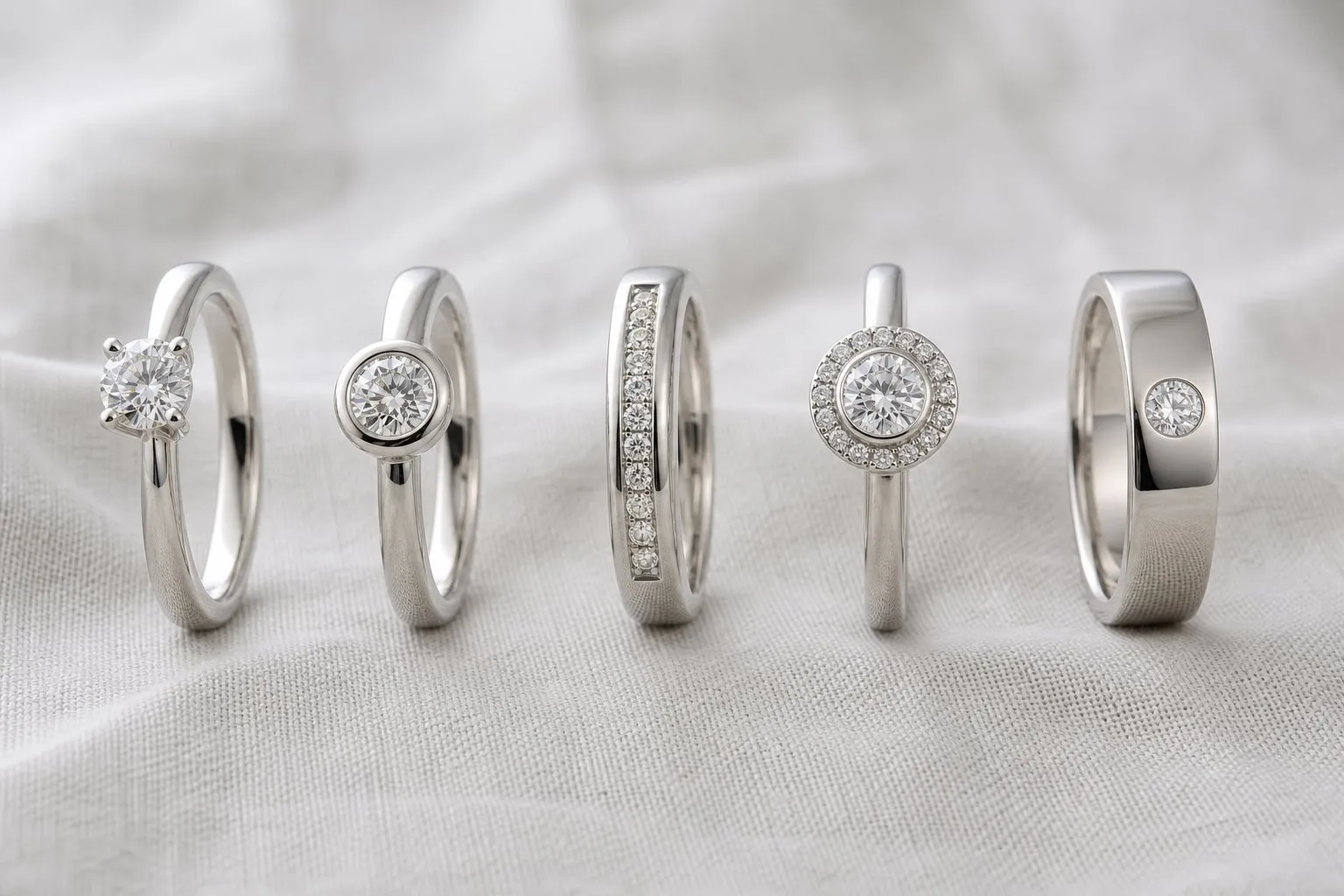
Engagement ring settings are the metal mountings that hold the stone, and GIA separates the setting, meaning how the stone is secured, such as prongs or a bezel, from the setting style, meaning how the stones are arranged, such as solitaire or halo. This guide covers every type and style GIA defines and, for each one, what it does once the ring is worn daily: what catches on clothing, what protects the stone’s edge, what collects dirt and what a jeweler cannot resize.
Retailer guides answer the first question and stop. The lines below are GIA’s own wording, kept rather than trimmed away.
What is on this page11 sections
Key Takeaways
- GIA separates the setting, how a stone is secured, from the style, how stones are arranged, so a cathedral or halo ring still needs prongs or a bezel under it.
- Prongs let the most light in, but GIA says their raised edges can catch on fabrics, while a bezel’s smooth edges are less likely to catch and a flush-set stone is unlikely to catch.
- GIA says channel, bar and pave settings are harder to resize, and tension-set rings can be very difficult, and sometimes impossible.
- GIA says settings with many small details, halo and pave among them, collect dirt more easily and need more frequent cleaning.
- No gemological or trade body publishes a durability ranking of settings, and GIA says the jeweler’s skill weighs as much as the design.
What a Ring Setting Is, and What a Setting Style Is
Two words do most of the damage in a jewelry store. Shoppers compare a halo against a bezel as though they were alternatives, when GIA’s own vocabulary says one is a style and the other is a setting.
The Head, the Shoulders and the Shank
GIA defines a ring setting as the metal mounting of a ring, including the parts that hold the gemstone in place as well as the band that wraps around the finger. That mounting has three regions. The head is the cradle at the top that grips the stone. The shoulders are the two sides that climb toward it. The shank is the band itself, the part that circles your finger. Everything below on catching and light concerns the head; everything on resizing concerns the shank.
Settings Hold the Stone, Styles Arrange It
GIA puts the distinction directly: ring settings describe how a gemstone is secured, while setting styles refer to the overall arrangement of the stones in a ring. A solitaire and a halo can both be held by prongs, and GIA notes that styles such as solitaire, halo and three-stone create very different looks even when the same type of setting is used. So a halo is not an alternative to prongs. It is a pattern of stones arranged around whatever grips the center.
Why the Difference Changes What You Ask a Jeweler
Once the two words separate, your question changes. You stop asking only what the ring looks like and start asking what holds the stone, because the grip decides the behavior covered further down this page: what snags, what shields the girdle, what resists a resize. It also tells you which trade-off you are accepting rather than discovering later. GIA adds a caution no question can substitute for, saying the skill of the jeweler and the quality standards of the store are equally important to durability.
Engagement Ring Settings Compared
This is the chart people search for. Every cell below is GIA’s own wording from its 2026 settings guide or a close paraphrase of it, with no score, no ranking and no price anywhere in the grid.
| Setting | How it holds the stone | Exposure of the stone | Catching on clothing | Resizing | Source |
|---|---|---|---|---|---|
| Prong | Narrow metal claws bent over the edge, usually four or six on a round brilliant | Most of the stone exposed | Raised edges can sometimes catch on fabrics | Not named as a problem | GIA 2026 |
| Bezel | A thin rim of metal wrapping the girdle | Perimeter covered | Smooth edges are less likely to catch | Not named in this guide | GIA 2026 |
| Flush | The stone set into the metal, level with the surface of the band | Only the top of the stone visible | Unlikely to catch | Not named in this guide | GIA 2026 |
| Channel | A row of stones in a groove between two parallel metal walls | Less exposed than prong-set accents | Less likely to catch than prong-set accents | Can be difficult, especially if the stones extend far around the band | GIA 2026 |
| Bar | Stones held between vertical metal bars rising from the band | More exposed than channel | Not named in this guide | Can be more difficult, especially if the stones extend far around the band | GIA 2026 |
| Pave | Small stones held close together by tiny beads or prongs | Many small stones near the surface | Not named in this guide | Can be more difficult, since adjusting the ring may disturb the small stones | GIA 2026 |
| Tension | The stone suspended between the open ends of the band by pressure | More exposed than bezel or channel; a hard blow can shift or loosen it | Not named in this guide | Can be very difficult, and sometimes impossible | GIA 2026 |
| Basket | A prong setting with horizontal supports forming a basket beneath the stone | As open as a prong setting from above | Not named in this guide | Not named in this guide | GIA 2026 |
How to Read the Table
Every cell traces to one document, GIA’s 2026 guide to ring settings, so the columns are consistent rather than stitched from a dozen sellers. Phrases such as “more exposed” and “less likely to catch” are GIA’s qualitative descriptions, not scores, and nothing in the grid is a measurement. “Not named in this guide” means GIA does not raise the point for that setting, which is not the same as GIA clearing it. The resizing column is about the band, not the head.
What Nobody Publishes About Settings
Here is the gap, worth saying plainly. No gemological body and no trade association publishes a durability ranking of engagement ring settings. There is no failure rate, no snagging test, no security league table. We looked and found none, so this page does not publish one either. GIA points at the reason: the durability of a ring depends not only on the setting style but also on the quality of its construction. The absence of a ranking does not mean the settings behave alike. It means the differences GIA describes are qualitative.
The Settings: How Each One Holds a Stone
These are the mountings GIA defines, which is the mechanical half of the vocabulary. Each entry keeps the caveat GIA attaches to it, because the caveat is the part retailer pages quietly drop.
Prong Settings, and the Three Prong Shapes
GIA says a prong setting holds a gemstone securely while allowing maximum light to enter the stone, and that most round brilliant diamond rings use four or six prongs. GIA attaches caveats: prongs should be checked occasionally to ensure they remain secure, and their raised edges can sometimes catch on fabrics. GIA names three prong shapes, rounded, claw and V-shaped, and says V-shaped prongs protect pointed corners on cuts such as pear and marquise, worth reading alongside our guide to engagement ring shapes. GIA also notes a six-prong setting is more likely to hold the diamond if a prong breaks.
Bezel and Flush Settings
GIA describes a bezel as a thin rim of metal surrounding the stone’s edge and holding it firmly in place, with smooth edges less likely to catch on clothing or gloves, though it covers more of the girdle and lets slightly less light in than prongs. Our bezel setting guide covers the rest. A flush setting sets the stone level with the surface of the band, usually needs a wider, thicker shank, is unlikely to catch, and admits less light than a bezel or prong setting.
Channel, Bar and Pave Settings
A channel setting holds a row of stones in a groove between two parallel metal walls. GIA says channel-set stones are less exposed and less likely to catch than prong-set accents, though channel-set rings can be difficult to resize. Bar-set stones sit between vertical bars, are more exposed than channel-set ones and, GIA says, also harder to resize. Pave uses tiny beads or prongs, needs occasional maintenance, and resists resizing because adjusting the ring may disturb the small stones. With Clarity, a seller, adds that soaking a pave ring raises the likelihood of stones coming loose.
Tension and Basket Settings
GIA says a tension setting suspends a gemstone between the open ends of a metal band using engineered pressure. The open structure leaves the stone more exposed than in a bezel or channel setting, a hard blow can shift or loosen it, and such rings can be very difficult, and sometimes impossible, to resize. In a separate guide GIA calls a tension setting a riskier choice for an engagement ring. A basket setting is quieter work: GIA calls it a type of prong setting with horizontal supports connecting the prongs beneath the stone, a framework that helps stabilize them.
The Styles: How the Stones Are Arranged
Styles are the arrangement half of GIA’s vocabulary. Each one still sits on top of a setting from the section above, so read the row below together with whatever is gripping the stone.
| Setting style | What defines it | What it changes about the ring | Source |
|---|---|---|---|
| Solitaire | A single center stone with little or no additional decoration | Pairs easily with a wide range of wedding bands | GIA 2026 |
| Halo | A prong or bezel set center stone ringed by smaller accent stones | The center stone can appear to be the size of the halo; the small stones collect dirt more easily | GIA 2026 and GIA 2025 |
| Three-stone | A center stone flanked by two smaller side stones | Side stones should typically be within about two color grades of the center stone | GIA 2026 |
| Cathedral | Arches of metal rising from the shank to support the center setting | Raises the stone above the band; may be more likely to catch, though the arches can add stability | GIA 2026 |
| Cluster | Many small stones grouped to read as one design | Lets smaller stones produce a bold overall look | GIA 2026 |
| Trellis | Prongs that cross one another in an X or lattice pattern at the sides | Overlapping metalwork may need more frequent cleaning | GIA 2026 |
| Toi et moi | Two stones set side by side | Reads as a pair rather than one focal stone | GIA 2026 |
Solitaire and Three-Stone
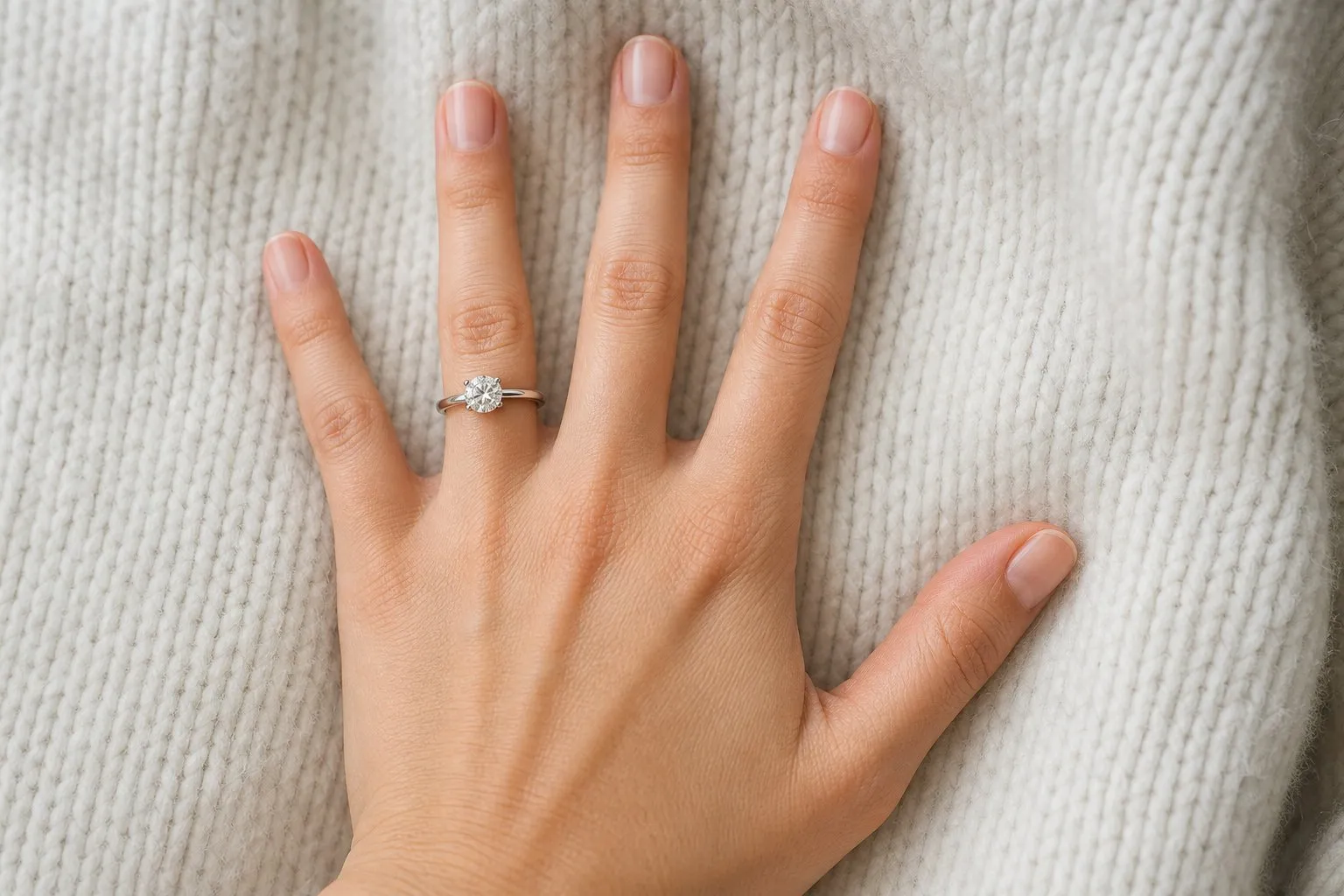
GIA describes the solitaire style as a single center gemstone with little or no decoration, and says its design pairs easily with a wide range of wedding bands. The three-stone style sets a center gemstone flanked by two smaller side stones. Whiteflash, a seller, calls it a center diamond enhanced by two matching smaller diamonds. GIA adds that the side stones should typically fall within about two color grades of the center stone, and says the design works well whatever the size of the hand or finger. The arrangement is said to symbolize a couple’s past, present and future.
Halo and Cluster
GIA defines the halo style as a prong or bezel set center gemstone surrounded by a ring of smaller accent stones, which proves a style needs a setting under it. GIA says the center stone can appear to be the size of the halo, and gives no figure for the effect. Blue Nile, a seller, draws the line people get wrong: a halo wraps the center stone with diamonds or gemstones, while a bezel wraps it with metal. The cluster style groups many small gemstones to read as one design. For both, GIA recommends periodic professional cleaning of intricate settings.
Cathedral and Trellis
GIA says the cathedral style features arches of metal that rise from the shank to support the center setting, framing the stone and raising it above the band. It adds that the elevated structure may be more likely to catch on clothing or objects, although the arched supports can add stability. Our cathedral setting guide has the detail. Trellis is different: GIA describes prongs crossing one another at the sides in an interwoven, lattice-like pattern, and notes the overlapping metalwork may require more frequent cleaning.
Toi et Moi
The toi et moi style sets two gemstones side by side, which GIA reads as two souls coming together. GIA traces its popularity to the early 19th century, when Napoleon Bonaparte gave his first wife Josephine a toi et moi ring set with a pear-shaped diamond and a pear-shaped sapphire. Because there are two focal stones rather than one, the matching questions are about the two stones agreeing with each other rather than about a single center stone carrying the ring.
What Each Setting Does in Daily Wear
This is the part retailer guides leave out, and it is why the page exists. Every line below has a named source attached, and no line orders the settings into a ranking that nobody measures.
What Catches on Clothing
GIA is specific, setting by setting. Prongs have raised edges that can sometimes catch on fabrics. A bezel’s smooth edges are less likely to catch. A flush-set stone’s low profile makes it unlikely to catch. Channel-set stones are less likely to catch than prong-set accents. A cathedral’s elevated structure may be more likely to catch on clothing or objects. Those are five qualitative statements, not a sequence. GIA also notes that GIA-trained Graduate Jewelers are trained to identify and correct prongs that may catch or snag on clothing or hair, so snagging is often repair work rather than fixed.
What Holds a Stone Through a Knock
GIA says bezel settings offer excellent resistance to chips and everyday wear. On prongs, GIA writes that a six-prong setting can offer more protection than a four-prong one, because if a prong breaks the six-prong version is more likely to hold the diamond in place. A basket’s horizontal supports help stabilize the prongs beneath the stone. Bar-set stones are more exposed than channel-set stones and may be slightly more vulnerable to impact or chipping. A hard blow can shift or loosen a tension-set stone. GIA publishes no ranking from these statements, and neither do we.
What Collects Dirt and Needs Checking
GIA says settings with many small details can collect dirt more easily and may require more frequent cleaning than simpler styles, which is the halo and the pave band, and that ultrasonic cleaners can sometimes dislodge stones that are already loose. Trellis metalwork joins the list. GIA also notes prongs may require re-tipping, and that stones may need tightening, which jewelers accomplish by adjusting prongs, beads or metal walls depending on the type of setting. For the method itself, follow GIA’s routine as set out in our cleaning guide.
The Settings That Resist a Resize
Resizing is a property of the setting, decided the day you buy rather than the day the ring feels tight. Cost and process belong to our resizing guide; this section is only about which settings fight back.
What GIA Names, Setting by Setting
GIA says rings with pave and channel settings cannot be resized easily, and that it can be very difficult to resize eternity or anniversary rings, meaning those with diamonds around the entire band. Its settings guide agrees: channel-set and bar-set rings are more difficult to resize if the stones extend far around the band; pave-set bands are harder because adjusting the ring may disturb the small stones; and tension-set rings can be very difficult, and sometimes impossible. Brilliant Earth, a seller, says rings can generally be sized about two sizes before the structure and design may be compromised.
Why This Is a Buying Question
If stones run the whole way around the band, the size you buy is close to the size you keep, so the measuring happens before the order rather than after the proposal. That reverses the usual sequence. It also changes what you ask about a shank you like: whether it is plain at the bottom, and how far the stones travel. If a resize is likely to be part of the plan, read what a resize costs before you choose a fully set band.
Which Engagement Ring Setting Should You Choose?
There is no single winner to name, because best depends on what you are protecting and on whose published wording you are trusting. The table below sorts by situation, and every reason in it is attributed.
| Your situation | Setting to consider | Why, and on whose wording |
|---|---|---|
| You wear gloves or wash your hands all day | Bezel, or a flush-set stone | GIA says smooth bezel edges are less likely to catch and a flush stone’s low profile is unlikely to catch |
| You want the most light in the stone | Prong | GIA says a prong setting allows maximum light to enter the stone |
| Your stone has points or corners | V-shaped prongs, or a partial bezel | GIA says V-prongs are designed to protect pointed corners |
| You knock your hands on things | Six prongs rather than four, or a bezel | GIA says a six-prong setting is more likely to hold the stone if a prong breaks |
| You are drawn to a floating stone | Ask about a tension setting with both eyes open | GIA calls it a riskier choice and says a hard blow can shift or loosen the stone |
| Your ring size may change | A plain or partly plain shank | GIA says pave and channel settings cannot be resized easily and stones around the whole band make it very difficult |
| You dislike cleaning small crevices | Solitaire rather than halo or pave | GIA says settings with many small details collect dirt more easily |
| You want the smallest stone to read as large | Halo, or a cluster | GIA says the center stone can appear to be the size of the halo, with no figure given |
If You Work With Your Hands
Two settings carry GIA’s own endorsement here. GIA calls bezel settings a practical choice for people who work with their hands, naming nurses in that line, and says the same of flush settings because the stone sits close to the finger. GIA elsewhere calls a bezel a great choice for active people. The honest limit: a setting protects the stone, not the finger, so around machinery or heavy lifting no setting makes a ring safe. Many people wear a plain band for the workday, and our guide to wedding rings for nurses covers that shift.
If You Want the Most Light in the Stone
GIA ranks nothing, but it does describe light entry setting by setting, and the statements line up. A prong setting allows maximum light to enter the stone. A bezel covers more of the girdle and allows slightly less light in. A flush setting admits less light than a bezel or prong setting, which GIA says can mean somewhat less brightness. A tension setting leaves the stone more exposed than a bezel or channel, so little metal stands between the stone and the light. Nobody publishes a brightness percentage, so no figure appears here.
If Your Ring Size May Change
Fingers change size, with heat, with pregnancy, with weight, with the years, and the setting decides whether that is an inconvenience or a wall. A band set with stones all the way around closes the door on adjustment, as the section above sets out. A plain shank, or one plain across the bottom while the stones stop at the shoulders, keeps it open. If a size is likely to move, buy toward the shank that can follow it, and measure your ring size before ordering rather than hoping a jeweler can fix it later.
Buying a Setting Without a Stone
A real slice of this search wants the mounting on its own, with no center stone in it. That is a normal purchase, and the vocabulary from the top of this page makes it easy to ask for.
What a Mounting Is, and What It Is Not
Because GIA defines a setting as the metal mounting of a ring, including the parts that hold the gemstone and the band that wraps the finger, a mounting sold on its own is that ring without its center stone. The head is built and the accent stones in the shank or halo are usually already set, so what is missing is the one stone in the middle. You buy that stone separately, loose and graded, and a jeweler sets it into the head you chose.
What to Ask Before You Buy One
The questions are about fit and responsibility:
- Which stone shapes and carat range is this head built for, and will a larger stone still seat?
- Who sets the stone, and who insures both pieces while the setting work is done?
- Can the mounting be resized once the stone is in it, given what the resize section says?
- Does the return window survive a stone being set, or does setting end it?
Get the answers in writing before either half is paid for, because once a stone is seated the two purchases are no longer separable.
Frequently Asked Questions
What are the different settings for engagement rings?
The settings GIA defines are prong, bezel, flush, channel, bar, pave, tension and basket, each describing how the metal grips the stone. Those differ from setting styles such as solitaire, halo, three-stone, cathedral, cluster, trellis and toi et moi, which describe arrangement. The comparison table above sets the eight side by side.
Which setting is best for an engagement ring?
Best for what, is the honest reply, because no authority names a winner. GIA describes qualities, not rankings: prongs admit maximum light, bezel and flush profiles are less likely to catch, channel stones sit less exposed, tension leaves a stone open to a hard blow. GIA also says the jeweler’s skill matters as much as the design.
Can you buy just an engagement ring setting?
Yes. Since GIA defines a setting as the metal mounting of a ring, a mounting sold alone is the finished ring minus its center stone, and sellers list them that way. Ask which shapes and carat range the head takes, who sets and insures your stone, and whether the return window survives setting.
What is the 2:1:1 rule for wearing jewelry?
We found no named authority behind it. No gemological institute or trade body we hold publishes a 2:1:1 rule for wearing jewelry, so treat it as an unsourced styling convention, not a standard. What decides a stack is the height of your setting, whether its edges catch, and how the bands sit together.
How much should I spend on an engagement ring if I make $100,000 a year?
No authority sets a percentage of income. Brilliant Earth, a seller, traces the familiar salary rule to a 1930s De Beers advertising campaign designed to boost diamond sales, and calls it outdated rather than sound financial advice. Our guide on how much to spend on an engagement ring sets out what the published data does and does not show.
Who legally owns an engagement ring?
There is no single rule we can point you to. Ownership after a broken engagement is decided by law where the couple lives, not by jewelers or gemological bodies, and no source behind this guide addresses it. We do not publish legal advice, so ask a qualified lawyer in your own jurisdiction.
Sources
- GIA 4Cs, Complete Guide to Engagement Ring Settings: Types vs. Styles, 2026.
- GIA 4Cs, How to Protect Your Diamond Engagement Ring, 2025.
- GIA 4Cs, How to Make Your Diamond Engagement Ring Look Bigger, 2025.
- GIA 4Cs, Ring Size Guide: Tips and Ring Size Chart, 2018.
- GIA 4Cs, Engagement Ring Styles to Flatter Her Hand and Finger, 2017.
- With Clarity, Here’s What You Need to Know Before Buying a Pave Setting, 2024.
- Blue Nile, Guide to Bezel Settings, 2026.
- Whiteflash, Three Stone Engagement Rings, undated, accessed 11/09/2026.
- Brilliant Earth, What to Do if Your Ring Is Too Big, 2026.
- Brilliant Earth, What Is the 3-Month Salary Rule?, 2026.