

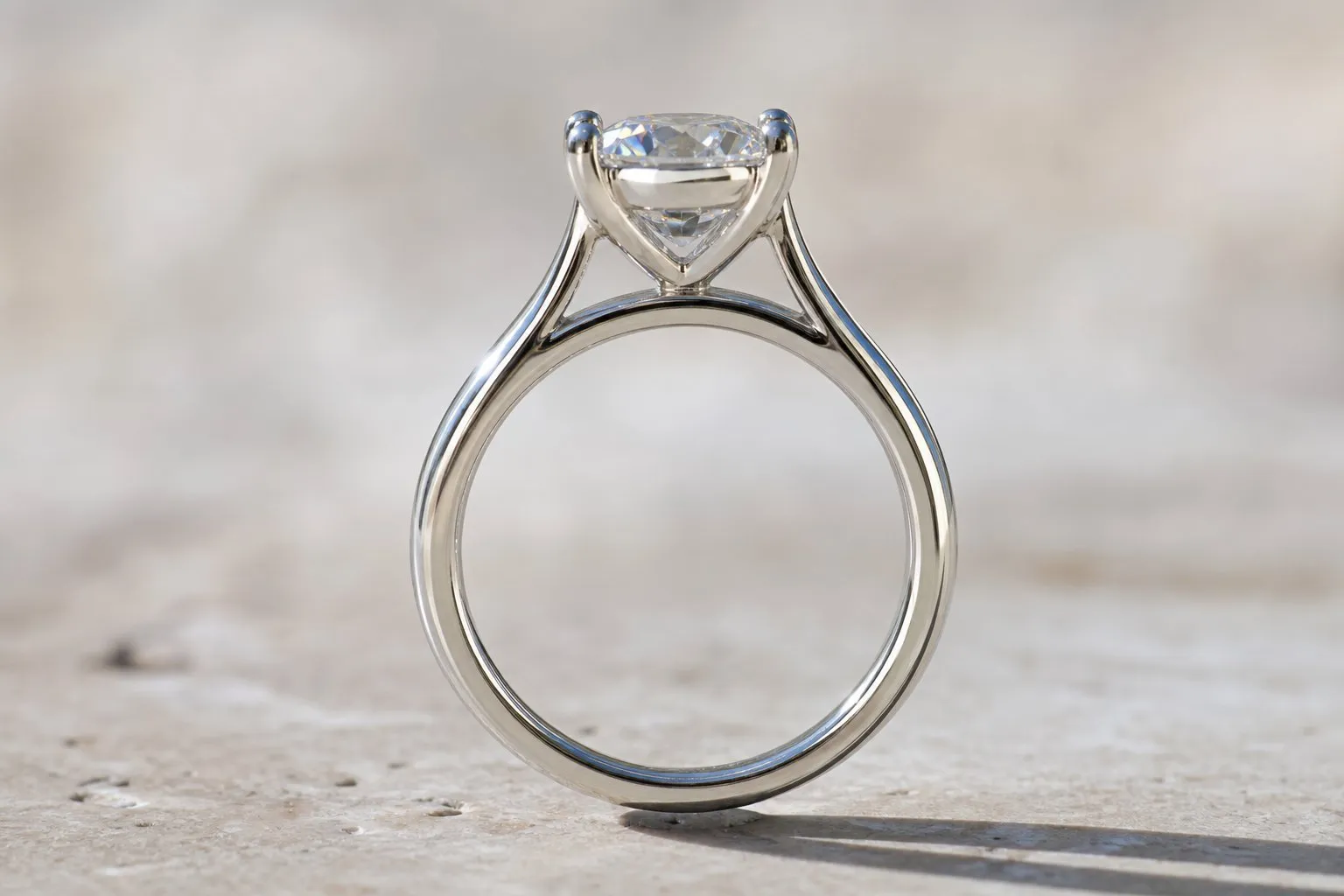
A cathedral setting is a pair of metal arches that rise from the band to support and lift the center stone above it, and GIA classes it as a setting style rather than a way of holding the stone, so a cathedral ring still grips its stone with prongs or a bezel. That height is the whole story: it decides what the ring catches on, what supports the head, and whether a straight wedding band can sit flush beside it.
What is on this page10 sections
Key Takeaways
- GIA describes a cathedral setting as arches of metal rising from the shank to support the center setting, raising the stone above the band.
- It is a setting style, not a grip, so prongs or a bezel still hold the stone underneath the arches.
- GIA gives both sides in one sentence: the elevated structure may be more likely to catch on clothing or objects, although the arched supports can provide additional stability for the center setting.
- Brilliant Earth says setting height is the biggest factor in whether a straight wedding band sits flush, and that high-set rings let a straight band slide alongside the stone.
- GIA credits the halo and the bezel with making a stone look larger, never the cathedral.
What a Cathedral Setting Is
Three things get confused under this one word: what the arches are, what they do, and what is actually holding your stone. GIA’s 2026 settings guide separates all three.
The Arches That Give It the Name
GIA describes the cathedral as a style whose arches of metal rise from the shank, which is simply the part of the metal mounting that wraps around your finger. Those upward curves, which GIA also calls shoulders, frame the gemstone and raise it above the band, creating what the guide calls a more prominent and structured appearance. The consequence a catalog photograph rarely shows is underneath: the open space beneath the center stone can accommodate decorative details or hidden design elements, which only read from the side.
A Style, Not a Way of Holding the Stone
This is where product pages mislead. GIA draws a line between ring settings, which describe how a gemstone is secured, and setting styles, which describe the overall arrangement of the stones, noting that the same type of setting produces very different looks across styles. The cathedral sits on the style side of that line. So cathedral versus prong is not a choice you have to make: the cathedral is the shoulders, and the prongs or the bezel are the grip. The full list of both lives in our guide to engagement ring settings.
What Sits Under the Arches
Ask any listing what is doing the holding. Usually it is a prong setting, which GIA says holds a gemstone securely while allowing maximum light to enter the stone, though prongs should be checked occasionally and their raised edges can sometimes catch on fabrics. The alternative is a bezel setting, a thin rim of metal around the stone’s edge whose smooth edges are less likely to catch. Cathedral shoulders are sold with oval, marquise and emerald cut center stones as readily as with round ones, so your choice among engagement ring shapes stays open.
Cathedral vs. the Settings and Styles It Gets Compared With
The comparisons shoppers actually type pit the cathedral against things that were never its rivals. The table sorts them by what each one is in GIA’s own terms.
| Design | What it is in GIA’s terms | What holds the stone | Profile height | In-use note GIA publishes | Source |
|---|---|---|---|---|---|
| Cathedral | A setting style: arches rising from the shank to support the center setting | Prongs or a bezel, underneath the arches | Raised above the band | May be more likely to catch on clothing or objects, although the arches can add stability to the center setting | GIA 2026 |
| Plain-shank solitaire | A setting style: a single center stone with little or no decoration | Prongs or a bezel | Follows the head, with no arches | Pairs easily with a wide range of wedding bands | GIA 2026 |
| Halo | A setting style: accent stones encircling the center stone | Prongs or a bezel, plus the accent setting | Often set high above the finger, per Nekta New York | Small stones collect dirt more easily and want periodic professional cleaning | GIA 2026, Nekta New York 2025 |
| Bezel | A setting: a thin rim of metal around the stone’s edge | The rim itself | Can sit low to the finger | Smooth edges are less likely to catch; slightly less light enters the stone | GIA 2026 |
| Trellis | A setting style: prongs crossing in an X or lattice at the sides | The crossing prongs | Follows the head | Overlapping metalwork may need more frequent cleaning | GIA 2026 |
Cathedral vs. Solitaire
These are not opposites. GIA defines the solitaire style as a single center gemstone with little or no additional decoration, and says its simple design pairs easily with a wide range of wedding bands. A solitaire can sit on arched shoulders or on plain ones, which means the real question behind cathedral versus non cathedral is the shoulders, not the stone count. What the arches change is the height of the head, the side profile, and the decorative space that opens underneath. What they do not change is how many stones you are buying.
Cathedral vs. Prong
On a product page the word cathedral tells you nothing about the grip, so treat it as an unanswered question and ask how many prongs the head has, or whether the stone is bezel set instead. Prongs are the option that lets the most light into a stone, and GIA’s guide to protecting a ring adds a detail worth asking about: if a prong breaks, a six-prong setting is more likely to hold the diamond in place than a four-prong setting. That question is about the head; the arches are a separate decision.
Cathedral vs. Halo
A halo is a ring of smaller accent stones around a prong or bezel set center stone, so it changes the outline you see from above, while a cathedral changes the profile you see from the side. A ring can be both, and plenty are. Nekta New York notes that halos are usually set high above the finger to maximize sparkle and presence, which is exactly why the band question gets difficult, and we take it up on our page on wedding bands for halo rings.
What a Raised Setting Does in Daily Wear
This is the part the retailer pages skip. Every line below is something a named source publishes, including the sentence the trade usually quotes only half of.
Catching on Clothing
GIA is direct about the cost of height: because cathedral settings often raise the center stone higher above the band, the elevated structure may be more likely to catch on clothing or objects. If that is your deciding factor, the low-profile answer is a bezel, whose smooth edges GIA says are less likely to catch on clothing or gloves. It is also a complaint that can be worked on, since GIA-trained Graduate Jewelers are trained to identify and correct prongs that may catch or snag on clothing or hair.
Security: Both Halves of What GIA Says
GIA’s sentence has two halves and the market quotes the first. In full: the elevated structure may be more likely to catch on clothing or objects, although the arched supports can provide additional stability for the center setting. That is the entire published answer, and no body ranks settings for security beyond it. GIA also limits how much the design decides: durability depends not only on the setting style but on the quality of construction, with the jeweler’s skill and the store’s standards equally important. Resizing is a separate question, and GIA names pave, channel and eternity bands as the hard ones, not cathedral shoulders, so start with what a resize costs.
Cleaning Around the Arches
The open space beneath the stone is part of the design, and it is also reachable, which is the quiet upside of a lifted head. The caveat is decoration rather than height: GIA says settings with many small details collect dirt more easily and may require more frequent cleaning than simpler styles, so a cathedral carrying pave or a halo asks more of you. Expect upkeep too, since prongs may require re-tipping and stones may need tightening. For the method, follow how to clean a diamond ring.
Cathedral Settings and Your Wedding Band
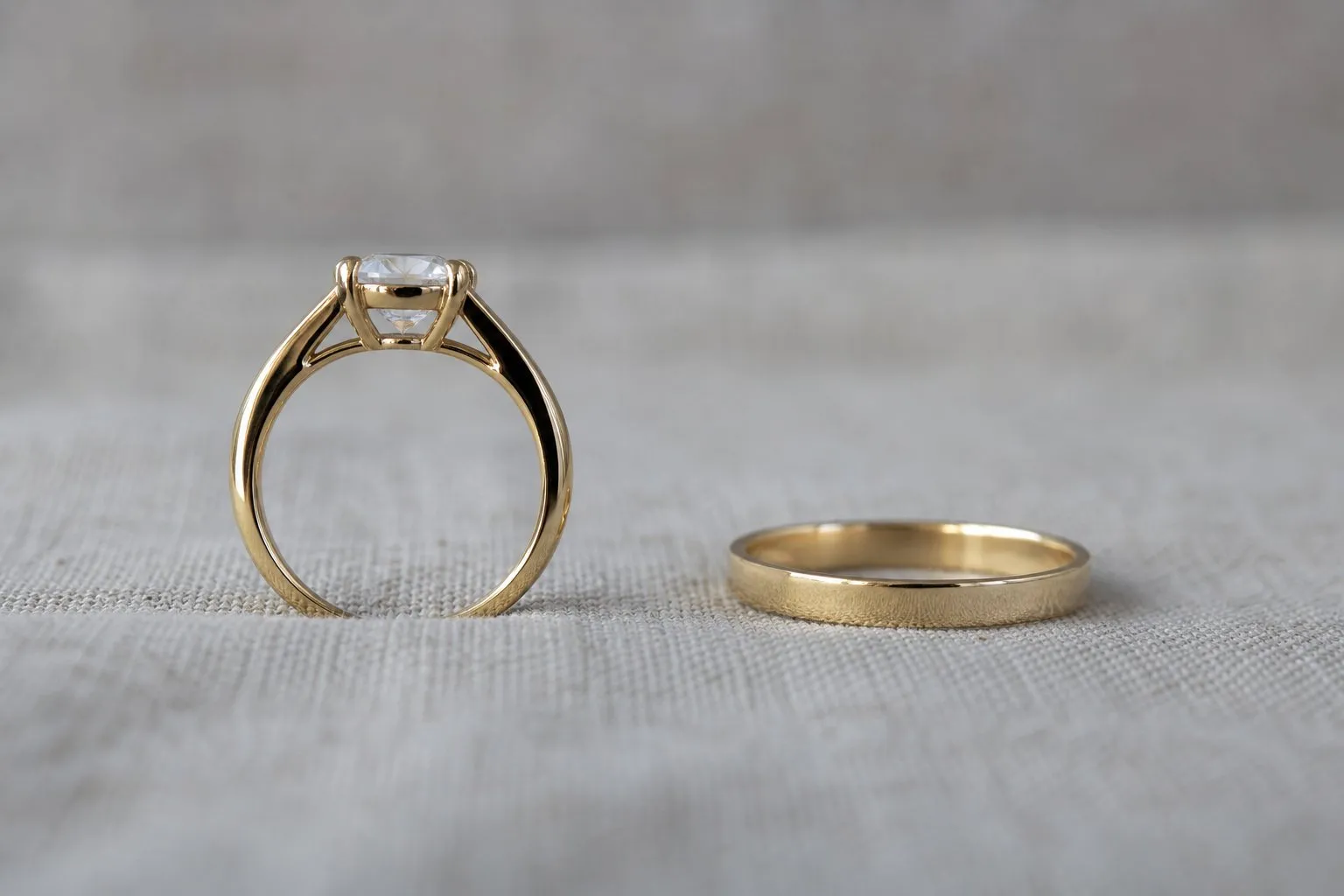
Here the height stops costing you and starts paying you back, and it is the one part of the cathedral story that two named sellers document in detail.
Why Height Helps a Straight Band Sit Flush
Brilliant Earth puts setting height first: if a flush fit is important to you, it says setting height should be your first consideration, because it is the biggest factor in whether a straight wedding band will sit flush against your engagement ring or leave a visible gap. High-set rings, it continues, are elevated enough to allow a straight band to slide neatly alongside the center stone, while low-set rings and styles with side stones, decorative galleries or hidden halos can often prevent it. Nekta New York names the style outright: opting for cathedral settings can provide the necessary clearance for your wedding band.
When a Curved or Notched Band Is Still Needed
Clearance is not a guarantee. Nekta New York describes the fallback for an elevated head: a notch cut into the band allows it to slide under or wrap around part of the setting. The Diamond Setter warns that the top view can be misleading, because the gap usually comes from the side of the ring where the setting meets the band, so judge a pair from the side as well as from above. With Clarity adds the reason this is not only cosmetic: a gap can cause discomfort, snagging or damage to the rings over time. Compare bands that sit beside a round solitaire.
Does a Cathedral Setting Make the Diamond Look Bigger?
No, and the wording is where the honesty lives. GIA’s settings guide says the elevated design allows the gemstone to stand out and can make the ring appear more substantial while maintaining a classic look. Read that again: the ring, not the stone. When GIA writes about making a stone appear larger, it names two other things. In a halo, a ring of smaller diamonds artfully placed around a center stone can make that stone appear to be the size of the halo. In a bezel, a band of metal surrounds the girdle, so the diamond’s circumference may appear to be larger. Neither is the cathedral, so judge the profile on your own hand.
Is a Cathedral Setting Outdated?
Not by the only measure anyone publishes. GIA’s guide from this year still calls cathedral settings popular, and describes the style as a popular choice for people who want a design that feels both refined and distinctive while keeping the focus on the center gemstone. The honest half of the answer is the half that is missing: no gemological body and no trade association publishes popularity or trend data broken down by setting, and we found none, so nobody can tell you whether this style is climbing or slipping. What is documented is that the field’s best-known authority called it popular and classic in a 2026 guide, and anything more definite would be invented.
Who a Cathedral Setting Suits

There is no best setting, and no source publishes one. What the sources support is a set of if-then answers, so the table asks what you need rather than what is fashionable. Read it as best for a stated purpose, on named wording: GIA for the arches and for snagging, the two sellers for the band.
| Your situation | Cathedral or not | Why, and on whose published wording |
|---|---|---|
| You want a straight wedding band to sit flush | Cathedral helps | Brilliant Earth says setting height is the biggest factor and high-set rings let a straight band slide alongside the stone |
| You want the stone lifted and framed from the side | Cathedral | GIA says the arches frame the gemstone and raise it above the band |
| You wear knitwear, gloves or scrubs all day | Consider a bezel or a low profile instead | GIA says the elevated structure may be more likely to catch, and that smooth bezel edges are less likely to catch |
| You want a hidden detail under the stone | Cathedral | GIA says the open space beneath the center stone can carry decorative or hidden design elements |
| You want the smallest stone to read as large | A halo or a bezel, not a cathedral | GIA names the halo and the bezel for that effect and does not name the cathedral |
| You are pairing it beside a high halo | Cathedral helps | Nekta New York says a cathedral setting can provide the clearance a wedding band needs |
| You dislike cleaning small crevices | A plain cathedral solitaire rather than a cathedral with pave | GIA says settings with many small details collect dirt more easily |
Frequently Asked Questions
What does a cathedral setting mean?
It means the ring’s shoulders arch upward. GIA defines the cathedral as a style whose metal arches rise from the shank to support the center setting, lifting the stone above the band. The word describes that structure only, so it says nothing at all about which grip holds your stone.
Is cathedral setting more secure?
Neither a flat yes nor a flat no is honest here. GIA publishes one sentence with two halves: the elevated structure may be more likely to catch on clothing or objects, although the arched supports can provide additional stability for the center setting. Nothing published ranks settings for security beyond that.
Does cathedral setting make diamonds look bigger?
Not the diamond itself. GIA credits the cathedral with making the ring appear more substantial, which is a claim about the whole piece. For the stone, GIA points instead to a halo, where the center can read as large as the circle framing it, and to the metal rim of a bezel.
What is the difference between a cathedral setting and a halo setting ring?
One is the shoulders, the other is the frame. A cathedral is the pair of arches lifting the head above the band, and a halo is a circle of smaller accent stones around a prong or bezel set center stone. Many rings carry both features at once.
Is a cathedral setting outdated?
Nothing published says so. GIA’s 2026 guide still calls the style popular, and pairs it with the word classic. We went looking for popularity or trend figures by setting and found none, from GIA or from any trade body, so treat any claim of a decline or a revival as unsourced.
What is the classiest style of engagement ring?
No authority ranks engagement ring styles by taste, and we are not going to invent one. What GIA does publish is more useful to a buyer: durability depends not only on the setting style but on the quality of construction, and the jeweler’s skill and the store’s standards matter equally.
Sources
- GIA 4Cs, “Complete Guide to Engagement Ring Settings: Types vs. Styles”, 2026, https://4cs.gia.edu/en-us/blog/guide-to-ring-settings/
- GIA 4Cs, “How to Make Your Diamond Engagement Ring Look Bigger”, 2025, https://4cs.gia.edu/en-us/blog/engagement-ring-settings-that-make-your-diamond-look-bigger/
- GIA 4Cs, “How to Protect Your Diamond Engagement Ring”, 2025, https://4cs.gia.edu/en-us/blog/how-to-protect-your-diamond-engagement-ring/
- GIA 4Cs, “Ring Size Guide: Tips and Ring Size Chart”, 2018, https://4cs.gia.edu/en-us/blog/how-to-determine-ring-size-tips-and-ring-size-chart/
- Brilliant Earth, “How to Choose a Wedding Band”, 2026, https://www.brilliantearth.com/guides/how-to-choose-a-wedding-band/
- Nekta New York, “Why Some Wedding Bands Never Sit Flush with Halo Rings”, 2025, https://www.nektanewyork.com/blogs/news/why-some-wedding-bands-never-sit-flush-with-halo-rings
- With Clarity, “How do you find a flushed-fit wedding band for your hidden halo engagement ring?”, 2025, https://www.withclarity.com/blogs/wedding-bands/how-do-you-find-a-flushed-fit-wedding-band-for-your-hidden-halo-engagement-ring
- The Diamond Setter, “Halo ring wedding band fit: choose the right shape”, undated, accessed 11/09/2026, https://thediamondsetter.co.uk/blogs/news/halo-ring-wedding-band-fit