

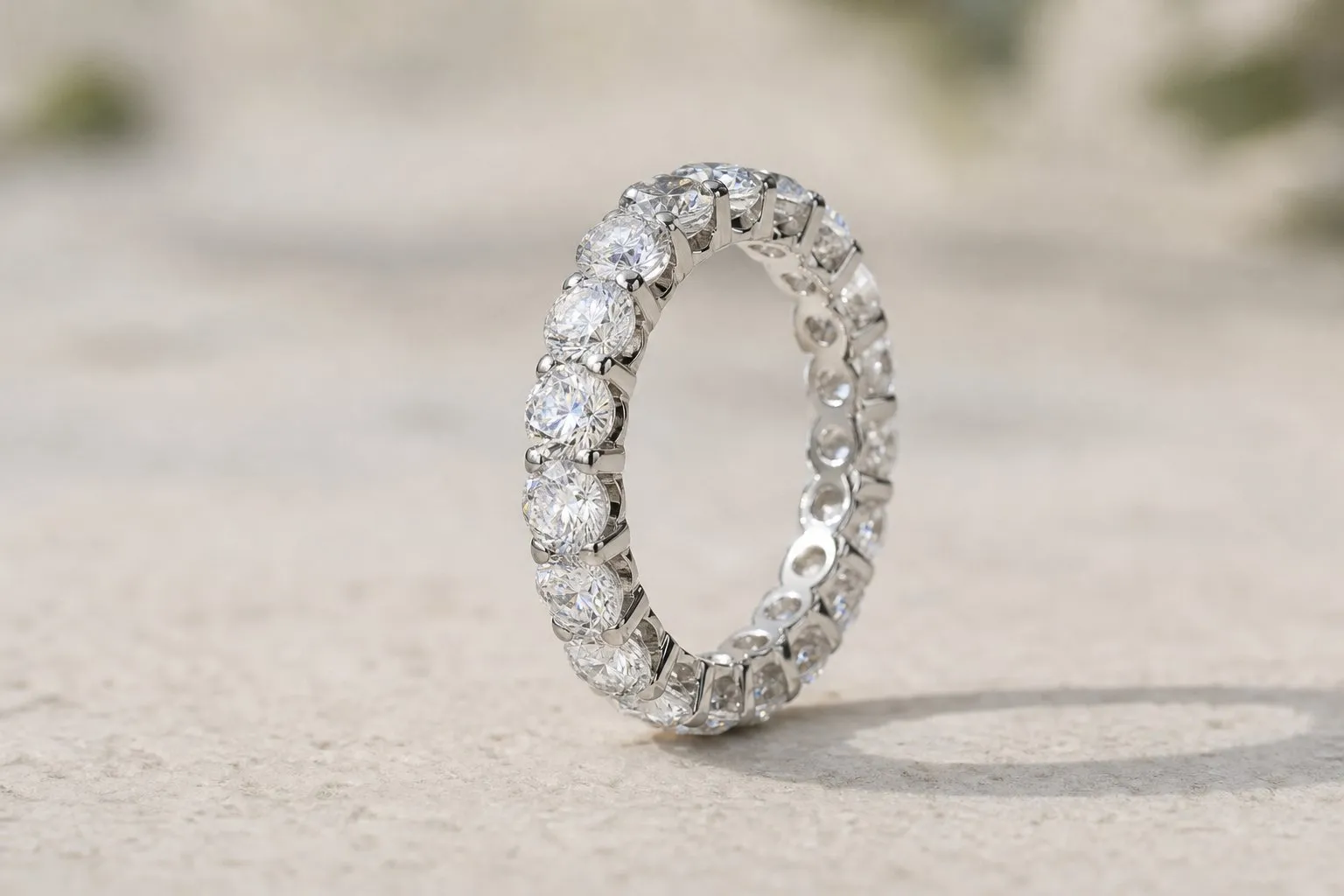
The short answer to what is an eternity ring is that it is a band of precious metal set with a continuous line of identically cut gemstones, usually diamonds, running the whole way around it, and GIA calls these eternity or anniversary rings, meaning those with diamonds around the entire band. Because a full one carries no plain metal anywhere, GIA says it can be very difficult to resize, and several named sellers say they will not resize one at all, so the size you buy is usually the size you keep.
What is on this page9 sections
Key Takeaways
- An eternity ring is a band set with a continuous line of identically cut stones all the way around, which GIA calls eternity or anniversary rings, meaning those with diamonds around the entire band.
- GIA’s 2018 ring size guide says such rings can be very difficult to resize, and that is the only statement any gemological authority publishes about them.
- Going further than GIA, Blue Nile, Brilliant Earth, Do Amore, Espling Jewelers and With Clarity each say a full eternity band cannot be resized or can only be remade: retailer consensus rather than a gemological standard.
- Espling Jewelers gives the reason: with stones encircling the band, there is no bare metal to cut.
- A half eternity band keeps a plain section at the back, which Espling says allows for future resizing.
What an Eternity Ring Is
The definition is simple, and the pages that rank for this query agree on it. What they leave out is the consequence, so this page settles the definition first and then deals with sizing.
A Continuous Line of Stones Around the Band
Wikipedia, a supporting reference, describes an eternity ring as a band of precious metal set with a continuous line of identically cut gemstones, usually diamonds. GIA uses its own phrasing for the same object, calling them eternity or anniversary rings, meaning those with diamonds around the entire band. Most are built as channel settings, where a row of stones sits in a groove between two parallel metal walls, or as pave settings, where small stones sit closely together to create a continuous surface of sparkle. GIA notes both resist adjustment.
Full Eternity vs. Half Eternity
A full eternity band carries stones the whole way around. Espling Jewelers describes the alternative plainly: a half eternity ring carries stones covering only the top half of the band, leaving the rest as polished metal. Wikipedia gives the original reason for that design, noting that because stones encircling the entire band can make a ring uncomfortable to wear, an alternative design places stones only across the face. Comfort, though, is not why the choice matters most to a buyer. That reason is the next section, and it is a sizing one.
Why a Full Eternity Band Usually Cannot Be Resized
This is the fact the ranking pages bury on their policy pages. It comes in two tiers that this page keeps apart: what the one gemological authority publishes, and what individual sellers publish about their own workshops.
| Who says it | What they are | What they publish about resizing an eternity band | What they offer instead |
|---|---|---|---|
| GIA (2018 ring size guide) | Gemological authority, nothing to sell | It can be very difficult to resize eternity or anniversary rings, meaning those with diamonds around the entire band. GIA stops at very difficult | Nothing stated; GIA publishes no eternity-ring guide |
| Blue Nile (Non-Resizable Ring Types, 16/02/2024) | Seller | Some can be resized and some cannot; the wraparound stones make them difficult, and rings with complex settings or minimal spaces between stones may not be eligible for safe resizing | A 30-day exchange, per its own ring size page |
| Brilliant Earth (returns page) | Seller | Eternity rings cannot be resized due to their design | A free exchange within 60 days of the purchase becoming available |
| Brilliant Earth (too-big guide, 2026) | Seller | Bands with stones all around can be difficult or impossible to resize without compromising the design | Notes that rings generally size about two sizes, which a plain band can and this cannot |
| Do Amore (2026) | Seller | Lists eternity bands among the rings it cannot resize at all | Not stated for this ring type |
| Espling Jewelers | Seller | With stones encircling the band there is no bare metal to cut and resize, and adjusting one can loosen or misalign the stones | Remaking it in a larger size, or choosing a half eternity band instead |
| With Clarity (2024) | Seller | Names eternity milgrain rings as one of only two ring types it says cannot be resized at all | Not stated for this ring type |
What GIA Says, and What It Does Not Say
GIA’s 2018 ring size guide says it can be very difficult to resize eternity or anniversary rings, that is, those with diamonds around the entire band, and in the same passage that rings with pave and channel settings cannot be resized easily. That sentence is the whole of it. GIA publishes no eternity-ring guide, gives no mechanical reason and offers no remedy, and its wording stops at very difficult rather than at impossible. It is the strongest sourced statement from a gemological authority, and weaker than what you will read in a store.
What Six Named Sellers Say
Going further than GIA, sellers speak about their own benches. Blue Nile says the wraparound stones make eternity rings difficult to resize and that ones with complex settings or minimal spaces between their stones may not be eligible for safe resizing. Brilliant Earth says flatly that eternity rings cannot be resized due to their design. Do Amore lists eternity bands among the rings it cannot resize. With Clarity names eternity milgrain rings among the only rings it says cannot be resized. Espling Jewelers supplies the mechanics: with stones encircling the band there is no bare metal to cut and resize, adjusting the ring can loosen or misalign the stones, and a too tight eternity ring can only really be remade in a larger size. Read together, this is retailer consensus rather than a gemological standard, six sellers converging on the same practical answer while the one gemological authority that mentions it goes only as far as very difficult.
What That Means Before You Buy
Sizing happens before the order, not after it, so measure your ring size before you order, and measure the finger that will wear the ring. The remedies on offer are each seller’s own policy on the date read rather than an industry norm: Blue Nile offers an exchange within 30 days of purchase, and Brilliant Earth a free exchange within 60 days of the purchase becoming available. Brilliant Earth also notes rings can generally be sized about two sizes, the margin a plain band gives you and this one does not. For what a resize costs or how long a resize takes, those pages cover resizing in general.
The Half Eternity Band Keeps the Choice Open
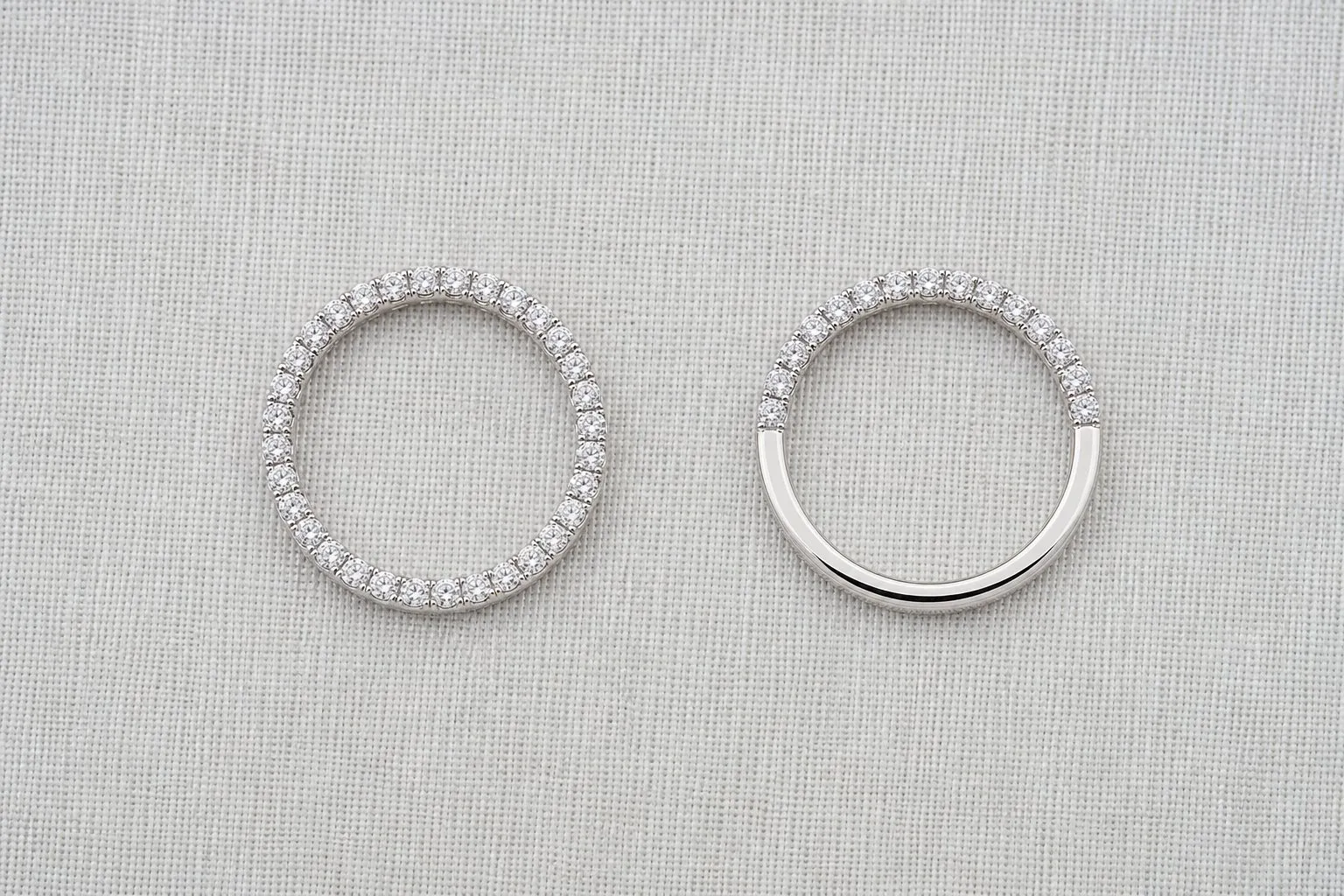
The half eternity band is usually presented as the lesser version, a style option for people who want most of the look. Treated properly, it is the consequential half of the decision, because of what its plain section makes possible later.
The Plain Section Is the Whole Point
Espling Jewelers puts the remedy in a sentence: if flexibility is a concern, a half eternity ring, with stones covering only the top half of the band, allows for future resizing. The reason follows from its explanation of the problem, since the bare metal at the back is what a jeweler has to cut and rejoin to change a size. The trade-off is worth saying out loud: fewer stones, and the line of stones does not show from every angle as the ring turns.
How Each One Sits on the Finger
Width changes how a size feels. Brilliant Earth says a wider band will feel tighter than a narrower band in the same ring size, that you may need to size up by half a size for a wider style, and that narrower widths stack more comfortably. Wikipedia offers the comfort logic behind the half design, noting a band of stones right around the finger can sit less easily than one with a smooth underside. Metal matters too, and wedding band metals compared handles that choice.
What an Eternity Ring Is Given For
Here the honest answer comes first: no gemological or trade authority publishes a rule about when an eternity ring is given. There is a common practice, a named description of it, and nothing firmer.
Anniversaries and Milestones
The nearest thing to a named source is GIA’s description of stackable bands as bands that can be added to the original wedding and engagement rings to celebrate an anniversary or other special occasion. Read it as a description of what people do, not a rule about what anyone should do. We found no gemological or trade authority publishing a year, an anniversary number or a required occasion. Sellers do name particular milestones, and each is that seller’s own suggestion rather than a convention.
As a Wedding Band
Plenty of buyers choose an eternity band as the wedding band itself rather than as a later gift, and nothing in the sourced material treats those two purchases differently. The sizing consequence set out above applies the same way in both cases, which makes an eternity band a sizing decision before a style one. If you are working out how the two rings relate, our guide to engagement ring vs wedding ring covers which is given when.
The De Beers Origin Story, and How Far It Can Be Verified
Wikipedia attributes the modern eternity ring to a 1960s De Beers marketing campaign aimed at selling small Soviet-sourced diamonds, and notes earlier paste and topaz precedents from the 18th century. We could not verify this beyond Wikipedia’s own sourcing, so it belongs here as Wikipedia’s attribution rather than as established history. Wikipedia is a supporting reference on this page, good for vocabulary and for the comfort rationale behind the half design, and never the basis of anything you would act on.
Which Finger, and How to Wear It
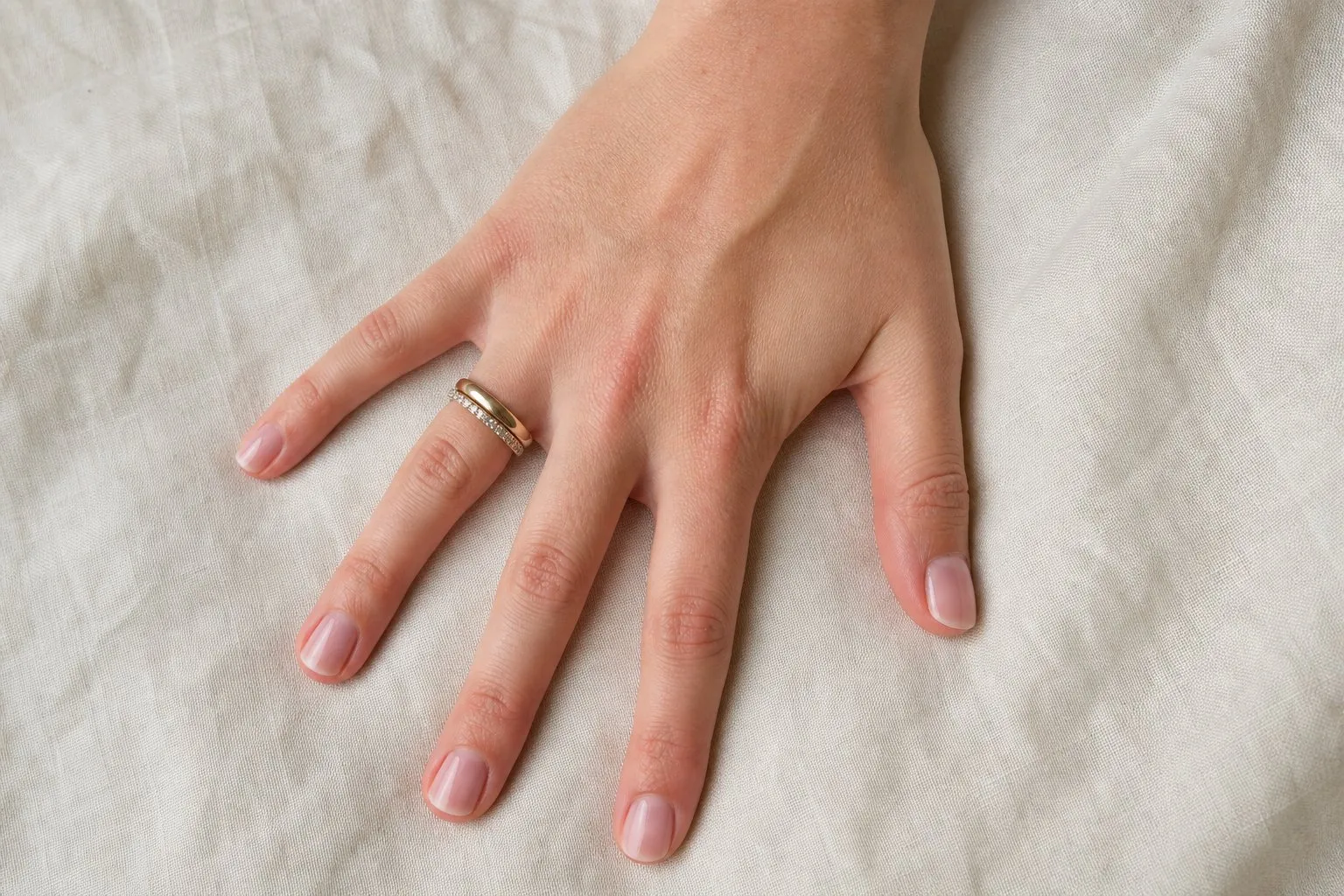
No authority publishes a rule for where an eternity ring goes specifically. What GIA does publish about wearing rings is a description of options, and our finger guides own the rest of this question.
Stacking It With an Engagement Ring
GIA treats stacking as a matter of taste, saying that ring stacking lets you showcase your personal style by wearing your engagement ring and wedding band alongside other rings on the same finger. It names two orders without ruling between them: the wedding ring on the finger first with the engagement ring on top, or the engagement ring first followed by the band. For the eternity ring itself, no named gemological, trade or historical authority publishes a placement rule, and we looked. See which hand a wedding ring goes on.
Wearing It on Its Own
GIA offers one further option rather than an instruction, suggesting you consider wearing your engagement ring on your right hand and your wedding band on your left. Worn alone, the two designs differ in one practical way: a full eternity band shows stones from every angle, so it reads the same however it turns during the day, while a half eternity band has a front and needs setting straight. On the finger question, read what the ring finger means.
Choosing Between a Full and a Half Eternity Ring
There is no winner here. The choice turns on one question: might this ring ever need to be adjusted? If the answer is yes, or if you cannot rule it out, the published wording from the sellers who service these rings points one way. If it is no, and an unbroken line of stones is what you came for, the full band does something the half cannot. The table sets out each situation with the source its recommendation rests on, so you can see whose words you are relying on.
| Your situation | Full or half | Why, and on whose published wording |
|---|---|---|
| Your ring size has changed before, or may change | Half eternity | Espling Jewelers says a half eternity band, with stones only across the top, allows for future resizing |
| You are buying as a surprise and are not certain of the size | Half eternity, or buy where the exchange window is clear | Blue Nile and Brilliant Earth each offer an exchange rather than a resize on eternity rings |
| You want the line of stones visible from every angle | Full eternity | The design is defined by a continuous line of stones around the whole band |
| You want the ring to sit comfortably under a stacked band | Half eternity | Wikipedia notes stones encircling the entire band can make a ring uncomfortable, which is why the half design exists |
| You want the widest band you can get away with | Either, but size it carefully | Brilliant Earth says a wider band feels tighter at the same ring size and may need half a size up |
| You expect to have it altered or engraved later | Half eternity | Espling Jewelers says a full eternity band has no bare metal to cut, and With Clarity lists engraved rings among those it cannot resize |
| You are set on a full eternity band | Full, measured properly first | GIA says such rings can be very difficult to resize, so the size you buy is close to the size you keep |
Frequently Asked Questions
What Is an Eternity Ring Given For?
An eternity ring is usually given to mark an anniversary or a milestone, though that is common practice and not a published rule. GIA describes stackable bands as bands added to the original wedding and engagement rings to celebrate an anniversary or other occasion, and nothing firmer exists.
What Are the Rules for Eternity Rings?
The only rule with a named source behind it concerns size, not etiquette. GIA’s ring size guide says eternity or anniversary rings can be very difficult to resize, and Blue Nile, Brilliant Earth, Do Amore, Espling Jewelers and With Clarity each go further, saying they will not resize one or can only remake it.
When Should a Woman Get an Eternity Ring?
There is no published answer to when a woman should get an eternity ring. We found no gemological or trade authority naming a year, an anniversary number or an occasion. The useful preparation is not timing but measurement, because the sellers who stock these rings offer an exchange rather than an adjustment.
When Should My Husband Get Me an Eternity Ring?
Again, no authority publishes a moment for it, and any specific milestone you read is a seller’s own suggestion rather than a convention. What is worth passing on is practical: the ring needs to be the right size on arrival, so make sure your size is measured and known before anyone orders one.
Which Finger Is an Eternity Ring Worn On?
No authority publishes a finger rule for eternity rings specifically. GIA treats stacking as a personal style choice, describing an engagement ring and wedding band worn alongside other rings on the same finger, and names two possible orders without choosing. For the hand and finger question itself, see what the ring finger means.
What Are the Four Rings a Woman Should Receive?
We found no gemological, trade or historical authority that publishes a list of four rings a woman should receive, so this page does not print one. The phrasing itself reads as marketing rather than custom, and listing four rings on no source would be inventing a tradition instead of reporting one.
Sources
- GIA 4Cs, Ring Size Guide: Tips and Ring Size Chart, 2018.
- GIA 4Cs, Engagement Ring Styles to Flatter Her Hand and Finger, 2017.
- GIA 4Cs, How to Wear Your Engagement Ring and Wedding Band, 2025.
- GIA 4Cs, Complete Guide to Engagement Ring Settings: Types vs. Styles, 2026.
- Blue Nile, Non-Resizable Ring Types, dated 16/02/2024, read 12/09/2026.
- Blue Nile, How to Measure Your Ring Size, undated, accessed 11/09/2026.
- Brilliant Earth, Free 30-Day Returns and 1-Year Resizes, undated, accessed 11/09/2026.
- Brilliant Earth, What to Do if Your Ring Is Too Big, 2026.
- Brilliant Earth, Ring Width Guide, 2026.
- Espling Jewelers, Can Eternity Rings be Resized?, undated, accessed 11/09/2026.
- Do Amore, Free Ring Resizing, 2026.
- With Clarity, Ring Resizing Demystified: The Complete Guide You Need, 2024.
- Wikipedia (supporting reference only), Eternity ring, accessed 12/09/2026.