

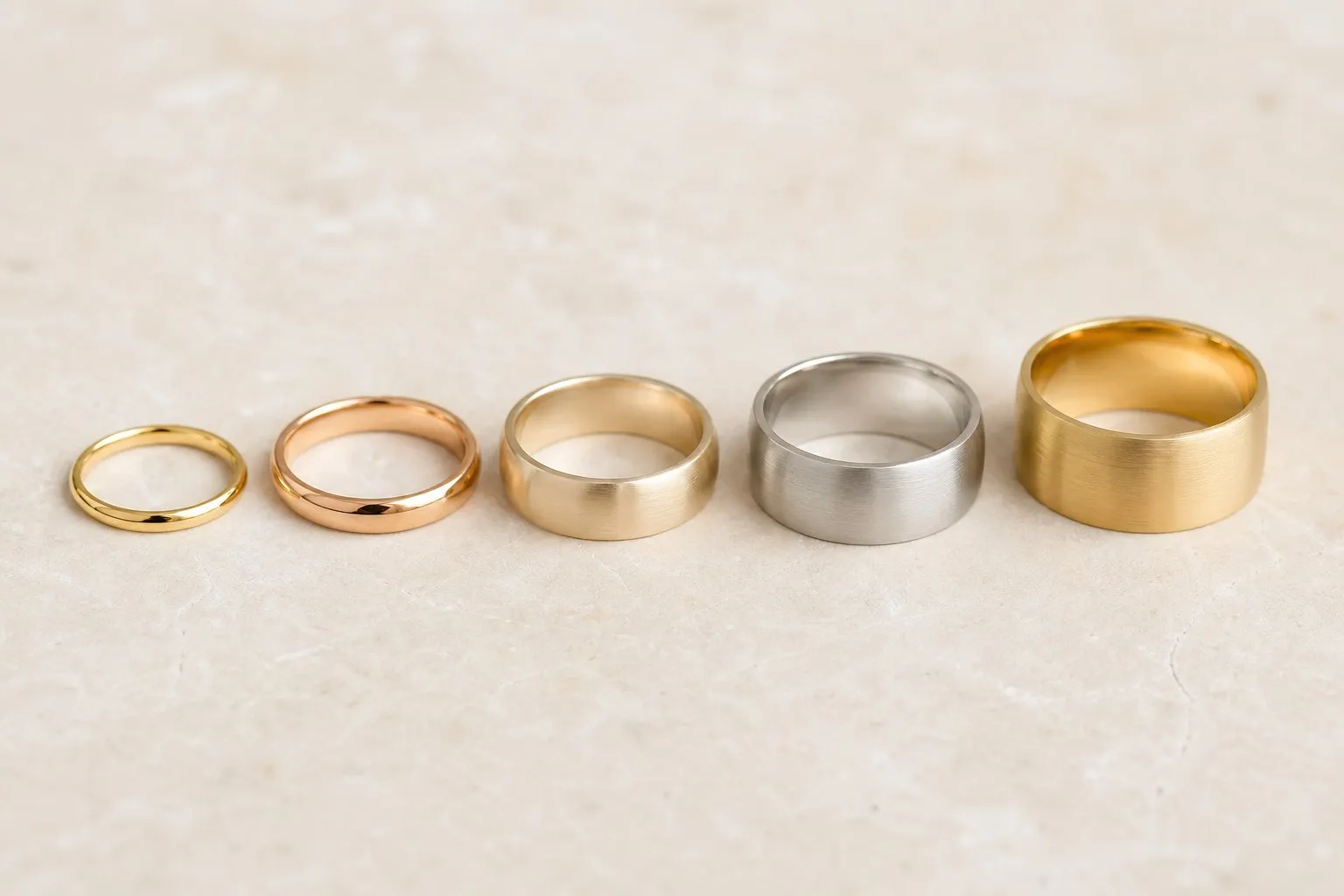
The women’s wedding band styles in ordinary use are the plain band, comfort fit, engraved and milgrain, channel and pavé set, full and half eternity, shaped or contoured, and stackable, and what decides the purchase is which of them can still be resized, soldered or added to years later. Four sellers say outright that a full eternity band cannot be resized, GIA stops at very difficult, and they disagree about which other styles are stuck, so this page names who said what rather than averaging them. The metal around a center stone is a separate question, answered on the band of an engagement ring.
What is on this page7 sections
Key Takeaways
- Brilliant Earth says eternity rings cannot be resized due to their design and exchanges them instead; Espling Jewelers says there is no bare metal left to cut.
- Blue Nile adds milgrain and ornate bands to the unresizable list, Do Amore adds fingerprint bands, With Clarity adds engraved rings, and Alpine Rings adds comfort fit.
- No gemological authority publishes a resizing rule for eternity bands, so this is seller convergence, not an industry standard.
- Brilliant Earth, 2026, says narrower widths stack more comfortably and leave room for several bands.
- GIA, 2026, says channel-set stones are less likely to catch on clothing than prong-set accents.
What a Wedding Band Style Rules Out
A wedding band is worn daily for decades, so the question at the counter is not which style you like but which ones close a door: resizing, soldering, stacking, replating. Brilliant Earth, 2026, says soldered rings cannot be worn individually and that a resize then means separating, sizing and re-soldering both rings; it names ring guards, spacer bands and ring jackets as alternatives to soldering a band to a solitaire.
| Band style | Can it be resized? | What else the style decides | Who published it |
|---|---|---|---|
| Plain metal band | Yesgenerally about two sizes up or down | The only style with no published restriction on resizing, soldering or stacking | Brilliant Earth, What to Do if Your Ring Is Too Big |
| Comfort fit | Typically not | Measured from the centerline where the ring is tightest, so measuring the outside edges gives the wrong size | Alpine Rings; Holden on what comfort fit means |
| Engraved | Noper With Clarity | The engraving is what is lost in a resize | With Clarity, Ring Resizing Demystified |
| Milgrain or ornate | Noper Blue Nile | The decoration runs around the band, leaving no plain section | Blue Nile, How to Measure Your Ring Size |
| Fingerprint band | Noper Do Amore | Not published | Do Amore, Free Ring Resizing |
| Full eternity | Nodifficult or impossible, on every seller we read, and very difficult per GIA | No bare metal to cut, so a too-tight ring is remade rather than sized. Sellers offer an exchange instead | Brilliant Earth; Espling Jewelers; Blue Nile; Do Amore; GIA 4Cs, 2018 |
| Half eternity | Yesbecause of the plain section at the back | The named design choice for anyone who expects to resize later | Espling Jewelers |
| Channel set | Difficult, especially where the stones extend far around the band | Channel-set stones are less exposed and less likely to catch on clothing than prong-set accents | GIA 4Cs settings guide, 2026; GIA 4Cs, 2018 |
| Pavé set | Difficult: a close pavé setting makes resizing difficult | A low but still present chance of losing side stones | With Clarity; GIA 4Cs, 2018 |
Whether It Can Ever Be Resized
Brilliant Earth, 2026, says rings can generally be sized up or down by about two sizes before their structure and design may be compromised. With Clarity, 2024, adds that the cut is made at the bottom of the band, the part under the most stress, and is weaker afterward. So the unresizable styles are those with no plain metal left at the shank, and the sellers publishing exclusion lists disagree about which: what a resize costs, how long it takes.
Plain, Comfort Fit and Engraved Bands
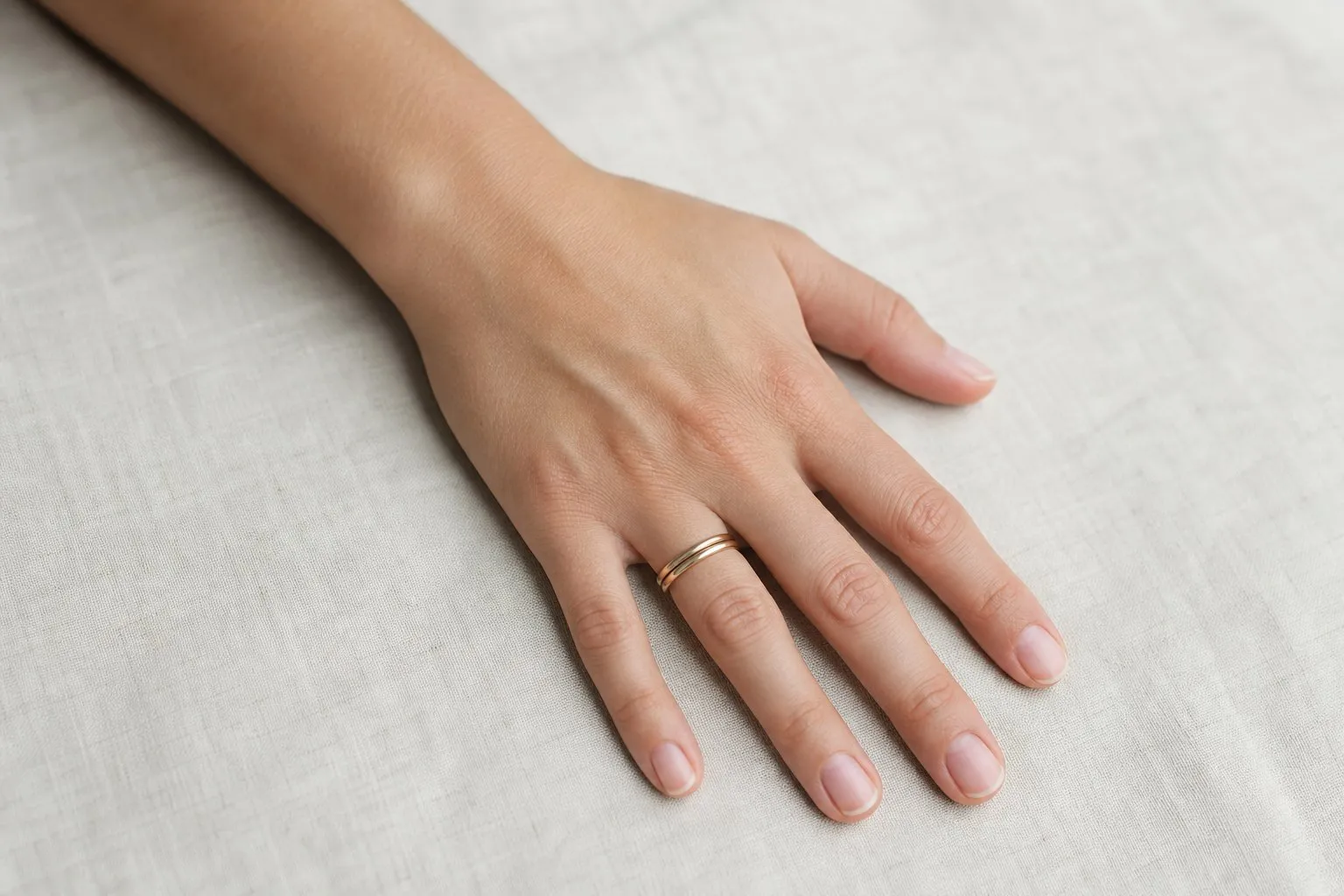
These three styles have nothing set into them, so the consequences come from the shape of the metal and from what is cut into it.
The Plain Metal Band
A plain band is the only style here with no published restriction on resizing, soldering or stacking, which is the whole of its practical case. Brilliant Earth, 2026, puts women’s bands generally at 4mm or under and says a wider band feels tighter than a narrower band in the same ring size, so a wide style may need half a size up. Measure the size first, then compare every band metal.
Comfort Fit Is a Shape, Not a Size
Holden says comfort fit is the style in which a ring is made, not a statement that the ring is the correct size. Alpine Rings says the measurement is taken from the centerline, where the ring is tightest, and that comfort fit rings typically cannot be resized, so a flexible exchange policy matters. Brilliant Earth adds that it is especially popular on bands around 8mm and wider: what comfort fit changes.
Engraving and Milgrain
With Clarity, 2024, says the only rings that cannot be resized are engraved rings and eternity milgrain rings. Blue Nile lists milgrain or ornate bands alongside eternity rings with a set number of gemstones per finger size, silver and metals such as tungsten, and offers a 30-day exchange instead. Do Amore adds fingerprint bands. Our own reading: what removes the plain section a jeweler needs is decoration running right around the band, stones or metalwork alike.
Set Bands: Eternity, Half Eternity, Channel and Pavé
This is where the styles stop being reversible, and it is also where the published sources agree most and disagree most.
A Full Eternity Band Is the Hard Case
Brilliant Earth says eternity rings cannot be resized due to their design and offers a free exchange. Espling Jewelers explains that stones encircling the band leave no bare metal to cut, so a too-tight eternity ring can only really be remade larger. Blue Nile and Do Amore both list eternity bands among the rings they cannot size. GIA, 2018, goes as far as very difficult to resize, and no further. No gemological authority publishes a resizing rule for eternity bands, and GIA’s own sites contain none, so this is four named sellers converging rather than a standard.
Half Eternity, Channel and Pavé
Espling Jewelers says a half eternity ring, with stones covering only the top half of the band, allows for future resizing. GIA, 2026, says channel settings are common on wedding bands, that channel-set stones are less exposed than prong-set accents, and that channel-set rings can be difficult to resize. With Clarity, 2024, says a close pavé setting makes resizing difficult and carries a low but present chance of losing side stones: cleaning a set band without loosening it.
Shaped, Contoured and Stacked Bands
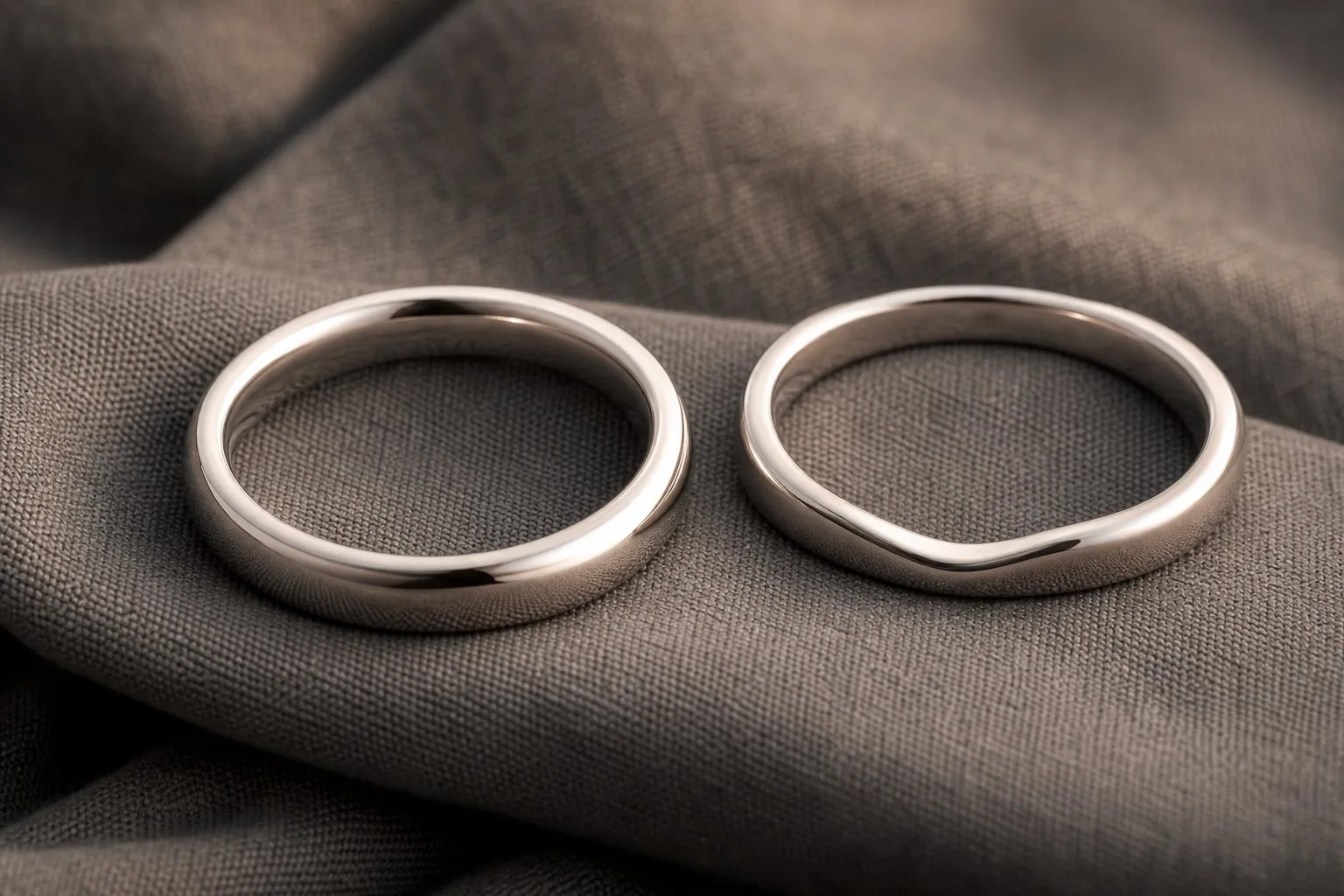
Two of these styles exist only in relation to another ring, so that ring decides them: Brilliant Earth, 2026, ties a flush fit to the engagement ring’s setting height, and With Clarity, 2025, says angular cuts may need notches or a band made to fit. Options per stone shape: bands shaped for an oval, bands that clear a halo, bands shaped for a pear and bands for an emerald cut.
| What is true of you | What that argues for | The published reason |
|---|---|---|
| Your ring size has changed before, or you expect it to | A plain band or a half eternity, not a full eternity and not comfort fit | A half eternity band’s plain section allows future resizing; comfort fit typically cannot be resized12 |
| You want the band engraved | Decide the size first, because the engraving is what a resize costs you | With Clarity says engraved rings cannot be resized |
| Your engagement ring sits low on the finger | A curved, contoured or open band, chosen for your stone shape | Lower-profile settings may require a curved, contoured or open band to prevent gaps3 |
| Your engagement ring has an angular stone | Expect a notch, and expect it to be made for the ring | Angular cuts like princess or emerald may require notches for proper alignment4 |
| You want to add bands later | Narrower widths, and one metal rather than two | Narrower widths stack more comfortably and leave room for multiple bands; mixing metals means planning for more maintenance33 |
| You do not want ongoing upkeep | Yellow or rose gold over rhodium-plated white gold, and fewer small stones | Rhodium plating wears away and must be replated occasionally; pavé carries a chance of losing side stones54 |
5 sources cited in this table
Wearing More Than One Band
Brilliant Earth, 2026, says narrower widths stack more comfortably and leave room for multiple bands, and GIA, 2017, says long, slender fingers are ideal candidates for stackable rings, the more so the longer the finger. Brilliant Earth also says harder metals scratch softer ones, so mixing metals means more maintenance, and GIA, 2015, says rhodium plating wears away, leaving white gold to need occasional replating.
Frequently Asked Questions
What are some popular styles of women’s wedding rings?
The styles most people buy are the plain metal band, the half eternity, the channel or pavé band, the shaped band, and a stackable set. Brilliant Earth, 2026, holds the one dated popularity figure we could verify, and it is about width: the most popular women’s band widths are 2mm to 3mm.
What are the different styles of ladies rings?
Three rings get grouped under that phrase. A wedding band is its own ring, plain or set, and is this page’s subject. An engagement ring band is the metal carrying a center stone. An anniversary band is added later, which is why GIA, 2017, treats stackable bands as additions: what separates the two rings.
What are the current trends in wedding bands?
We could not verify one. No named source with a year publishes a trend ranking for wedding band styles, so this page does not rank styles by popularity. What sources publish instead is consequence, such as which styles a named seller refuses to size.
What is the 2:1:1 rule in jewelry?
We could not find any named source that publishes a 2:1:1 rule in jewelry. That is not the same as saying no such rule exists: nothing we read attributes it to anyone, so we will not invent a version of it. The rules we can attribute concern resizing, setting security and width.
How much should I spend on an engagement ring if I make $100,000 a year?
No named source publishes a salary multiple as advice. Brilliant Earth, on a page dated 5 August 2026, traces the salary rule to a 1930s De Beers campaign and calls it outdated. The band is worn daily for decades, so weight the budget toward the style that forecloses least: what a wedding band actually costs.
Sources
- Brilliant Earth, What to Do if Your Ring Is Too Big, 2026. https://www.brilliantearth.com/guides/what-to-do-if-your-ring-is-too-big/
- Brilliant Earth, Free 30-Day Returns and 1-Year Resizes, accessed 11 September 2026. https://www.brilliantearth.com/30-Day-Returns/
- Brilliant Earth, Ring Width Guide, 2026. https://www.brilliantearth.com/guides/ring-width-chart/
- Brilliant Earth, Comfort Fit Ring vs. Standard Fit Ring, 2026. https://www.brilliantearth.com/guides/comfort-fit-ring-vs-standard/
- Brilliant Earth, How to Stack an Oval Engagement Ring with a Wedding Band, 2026. https://www.brilliantearth.com/guides/how-to-stack-oval-engagement-ring-with-wedding-band/
- Brilliant Earth, Soldered Rings: Pros, Cons, and Alternatives, 2026. https://www.brilliantearth.com/guides/soldered-rings/
- Brilliant Earth, How to Choose a Wedding Band, 2026. https://www.brilliantearth.com/guides/how-to-choose-a-wedding-band/
- Brilliant Earth, What Is the 3-Month Salary Rule?, page dated 5 August 2026. https://www.brilliantearth.com/guides/3-month-salary-rule/
- Espling Jewelers, Can Eternity Rings be Resized?, accessed 11 September 2026. https://www.esplingjewelers.com/blogs/news/can-eternity-rings-be-resized
- Blue Nile, How to Measure Your Ring Size, accessed 11 September 2026. https://www.bluenile.com/education/rings/find-your-ring-size
- Do Amore, Free Ring Resizing, 2026. https://www.doamore.com/free-ring-resizing/
- With Clarity, Ring Resizing Demystified, 2024. https://www.withclarity.com/blogs/engagement-ring/all-about-ring-resizing
- With Clarity, What You Need to Know Before Buying a Pave Setting, 2024. https://www.withclarity.com/blogs/engagement-ring/what-is-a-pave-setting
- With Clarity, How do you find a flushed-fit wedding band for your hidden halo engagement ring?, 2025. https://www.withclarity.com/blogs/wedding-bands/how-do-you-find-a-flushed-fit-wedding-band-for-your-hidden-halo-engagement-ring
- Alpine Rings, Standard Fit vs. Comfort Fit Ring, accessed 11 September 2026. https://alpinerings.com/blogs/news/standard-fit-vs-comfort-fit-ring-what-s-the-difference
- Holden, What Are Comfort Fit Wedding Bands?, undated. https://hiholden.com/blogs/all/what-are-comfort-fit-wedding-bands
- GIA 4Cs, Ring Size Guide: Tips and Ring Size Chart, 2018. https://4cs.gia.edu/en-us/blog/how-to-determine-ring-size-tips-and-ring-size-chart/
- GIA 4Cs, Complete Guide to Engagement Ring Settings, 2026. https://4cs.gia.edu/en-us/blog/guide-to-ring-settings/
- GIA 4Cs, Engagement Ring Styles to Flatter Her Hand and Finger, 2017. https://4cs.gia.edu/en-us/blog/engagement-ring-styles-to-flatter-hands-fingers/
- GIA 4Cs, Choosing Between White Gold, Platinum, Palladium, and Silver, 2015. https://4cs.gia.edu/en-us/blog/pick-right-white-metal-engagement-wedding-ring/