

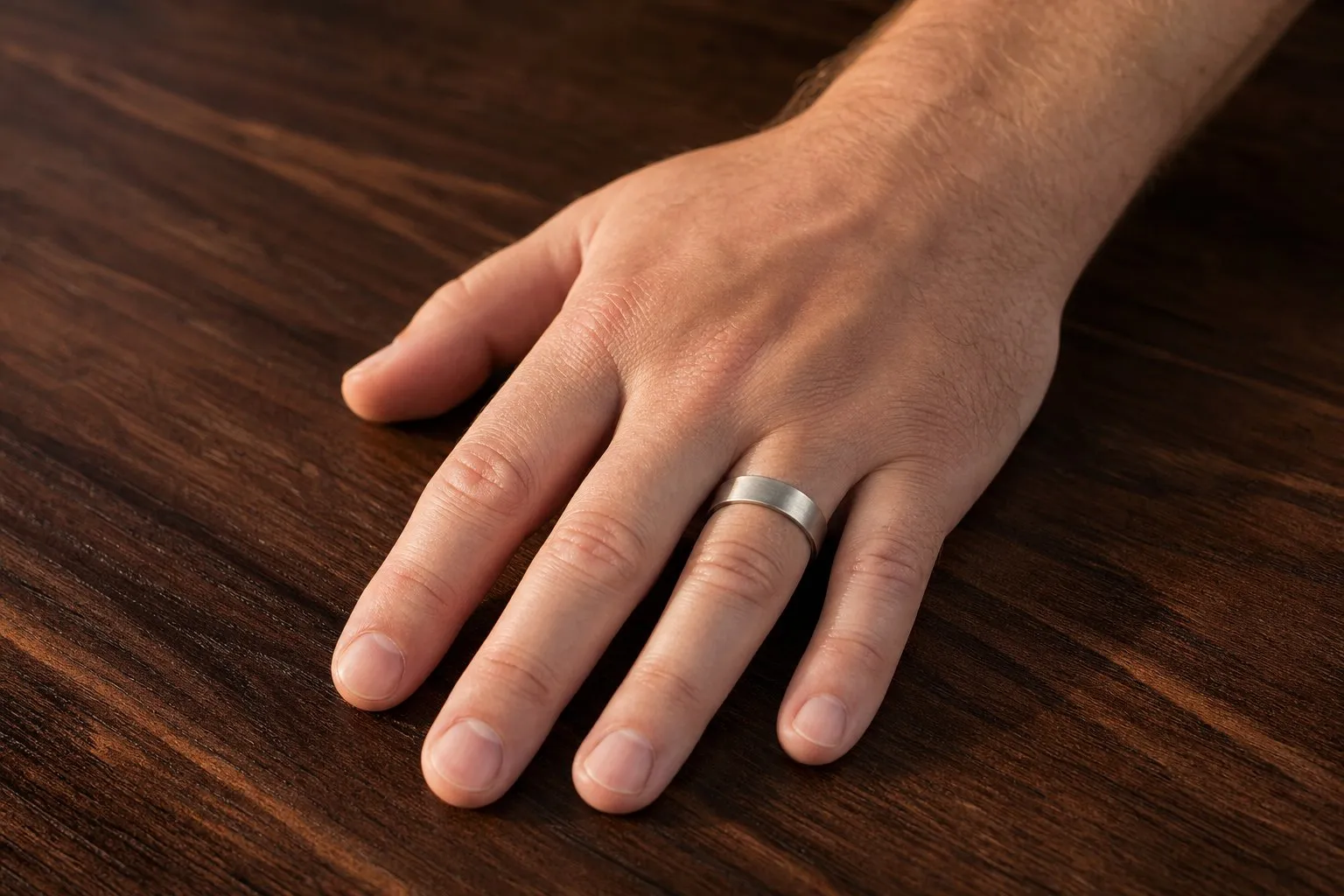
No survey, study or standard reports an average ring size for men, which means every average you have met on a retailer’s blog belongs to that individual jeweler and nobody else. This page names each source it has and dates it, says what kind of figure each one is, then spends its second half on what genuinely moves a finger size and what to do when a ring stops fitting.
What is on this page8 sections
Key Takeaways
- No survey, study or standard measures men’s ring sizes. Every published average traces back to one seller’s observation of its own customers.
- Martin Jewelers (2025) is the one named jeweler here that publishes a range for most men, and it is blog guidance, not a population statistic.
- Blue Nile’s published men’s size range describes the inventory it stocks, not what men wear.
- ANSUR II, the largest public US body-measurement dataset, holds 93 body measures for 4,082 men and no finger circumference at all.
- No source we found converts pounds gained or lost into ring sizes, so after a large weight change, measure again rather than predict.
What Is the Average Ring Size for Men?
Ask the open web and you get five confident answers from five sellers. There is no measured answer to quote, only published opinions with names attached, so below is every source we hold, each labeled by what kind of figure it is.
| Source | What it reports | What kind of figure it is | Year |
|---|---|---|---|
| Martin Jewelers | Most men between sizes 9 and 11 | One jeweler’s guidance on its own blog | 2025 |
| Blue Nile | Carries men’s rings from size 6 to 13 | A retailer’s stock range, not an average | Undated, accessed 10/09/2026 |
| JAXXON | A 3 inch circumference is nearer a US 16 to 17 and uncommon off the shelf | A retailer’s note on the top of the range | Undated, accessed 10/09/2026 |
| Brilliant Earth | Men’s wedding bands are generally 5 mm and wider | A band width, not a finger size | 2026 |
| ANSUR II, US Army anthropometric survey (Penn State OPEN Lab) | 93 body measures for 4,082 men; hand length, breadth, circumference and palm length, and no finger circumference | The largest public US body-size dataset, with no ring-size data at all | 20171 |
1 source cited in this table
What Each Source Actually Reports
Martin Jewelers, writing on its own blog in 2025, places most men between sizes 9 and 11. That is one jeweler’s guidance for its own customers, not a survey, and it carries no sample and no method. Brilliant Earth (2026) is often quoted in the same breath, but the figure it publishes is a width and not a size: men’s wedding bands are generally 5 mm and wider. A width describes the band; a size describes the finger. The two get repeated interchangeably, which is one way a single number turns into five.
Why No Survey Exists
We found no national survey, no study and no standard reporting men’s ring sizes. The nearest thing to a population dataset is ANSUR II, the US Army’s anthropometric survey released publicly in 2017 through Penn State’s OPEN Lab: 93 body measures for 4,082 men, with hand breadth, hand circumference, hand length and palm length among the published hand dimensions and no finger circumference anywhere in them. Its publisher also states that it “is still not an approximation of the US Civilian population”. So it cannot supply a men’s average, and its use here is the opposite one: it shows how thin the measured record is.
A Stock Range Is Not an Average
Blue Nile carries men’s rings from size 6 to 13. That sentence describes what one retailer sells, and a catalog is set by inventory economics: a store stocks the sizes that turn over and special-orders the rest. Read as an average, it quietly becomes a claim about men’s fingers, which it never was. For the millimeter behind each of those numbers, see the men’s ring size chart in millimeters.
Is a Size 7, 9 or 10 Big for a Man?
A 7, a 9 and a 10 are all ordinary men’s sizes. Calling one of them big or small only means comparing it against a range some individual seller chose to publish, so the comparison is worth as much as the source behind it and no more.
Where Those Sizes Sit in the Reported Range
Set against the range Martin Jewelers reports, a 9 sits at its lower edge, a 10 sits comfortably inside it, and a 7 falls below it while still sitting well within every stock range we found. None of that makes a 7 remarkable. It makes it a size one jeweler’s blog guidance does not happen to cover and that every retailer we checked sells anyway.
Sizes Above and Below What Shops Carry
The ends of a catalog are where the confusion starts. JAXXON publishes US size 14 at 23.0 mm across and 72.3 mm around, and notes that a 3 inch circumference is nearer a US 16 to 17, which is uncommon off the shelf. It also warns that most people confuse a diameter measurement with a circumference, which is how an ordinary finger produces an alarming number. A size beyond the 6 to 13 Blue Nile stocks usually points to a special order, not to an unusual hand.
Why Fit Beats the Average
A measured finger beats every figure on this page, including the ones with names attached. Blue Nile’s test is the one worth keeping: a ring should be snug enough to stay in place yet loose enough to slide over the knuckle with ease. That is a pass or fail you can run in seconds, and no average can run it for you. With no existing ring to copy, measure with our printable ring sizer before ordering.
What Changes a Man’s Ring Size
This is what the searches around this keyword are really asking: not what the average is, but why a finger will not hold still. The honest answers are smaller than the internet’s, and one of them is that nobody has measured the thing at all.
Temperature, Time of Day and Activity
Brilliant Earth (2026) states it plainly: fingers contract in cold conditions and expand in heat, and finger size can change with activity, hydration, temperature and diet. Blue Nile lists measuring when your hands are cold among the most common sizing mistakes, and advises taking the measurement at the end of the day, when fingers are warm and slightly larger. So a band that fits in the evening and spins on a cold morning is not the wrong size. It is a finger behaving the way fingers behave.
Weight Change, and What Nobody Quantifies
Nine of the fifteen related questions Google attaches to this search are about weight, so here is the flat answer: no source we found converts pounds gained or lost into ring sizes. Not one. Any page handing you a sizes-per-pound rule is publishing a number nobody measured. The only attributed claim available comes from Thom Duma Fine Jewelers, writing about women’s sizes, which publishes that age, weight fluctuations and lifestyle changes can affect finger size over time, with no figure attached to any of the three. After a large weight change, measure again instead of predicting.
Age and Knuckles
GIA notes that for most people the joint is larger than the rest of the finger, so a size taken only where the ring sits may not pass the knuckle when it matters. Thom Duma names age among the factors that can shift finger size over time, again without a number. The clinical literature takes the aging finger seriously: a peer-reviewed geriatric orthopaedics paper by Kates (2010) is devoted entirely to removing rings from it. None of that supports a rule that a man’s size rises with age, because nobody publishes one.
Which Hand, and How Wide the Band Is
Two adjustments get published repeatedly, and only one has an agreed size. Thom Duma Fine Jewelers reports that the dominant hand is usually about half a size larger than the other. On width, Brilliant Earth says a wider band feels tighter than a narrower band in the same ring size and may need half a size up; Fred Meyer Jewelers tells buyers to take one full size larger for a band wider than 6 mm; Martin Jewelers says a size 9 in a thin band may require a 9.5 in a wide band, and notes that men’s bands tend to run 6 to 8 mm. The sellers agree on the direction and disagree on the threshold, which is the whole of how band width changes the size you order.
When the Ring No Longer Fits
The two failures are not symmetrical. A loose ring costs you the ring, which is expensive and infuriating. A tight ring can cost you the finger, which is a medical problem with a published literature behind it.
Too Loose
A loose ring spins, sits crooked and eventually leaves your hand somewhere you will not find it again. Jewelers offer non-permanent fixes for exactly this, sizing beads and inserts among them, with a full resize as the permanent option. The step before any of them: confirm what the finger measures at the end of a warm day, because a band that read correctly in July can read loose in January.
Too Tight, Which Is the Emergency
A ring that will not come off is a hospital presentation, not an inconvenience. Moser and colleagues (2016) write that the most common reason for ring removal is swelling, when rings can have a painful tourniquet effect on digits. Asher and colleagues (2020) describe the inability to remove a ring as a common Emergency Department presentation, with a tourniquet effect that strangulates the tissue, and state that in cases of strangulation emergent referral to a specialist is indicated. If that is where you are, read how to get a ring off a swollen finger.
Resizing Limits and the Metals That Cannot Be Resized
Resizing is bounded by metal rather than by willingness to pay. GIA’s everyday-wear table lists gold and sterling silver as resizable up to 2 sizes, platinum as expensive to resize, titanium as limited to half a size and tungsten as not resizable. KAY resizes only two sizes up or two sizes down and says a ring’s material and design may decide whether it can be resized at all. Brilliant Earth (2026) puts resizing at $50 to $200 on average and generally up to two weeks. Blue Nile cannot resize silver or alternative metals such as tungsten and offers an exchange instead, which is why which metals can be resized and the size you order are one decision, worth settling before choosing tungsten wedding bands.
Which Size Should You Order?
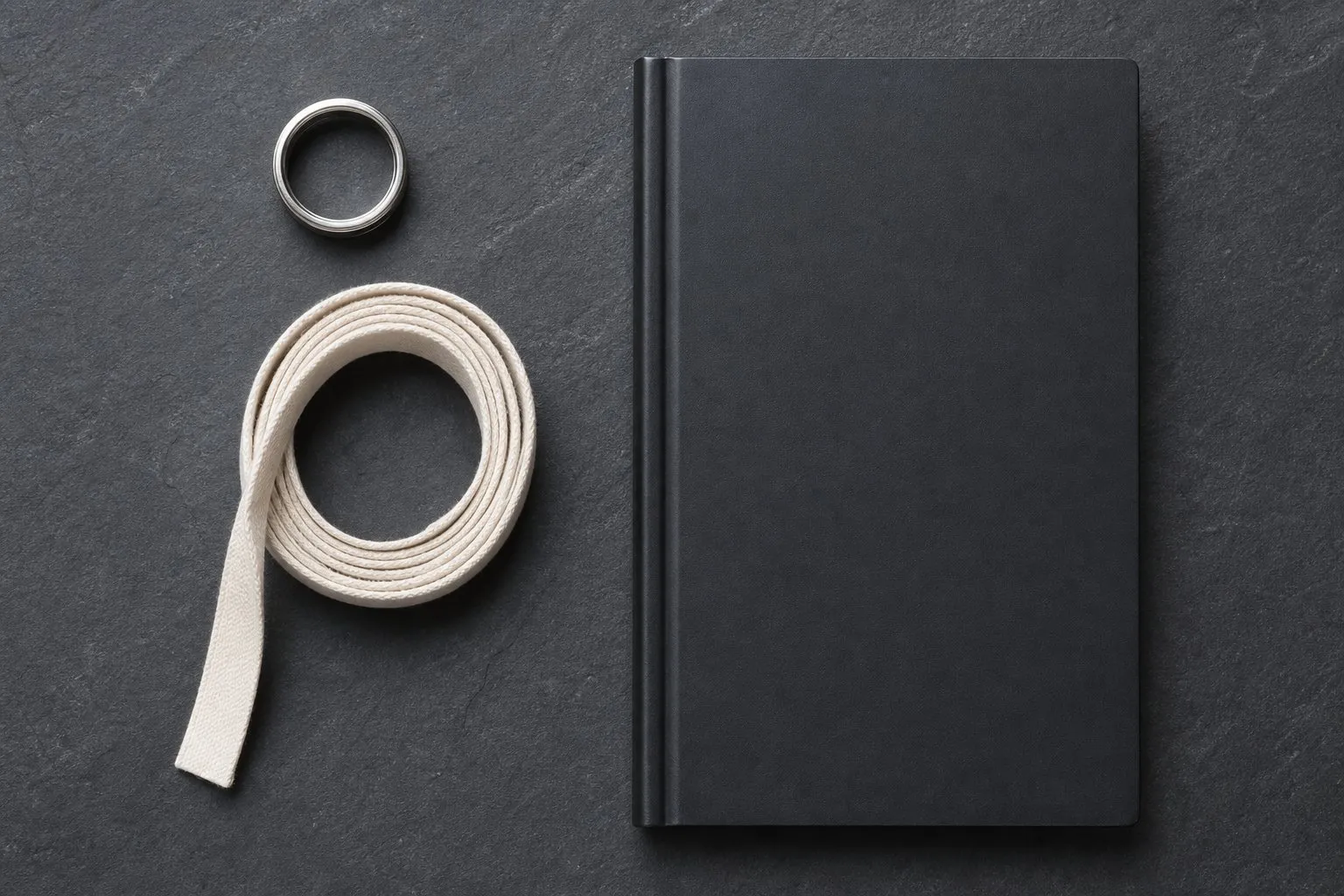
You cannot order an average, only a size. The table below turns everything above into the decision in front of you, with the owner of each reason named, so you can see whose rule you are following.
| Your situation | What to do | Why |
|---|---|---|
| You measured once, in the morning, in winter | Measure again at the end of a warm day | Fingers contract in cold and expand in heat; cold hands are a common sizing mistake12 |
| You fall between two sizes | Take the larger one | Blue Nile advises the larger size, and a ring that will not pass the knuckle is unwearable |
| The band is wider than about 6 mm | Go up half a size to a full size, or be measured on that width | Sellers disagree on the threshold: half a size up for wider styles, one full size above 6 mm13 |
| Your knuckle is wider than the base of the finger | Choose a size between the two measurements | For most people the knuckle is larger than the rest of the finger (GIA) |
| It is for the dominant hand | Expect about half a size more than the other hand | Thom Duma Fine Jewelers publishes that difference |
| Your weight has changed a lot since you last bought a ring | Measure again rather than predict a new size | Not publishedweight fluctuations can change finger size over time4 |
| You want tungsten, titanium or silver | Confirm the size before ordering and read the exchange terms | GIA: titanium is limited to half a size and tungsten cannot be resized; Blue Nile exchanges rather than resizes these |
| You are buying as a surprise with no measurement | Start from a range a named jeweler reports and buy where resizing or exchange is covered | Every published average belongs to one seller; the exchange is what protects the guess |
4 sources cited in this table
Frequently Asked Questions
Is a size 10 ring big for a man?
No, a 10 is an ordinary men’s size: it sits inside the range Martin Jewelers publishes and inside every retailer stock range we checked. Whether it feels big depends on your knuckle and on how wide the band is, not on where it lands against one jeweler’s guidance.
Is ring size 9 common for men?
Common is a word no dataset can support here. A 9 does sit at the lower edge of the 9 to 11 range Martin Jewelers publishes for most men, and every retailer we checked stocks it, so treat it as a perfectly normal size rather than as a measured majority of men.
Is ring size 7 average?
There is no average to compare it against, because no survey, study or standard measures men’s ring sizes. A 7 falls below the range one jeweler publishes for most men and well inside the sizes retailers stock, which makes it an ordinary size that happens to sit outside a single blog’s rule of thumb.
Will my fingers shrink if I lose 40 pounds?
They may, and no source we found converts pounds into ring sizes, so nobody can honestly tell you by how much. Thom Duma Fine Jewelers publishes only that weight fluctuations can affect finger size over time, with no figure attached. Measure again once your weight has settled instead of ordering against a predicted size.
Does finger size change with weight gain?
It can, and again no published source turns pounds into sizes. Thom Duma Fine Jewelers names weight fluctuations among the things that change finger size over time, and Brilliant Earth adds hydration, diet, activity and temperature to the same list. Each describes a direction; none gives a number you can order against.
Is it better for a ring to be loose or tight?
Slightly loose, because the two failures are not equal. Blue Nile’s standard is snug enough to stay in place yet loose enough to clear the knuckle with ease, and when you fall between two sizes it advises taking the larger one. A ring too tight to remove becomes a medical problem rather than a fit complaint.
Sources
- Martin Jewelers, Men’s and Women’s Ring Size Chart, 2025.
- Blue Nile, How to Measure Your Ring Size, undated, accessed 10/09/2026.
- JAXXON, How to Measure Ring Size, undated, accessed 10/09/2026.
- Brilliant Earth, Ring Width Chart, 2026.
- Brilliant Earth, Comfort Fit Ring vs. Standard Fit Ring, 2026.
- Brilliant Earth, What to Do if Your Ring Is Too Big, 2026.
- Penn State OPEN Lab (US Army ANSUR II data), ANSUR II, 2017.
- Thom Duma Fine Jewelers, Average Engagement Ring Size for Women, undated, accessed 10/09/2026.
- GIA 4Cs, How to Determine Ring Size: Tips and Ring Size Chart, accessed 11/09/2026.
- GIA 4Cs, Best Ring Material for Everyday Wear, 2025.
- Fred Meyer Jewelers, Ring Size Finder, undated, accessed 10/09/2026.
- KAY, How to Resize a Ring, undated, accessed 11/09/2026.
- Kates SL, A Novel Method of Ring Removal From the Aging Finger, Geriatric Orthopaedic Surgery and Rehabilitation, 2010.
- Moser A, Exadaktylos A, Radke A, Removal of a Tungsten Carbide Ring from the Finger of a Pregnant Patient, Case Reports in Emergency Medicine, 2016.
- Asher CM, Fleet M, Bystrzonowski N, Ring removal: an illustrated summary of the literature, European Journal of Emergency Medicine, 2020.