

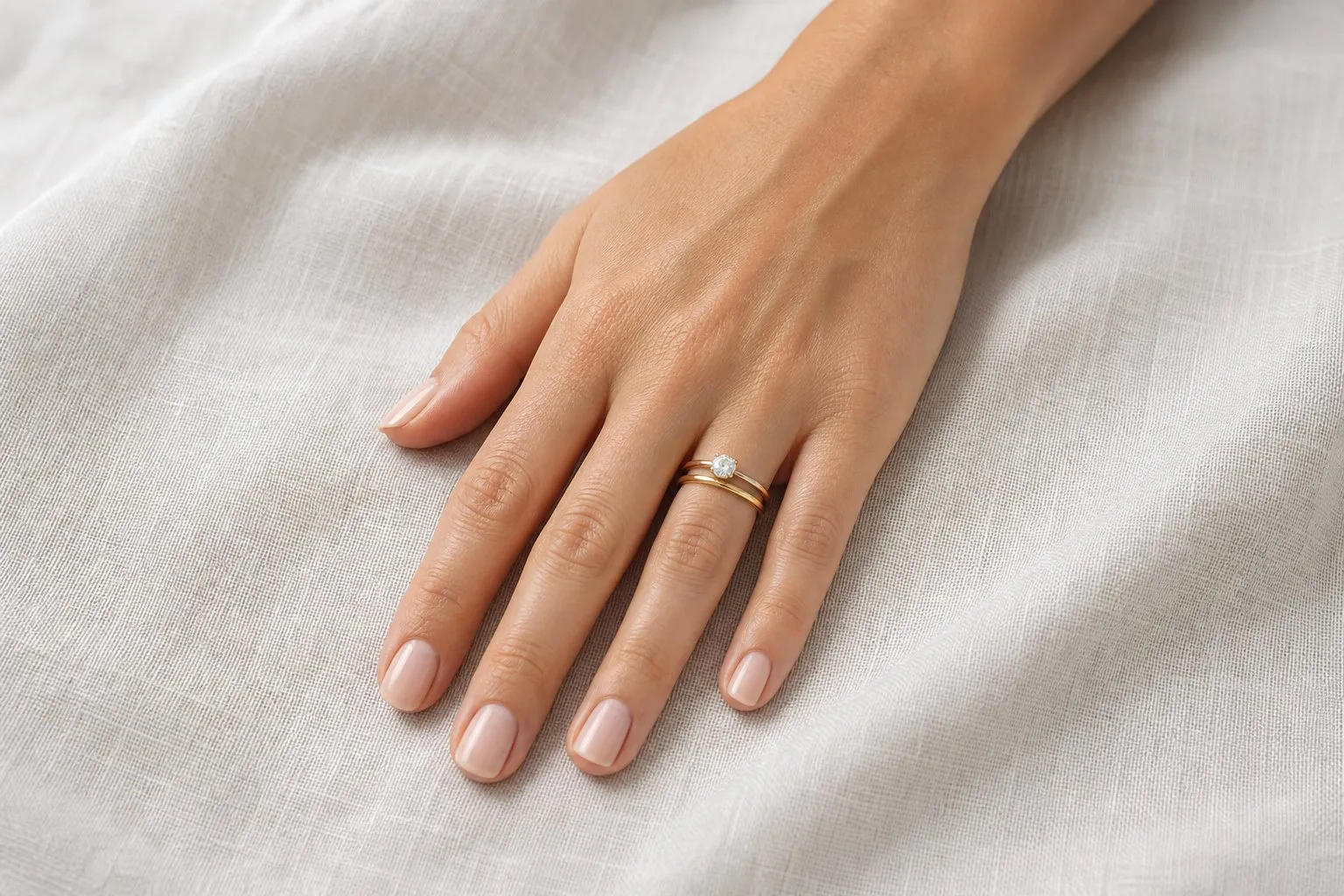
Most people who wear an engagement ring and wedding band after the wedding put both on the same finger, with the band closest to the hand and the engagement ring above it, and that is a convention rather than a rule. No gemological or trade authority we could find publishes an order at all, and GIA’s own 2025 guide describes both orders plus a third route of one ring on each hand. So this guide on how to wear engagement ring and wedding band together names who publishes which convention, then covers the two decisions that carry consequences, soldering and fit.
What is on this page8 sections
Key Takeaways
- GIA’s 2025 guide describes the wedding ring going on first with the engagement ring on top, and also the reverse, and prefers neither.
- We looked for a gemological, trade or historical authority publishing a wearing order and could not find one. The convention travels through retailer blogs only.
- Brilliant Earth, a retailer, titles its 2026 guide around traditions worth breaking and says there are “no strict rules about which finger or hand the wedding ring should be worn on.”
- Soldering is permanent: Brilliant Earth publishes that soldered rings “can’t be worn individually.”
- Two rings on one finger change the size question, because a wider band feels tighter in the same size.
The Two Orders That Are Published, and Who Publishes Them
Two stacking orders are in print, and the same 2025 GIA guide carries both. The useful question is not which is right but who published each one, and whether either was ever more than a custom.
Band First, Engagement Ring on Top
This is the common convention in the United States, and GIA’s 2025 guide describes it: “the wedding ring is placed on the finger first, with the engagement ring worn on top.” Retailer blogs repeat the order and give a reason for it, that the band then sits closer to the heart. That is their reason rather than a documented rule, and the belief behind it has a history we cover in what hand a wedding ring goes on.
Engagement Ring First, Band Above
The reverse order is published too, in that same GIA guide, which says you can “wear the engagement ring first, followed by the wedding band.” GIA describes it without preferring it. The reasons people give are practical: the engagement ring stays where it has sat since the proposal, and a raised setting is less exposed from underneath.
One Ring on Each Hand
The same guide offers a third route, suggesting you “consider wearing your engagement ring on your right hand and your wedding band on your left.” That solves a stack which never sits comfortably on one finger.
Why None of This Is a Rule
We searched for a gemological, trade or historical authority publishing a wearing order for the two rings and could not find one, only retailer blogs repeating the band-first convention. The strongest evidence for that reading is a seller conceding it: Brilliant Earth’s 2026 guide, titled around 18 traditions worth breaking, says “there are no strict rules about which finger or hand the wedding ring should be worn on,” and that “traditionally, both rings are made from the same metal, but they don’t have to be.” We could not find a rule, which is not the same as saying nobody ever published one.
| The order | Who publishes it | What they actually say | Is it a rule? |
|---|---|---|---|
| Wedding band first, closest to the hand, engagement ring above | GIA 4Cs, 2025, describing it as one option; the common US convention on retailer blogs | The wedding ring is placed on the finger first, with the engagement ring worn on top | NoGIA describes it without prescribing it |
| Engagement ring first, wedding band above | GIA 4Cs, 2025 | Wear the engagement ring first, followed by the wedding band | NoPublished as the alternative in the same guide |
| One on each hand: engagement ring right, band left | GIA 4Cs, 2025 | Consider wearing your engagement ring on your right hand and your wedding band on your left | NoOffered as something to consider |
| Stacked on one finger with other rings | GIA 4Cs, 2025 | Ring stacking lets you showcase your personal style by wearing your engagement ring and wedding band alongside other rings on the same finger | NoDescribed as a style choice |
Soldering the Two Rings Together
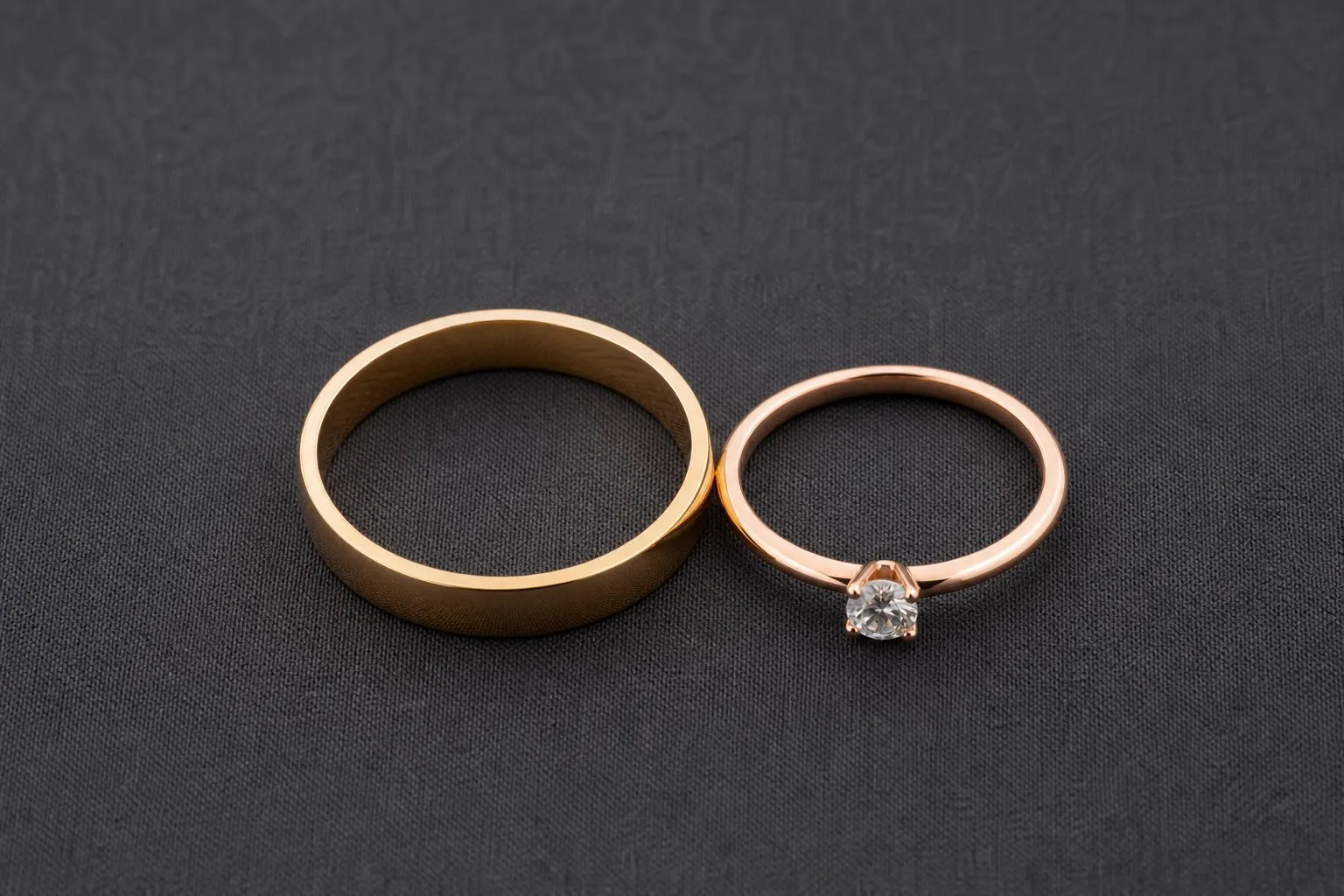
Order is reversible in a second. Soldering is not, and it is the one decision here that outlives the day you make it. Everything below comes from Brilliant Earth, a retailer, in its 2026 soldered rings guide, plus With Clarity in 2024.
What Soldering Actually Is
Brilliant Earth’s 2026 guide defines it physically: “soldered rings are two or more rings joined together using a metal alloy known as solder. This technique permanently bonds the rings.” The method is a torch, which “melts and fuses the rings at the joint.” Permanent is the operative word, and it is why the rest of this section exists.
When Jewelers Say It Is Worth Doing
Brilliant Earth names its own reasons in 2026: rings that “frequently spin or misalign on the finger,” design features “meant to complement each other” that do not line up worn separately, wanting “a more secure fit,” and “different metals in your rings (like platinum and gold) could cause friction and potential damage when worn together unsoldered.” A soldered set also has “more weight and stability,” making it “less likely to slip off.” The same guide says soldering is “typically” done after the wedding, and that “many jewelers recommend wearing the rings separately for a few weeks” first. The shopping side belongs to soldering a band to a solitaire, and the alternatives.
What It Commits You To
In Brilliant Earth’s own 2026 wording, “soldered rings can’t be worn individually,” and separating them “involves a jeweler cutting the solder joint and carefully refinishing the rings, which may leave slight marks.” The set becomes one object: no band alone at work, no engagement ring alone for an evening. That seller published a soldering cost in 2026 of “$185 to $200, depending on factors like ring material, design complexity, and the jeweler’s expertise,” which is its own range and not what jewelers in general charge.
What It Does to a Future Resize
Brilliant Earth publishes in 2026 that “adjusting the size of soldered rings is more complex and could incur higher costs,” because the jeweler “must carefully separate the rings, resize them individually, and then re-solder them.” With Clarity, in 2024, adds why that matters over years: “the area in where it was cut and soldered is naturally weaker than the rest of the ring,” and those cuts sit at “the bottom of the band, which is usually the part subjected to the most stress.” Staghead Designs says in 2026 that rings in black zirconium, Damascus steel, tungsten or titanium “cannot be cut and re-soldered” and mostly need a remake. That is Staghead on resizing, so the next step is our reading, not theirs: joining such a band to another ring is a different matter. Prices live in what a resize costs.
| Setup | What it commits you to | Effect on a future resize | Source |
|---|---|---|---|
| Soldered into one piece | The rings cannot be worn individually, and separating them means cutting the joint and refinishing, which may leave slight marks | More complex and possibly costlier: the jeweler may have to separate, resize individually, then re-solder | Brilliant Earth, 2026 |
| Ring guard | Nothing permanent: it holds the rings together temporarily | None of its own | Brilliant Earth, 2026 |
| Spacer band between the rings | Wearing a third ring, which reduces friction and movement | None of its own | Brilliant Earth, 2026 |
| Ring jacket encasing both | A decorative ring that keeps both in place | None of its own | Brilliant Earth, 2026 |
| Sizing bead inside one ring | A small metal bead that reduces effective diameter and stops the ring spinning | It is a sizing change in itself, so ask before adding one | Wikipedia, Ring size, general reference |
The Alternatives to Soldering
Three reversible options are published by the same 2026 guide, and a fourth answers a narrower problem. Each gives up something soldering delivers, which is the trade worth weighing before anyone lights a torch.
Guards, Spacers and Jackets
Brilliant Earth names all three in 2026. Ring guards are “a temporary solution that holds rings together without soldering.” Spacer bands are “thin bands worn between rings to reduce friction and movement.” Ring jackets are “decorative rings that encase both rings, keeping them in place.” None gives you the stability of one joined set, and a spacer or jacket means a third ring on the finger. Buying them belongs to soldering a band to a solitaire, and the alternatives.
A Bead for a Ring That Spins
Sizing beads answer one specific problem, a knuckle much wider than the base of the finger. The Wikipedia article on ring size, read here as a general reference rather than an authority, describes small metal beads added inside a ring to reduce its effective diameter, stop it spinning, and counterbalance a top-heavy ring. More in what sizing beads do to a loose ring.
Simply Wearing Them Apart
The option nobody frames as an option is leaving the rings separate: different fingers, different hands, or one ring day to day, which is the route GIA raises with its one-ring-per-hand suggestion. It costs nothing and can be undone every morning. If you are weighing whether the two need to live together at all, how the two rings differ helps.
How a Stacked Pair Wears Differently From One Band
Two rings on one finger are not one ring twice. They change the size question, they can rub against each other, and they can look mismatched in profile even when each is lovely alone.
Two Rings, One Size Question
Width drives the fit. Brilliant Earth’s 2026 width guide publishes that “a wider band will feel tighter than a narrower band in the same ring size,” that you “may need to size up by half a size” for a wider style, and that “narrower widths stack more comfortably.” GIA’s 2018 ring size guide adds that bridal sets “wider than 4 or 5 mm when the band and engagement ring are worn together require special consideration,” and says to consult your jeweler. Brilliant Earth also publishes that finger size changes with activity, hydration, temperature and diet. Start with find your ring size and what a curved inner edge changes about fit.
Profiles That Nest and Profiles That Do Not
Two rings meet along a surface, and its shape decides how they sit. Brilliant Earth’s 2026 band guide publishes that “stacking a flat band against a rounded shank, for example, can create a slight visual disconnect, while two rounded profiles tend to nest more naturally together,” that “trying the rings together is the best way to evaluate whether the stack feels balanced,” and that “poor alignment can lead to unnecessary wear over time.” Matching a band to a given stone shape is a shopping question our band pairing pages take.
When You Wear Only the Band
Plenty of people wear the band by itself for part of the week. GIA’s 2026 settings guide notes that raised prong edges “can sometimes catch on fabrics,” while a low profile is “unlikely to catch on clothing or gloves,” which is why the engagement ring often goes on after work. If a lower setting appeals, see a lower-profile setting to try a band against.
Which Setup Fits You?
Nothing here is etiquette. Each row below matches something you can verify on your own hand to the setup that answers it, and to the question worth asking a jeweler first.
If the Rings Spin or Sit Apart
Try the reversible fix before the permanent one. A guard or a spacer costs nothing you cannot undo, and it tells you whether the problem is really the pairing. If the rings still will not settle, soldering is the option built for exactly that.
If You Take Rings Off Often
Soldering is the weaker choice here, for the reason already established: a soldered set cannot be worn individually. If your week involves keeping the band and leaving the engagement ring at home, joining them removes that flexibility. The wedding day is its own question, answered in what to do with it on the wedding day itself.
If Your Size Is Likely to Change
Resize first and decide about soldering later, because a soldered set makes the resize more complex on the publisher’s own account, and an alternative metal may not take that route at all. Settle the size with find your ring size before anything is joined.
| If this is true | What fits | What to ask the jeweler |
|---|---|---|
| The rings spin and never line up | Try a guard or a spacer before soldering | Whether the misalignment is the profile or the size |
| The designs are meant to interlock and do not | Soldering is what this is for | Whether the joint will be visible once refinished |
| You remove rings for work every day | Keep them separate | Nothing yet: decide after a few months of wearing both |
| Your two rings are different metals | Ask before wearing them unsoldered long term | Whether friction between the two metals is a concern with your pair |
| Your finger size has changed before | Resize first, decide on soldering later | How many sizes your rings can take |
| One ring is an alternative metal such as tungsten or titanium | Expect a different route entirely | Whether that metal can be cut and re-soldered at all |
Frequently Asked Questions
Which goes first, engagement, and wedding ring?
Both orders are published and neither is a rule. GIA’s 2025 guide describes the wedding band going on first with the engagement ring above it, and also the engagement ring first with the band above, without preferring either. Whichever you pick, no named authority we found is contradicted by the choice.
What is the 2:1:1 rule in jewelry?
It circulates online as a styling guideline about how many pieces to wear together, and we could not find a named, dated publisher for it. Because no source we can point to defines it, this page states no version of it, and nothing about how your rings fit or wear depends on it.
Do you wear both an engagement and wedding band?
Most people wear both after the wedding, and nothing requires it. Some keep the band on during work hours and add the engagement ring afterward, some save the engagement ring for occasions, and some settle on one ring from the start. The pair is a custom, not an obligation.
Do you wear a wedding band under an engagement ring?
Yes, that is the more common arrangement in the United States, and it is a convention rather than a requirement. GIA’s 2025 guide names it as one of two published options. The practical reason people give is that a flat band sits neatly against the hand while the engagement ring stays visible above it.
How should I wear my engagement ring and wedding band?
The order is yours, so spend the decision on the three things that carry consequences. Soldering is permanent and takes away wearing either ring alone. Width changes the fit, since a wider band feels tighter at the same size. And a stack that spins usually has a size or profile problem underneath it.
Sources
- GIA 4Cs, “How to Wear Your Engagement Ring and Wedding Band”, 2025. https://4cs.gia.edu/en-us/blog/how-to-wear-engagement-ring-wedding-band/
- GIA 4Cs, “Ring Size Guide: Tips and Ring Size Chart”, 2018. https://4cs.gia.edu/en-us/blog/how-to-determine-ring-size-tips-and-ring-size-chart/
- GIA 4Cs, “Guide to Ring Settings”, 2026. https://4cs.gia.edu/en-us/blog/guide-to-ring-settings/
- Brilliant Earth, “Engagement Ring & Wedding Band Rules: 18 Traditions Worth Breaking”, 2026. https://www.brilliantearth.com/guides/engagement-ring-and-wedding-band-rules/
- Brilliant Earth, “Soldered Rings: Pros, Cons, and Alternatives”, 2026. https://www.brilliantearth.com/guides/soldered-rings/
- Brilliant Earth, “Ring Width Guide”, 2026. https://www.brilliantearth.com/guides/ring-width-chart/
- Brilliant Earth, “How to Choose a Wedding Band”, 2026. https://www.brilliantearth.com/guides/how-to-choose-a-wedding-band/
- Brilliant Earth, “Comfort Fit Ring vs. Standard Fit Ring: What’s the Difference?”, 2026. https://www.brilliantearth.com/guides/comfort-fit-ring-vs-standard/
- With Clarity, “Ring Resizing Demystified: The Complete Guide You Need”, 2024. https://www.withclarity.com/blogs/engagement-ring/all-about-ring-resizing
- Staghead Designs, “Frequently Asked Questions”, 2026. https://stagheaddesigns.com/pages/faqs
- Wikipedia, “Ring size”, undated article, accessed 11/09/2026. https://en.wikipedia.org/wiki/Ring_size