

A ring size conversion chart turns a size in one country’s system into its equivalent in another, so a US number becomes a British letter, a European number or an ISO size. The only figure that travels intact between every one of those systems is the measurement in millimeters, because the same US size has more than one published UK letter depending on which chart you read.
What is on this page8 sections
Key Takeaways
- On the ISO scale the size number is the inside circumference in millimeters, so an ISO 52 is a ring about 52 mm around the inside (ISO 8653:2016).
- The US size is an index rather than a dimension. The Bureau of Standards reported in 1921 that no printed statement of what the sizes are supposed to measure could be found.
- Three named charts give three different UK letters for a US 6: GIA prints L, Wikipedia and Brilliant Earth print L 1/2, Tiffany prints M.
- Take the diameter and the circumference from the same chart. Mixing two publishers is what produces a size that is off.
- When you order abroad, give the seller the inside circumference in millimeters and let it convert with its own chart.
Ring Size Conversion Chart (US, UK, Europe and ISO)
The diameter and circumference columns below are Tiffany’s published figures. Three UK columns appear because three named sources publish three different letters, and the ISO column repeats the circumference because on that scale the size number is the circumference.
| US size | Inside diameter, mm (Tiffany) | Inside circumference, mm (Tiffany) | ISO size | UK (Tiffany) | UK (GIA) | UK (Wikipedia) | Europe (Jared) |
|---|---|---|---|---|---|---|---|
| 4 | 14.9 | 46.8 | 46.8 | H 1/2 | H | H | 47 |
| 5 | 15.7 | 49.3 | 49.3 | J 1/2 | J | J 1/2 | 50 |
| 6 | 16.5 | 51.9 | 51.9 | M | L | L 1/2 | 52 |
| 7 | 17.3 | 54.4 | 54.4 | O | N | N 1/2 | 54 |
| 8 | 18.1 | 57.0 | 57.0 | Q | P | P 1/2 | 57 |
| 9 | 18.9 | 59.5 | 59.5 | S | R | R 1/2 | 60 |
| 10 | 19.8 | 62.1 | 62.1 | T 1/2 | T | T 1/2 | 62 |
| 11 | 20.6 | 64.6 | 64.6 | V 1/2 | V | V 1/2 | 65 |
| 12 | 21.4 | 67.2 | 67.2 | Y | X | X 1/2 | 67 |
| 13 | 22.2 | 69.7 | 69.7 | Z+1 | Z.5 | Z 1/2 | 70 |
How to Read the Chart
Diameter is measured straight across the inside of the band, wall to wall. Circumference is the distance around that same opening, which is what a strip wrapped around a finger gives you. The practical tell is the size of the number: a figure in the teens is a diameter, one in the forties through the seventies a circumference. Sizing a gift with no number at all, start from what jewelers report as the average ring size for women.
Which Column You Need
Match the column to the seller rather than to your own country. A British or Irish jeweler wants a letter, a French or German one wants a number in the fifties or sixties, and an ISO reference wants the circumference. If the seller publishes its own size guide, that guide’s column wins over this one every time. For sizes above the range printed here, the men’s ring size chart carries the larger end.
If You Already Have a Millimeter Measurement
A millimeter reading can be read straight against the chart above, in the diameter column or the circumference column depending on which of the two you took. Everything about producing that reading in the first place, including our printable ring sizer and the US ring size chart, lives on the tool.
What Each Ring Sizing System Measures
The four systems in an international ring size chart do not measure the same thing in the same unit, and one of them does not describe a physical dimension at all. Here is what each number actually is.
| System | What the number is | Form it takes | Who publishes a column for it |
|---|---|---|---|
| US and Canada | An index with no defined dimensions; quarter steps of about 0.032 in of inside diameter (Wikipedia) | Numbers, in half and quarter steps | Tiffany, Kay, Jared, Blue Nile, GIA, Larson, Brilliant Earth, Fred Meyer |
| UK, Ireland and Australia | A letter position on a scale, converted per publisher | Letters, with half and quarter steps | Tiffany, GIA, Wikipedia, Brilliant Earth, and they disagree |
| Europe and ISO | The inside circumference in millimeters1 | Numbers, roughly 41 to 76 | ISO 8653:2016; Jared as European Size, Brilliant Earth as France |
| Japan and East Asia | A separate scale of whole numbers, neither the US index nor the millimeter circumference | Whole numbers | GIA and Brilliant Earth publish an Asia column, Wikipedia an East Asia column; no per-size value is published on this page |
1 source cited in this table
The US and Canadian Scale
The US number is an index, not a dimension. The Bureau of Standards reported in 1921 that “All attempts to find any printed statement as to what the dimensions of the various sizes are supposed to be, have been unsuccessful.” The same circular recorded two gauge makers giving different diameters for the same sizes. Wikipedia describes the modern scale as quarter steps, with whole sizes differing by 0.032 in of internal diameter. So a size chart for rings US sellers publish is a retailer’s chart, not a national standard.
The UK, Ireland and Australia: Letters
The British scale uses letters, with half steps and occasionally quarter steps between them, so in places the step is finer than a US half size. Tiffany, GIA, Wikipedia and Brilliant Earth each publish a UK column, and they do not agree with one another. Ireland and Australia appear on the same letter scale in the charts that list them together, which is the only basis for treating the three as one system.
Europe and ISO: The Circumference in Millimeters
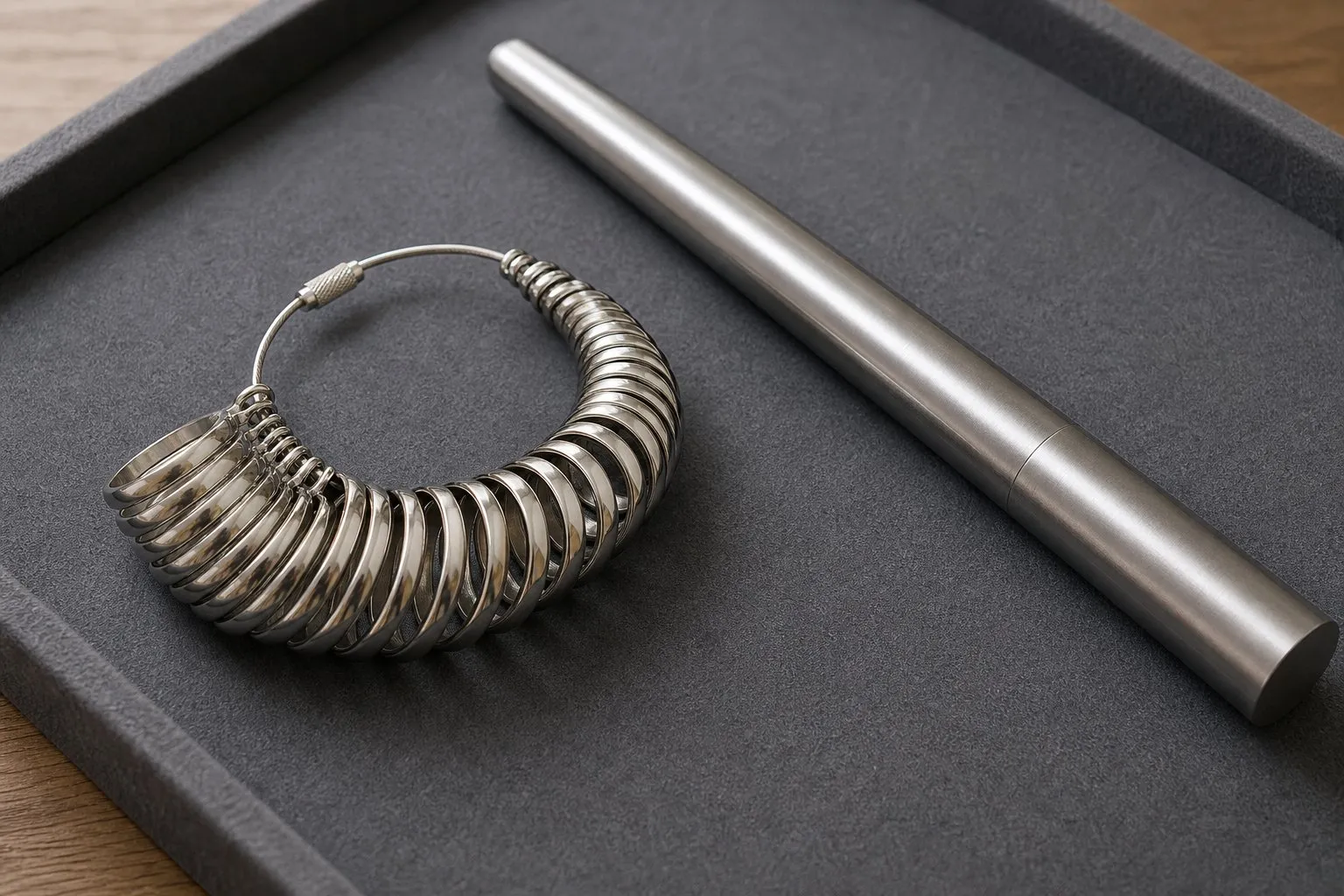
This is the clearest system on the page. ISO 8653:2016 defines ring size as the “circumference of the bigger cylinder that could be inserted in the ring”, and sets the range from 41 to 76. Because the number is the circumference, an ISO 52 is a ring about 52 mm around inside, and the ring stick runs from 13.05 mm of diameter at the bottom to 24.19 mm at the top. The European numbers Jared prints as European Size and Brilliant Earth as France sit on that scale.
Japan and East Asia: A Separate Integer Scale
Japanese and other East Asian sizes run on a separate scale of whole numbers that is neither the US index nor the millimeter circumference. GIA and Brilliant Earth each publish an Asia column and Wikipedia publishes an East Asia column, but no per-size value from any of them was recorded for this page, so no Japanese number appears here at all. Send the seller your inside circumference instead and let it convert.
A Conversion Is Only as Good as the Chart It Came From
Across the charts read for this page, the millimeters hold steady to a few tenths while the letters do not. That gap is the reason to care which publisher a conversion came from, and the three points below are the whole caution.
Three Charts, Three UK Letters for a US 6
This is the sharpest published contradiction in the set. For a US 6, GIA prints L, Wikipedia and Brilliant Earth both print L 1/2, and Tiffany prints M, all read on the same day. No arbiter exists to make one of them the right answer, which is why all three sit side by side in the chart above rather than being resolved into one. Our ring sizer records how far the published charts disagree in millimeters, size by size.
Never Mix Two Charts
The damage comes from pairing one jeweler’s diameter with another jeweler’s circumference, because the two publishers were never describing the same ring. Take both numbers from a single column. The ranges do not line up either: Brilliant Earth and Tiffany stop at US 13, Kay, Jared, Blue Nile, GIA and Larson reach 13.5, and Fred Meyer starts at US 5. A size can exist on one chart and not on another.
The One Published Formula and the One Published Tolerance
Wikipedia is the only source read here that publishes a formula: circumference equals 2.55 times the US size plus 36.5, and diameter equals 0.8128 times the US size plus 11.63. Its own table does not match that formula at every row, giving 51.9 mm at a US 6 where the formula returns 51.8 mm, and the article carries an original research maintenance banner. The single tolerance in ISO 8653:2016, plus or minus 0.02 mm, belongs to the ring stick, the jeweler’s measuring gauge. It is no tolerance on a ring, a finger or a printed chart.
Converting Millimeters, Centimeters and Inches
Every system above is reachable from one millimeter measurement, which makes this part arithmetic rather than lookup. Most of the errors that reach a jeweler are unit errors, and there are only two of them worth watching.
Diameter or Circumference, and How to Tell Which You Have
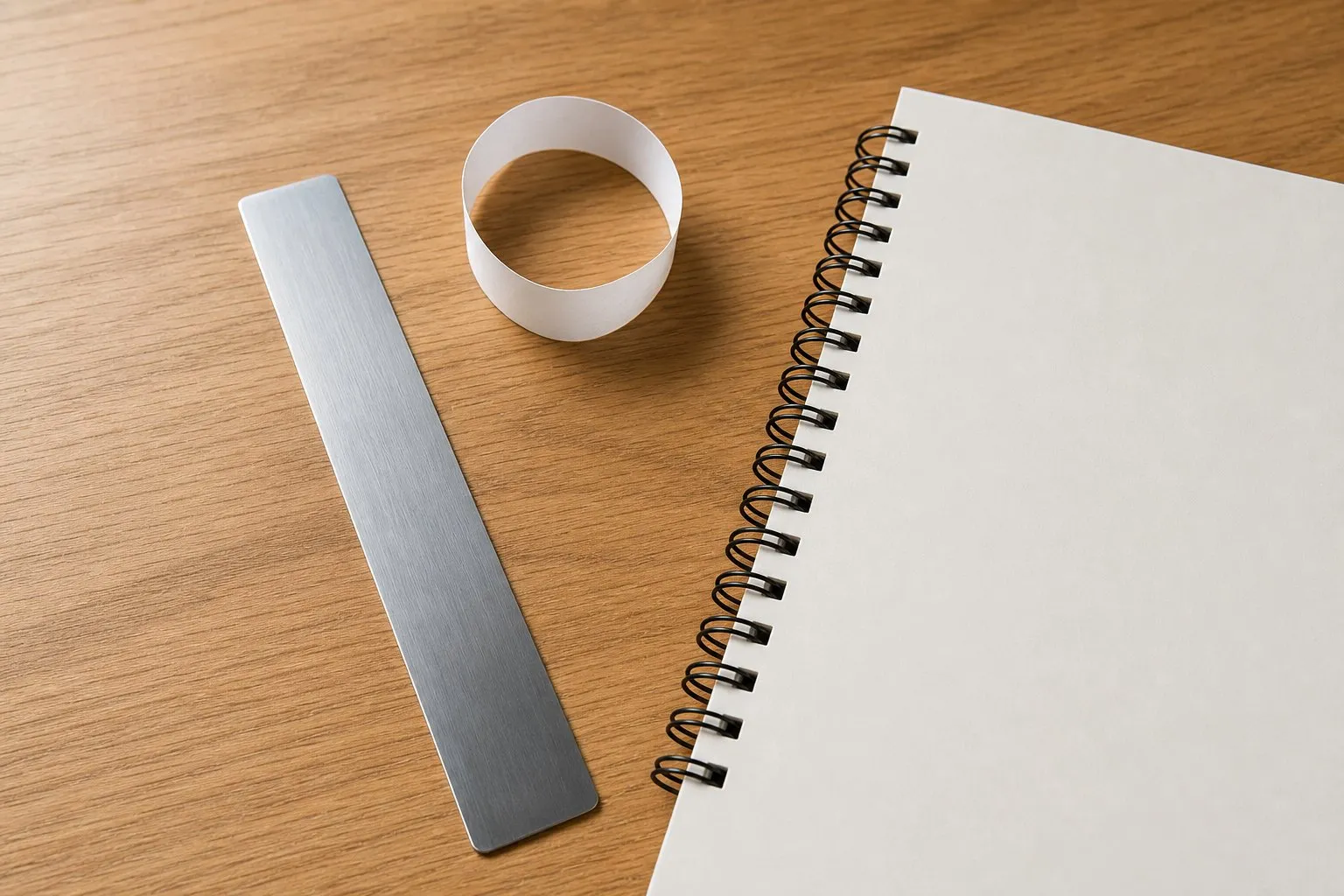
Circumference is about 3.14 times the diameter, so the two are never close enough to confuse once you know which you hold. A string or paper strip taken around the finger gives a circumference. A measurement across the inside of a ring you already own gives a diameter. Reading to the outside edge of a band rather than the inside is the common way to land a size too large.
Centimeters and Inches
Centimeters convert to millimeters by moving the decimal one place, so 5.19 cm is 51.9 mm and reads against the circumference column. Inch conversions here are our own arithmetic rather than Tiffany’s published figures: a measurement of 2.5 inches taken around the finger works out at roughly 63.5 mm, near the top of the chart above. An inch figure taken across a band is a diameter and belongs in a different column entirely.
Ordering From a Jeweler in Another Country
Ordering abroad is where a conversion error turns into a shipping problem rather than a walk back to the counter. The table below is the short version, case by case, and three habits do most of the work.
| Your situation | What to do | Why |
|---|---|---|
| Ordering from a British or Irish jeweler | Send the inside circumference in millimeters and ask which chart it uses | Three named charts give three different UK letters for the same US size |
| Ordering from a French, German or Italian jeweler | Give the circumference in millimeters; that number is the European size | On the ISO scale the size number is the circumference in millimeters1 |
| Ordering from a Japanese or other East Asian seller | Send the millimeters and ask the seller to convert | No Japanese per-size value is published on this page, and the charts that publish one were not recorded here |
| The seller publishes its own size guide | Use that guide’s numbers only | Published charts differ; pairing two charts is what produces the wrong size |
| You are between two sizes | Take the larger | Tiffany and Blue Nile both advise the larger size |
| The band is wide | Consider half a size up, or ask to be measured on that width | Wider styles feel tighter at the same measured size2 |
| The ring is silver, tungsten or another alternative metal | Confirm the size before ordering and check the exchange terms | Blue Nile cannot resize these and offers an exchange instead |
| You only have a millimeter reading and no chart you trust | Read it against the chart above, taking both figures from one column | The damage comes from mixing a diameter from one chart with a circumference from another |
2 sources cited in this table
Send Millimeters, Not a Letter
One instruction survives every disagreement above: give the seller the inside circumference in millimeters and let it convert with its own chart. The letters are where the publishers part company, so handing over a letter hands over somebody else’s conversion along with it. A figure in millimeters means the same thing in every country that prints a chart.
Ask Which Chart the Seller Uses
If a seller publishes its own size guide, use that guide’s numbers and no others, even where they differ from the chart above. A jeweler measuring you with a ring stick is working to the standard’s finger gauge definition, where the customer is sized with a ring matched to the stick, and that is the closest thing to a shared reference between countries.
Check the Resizing Terms First
A conversion error is only cheap if the ring can be resized or exchanged. Blue Nile states that silver rings and rings in alternative metals such as tungsten cannot be resized and offers an exchange instead, so check which metals can be resized and which cannot before you order. Tiffany and Blue Nile both advise taking the larger size when you fall between two, and Blue Nile suggests half a size up for wide styles, which is why a wide band fits tighter at the same size.
Frequently Asked Questions
What Is a Size 7 Ring Equivalent To?
A US size 7 is 17.3 mm across the inside and 54.4 mm around it on Tiffany’s chart, which places it at ISO 54. The UK letter depends on who published the conversion: Tiffany prints O, GIA prints N and Wikipedia prints N 1/2. Jared’s European column gives 54 for the same ring, matching the circumference.
What Is 7 Inches in Ring Size?
Seven inches around the finger comes to about 178 mm on our own arithmetic, which is far past the end of every ring size chart, since the largest ISO size is 76. A reading that size is usually a wrist, or a paper strip measured end to end rather than at the overlap. Measure again around the base of the finger.
What Size Ring Do I Wear if My Finger Is 2.5 Inches?
A finger measuring 2.5 inches around comes to roughly 63.5 mm, which falls between US 10 and US 11 in the chart above. Take the larger of the two, which is the advice Tiffany and Blue Nile both publish. If that figure was taken across a ring rather than around a finger, it is a diameter and no chart here covers it.
How Do I Know My Ring Size 6 7 or 8?
US 6, 7 and 8 sit one full size apart, and the chart above gives an inside diameter and an inside circumference for each, so the choice is a measurement rather than a guess. If you own a ring that fits the same finger, measure across the inside and read the diameter column. Otherwise ask a jeweler to size you with a finger gauge set.
How Can I Tell My Ring Size Without Measuring?
Not reliably: every route to a size ends in a measurement, either of the finger or of a ring that already fits it. The nearest shortcut is to borrow a ring worn on that finger and have a jeweler read it on a ring stick. The at-home methods and the printable sizer live on our ring sizer.
Sources
- International Organization for Standardization, ISO 8653:2016 Jewellery. Ring-sizes. Definition, measurement and designation, 2016 (clauses 1 to 4, public preview).
- S. W. Stratton, Circular of the Bureau of Standards No. 43: Jewelers’ and Silversmiths’ Weights and Measures, 2nd edition, United States Department of Commerce, 1921, section VII.
- Wikipedia, Ring size, accessed 11 September 2026.
- Tiffany & Co., Ring Size Guide, undated, accessed 11 September 2026.
- Jared, Ring Size Guide, undated, accessed 11 September 2026.
- Brilliant Earth, Ring Size Chart, undated, accessed 11 September 2026.
- GIA, How to Determine Ring Size: Tips and Ring Size Chart, 18 January 2018, accessed 11 September 2026.
- Blue Nile, How to Measure Your Ring Size, undated, accessed 10 September 2026.
- Larson Jewelers, Ring Sizing Chart for US Sizes, undated, accessed 11 September 2026.