

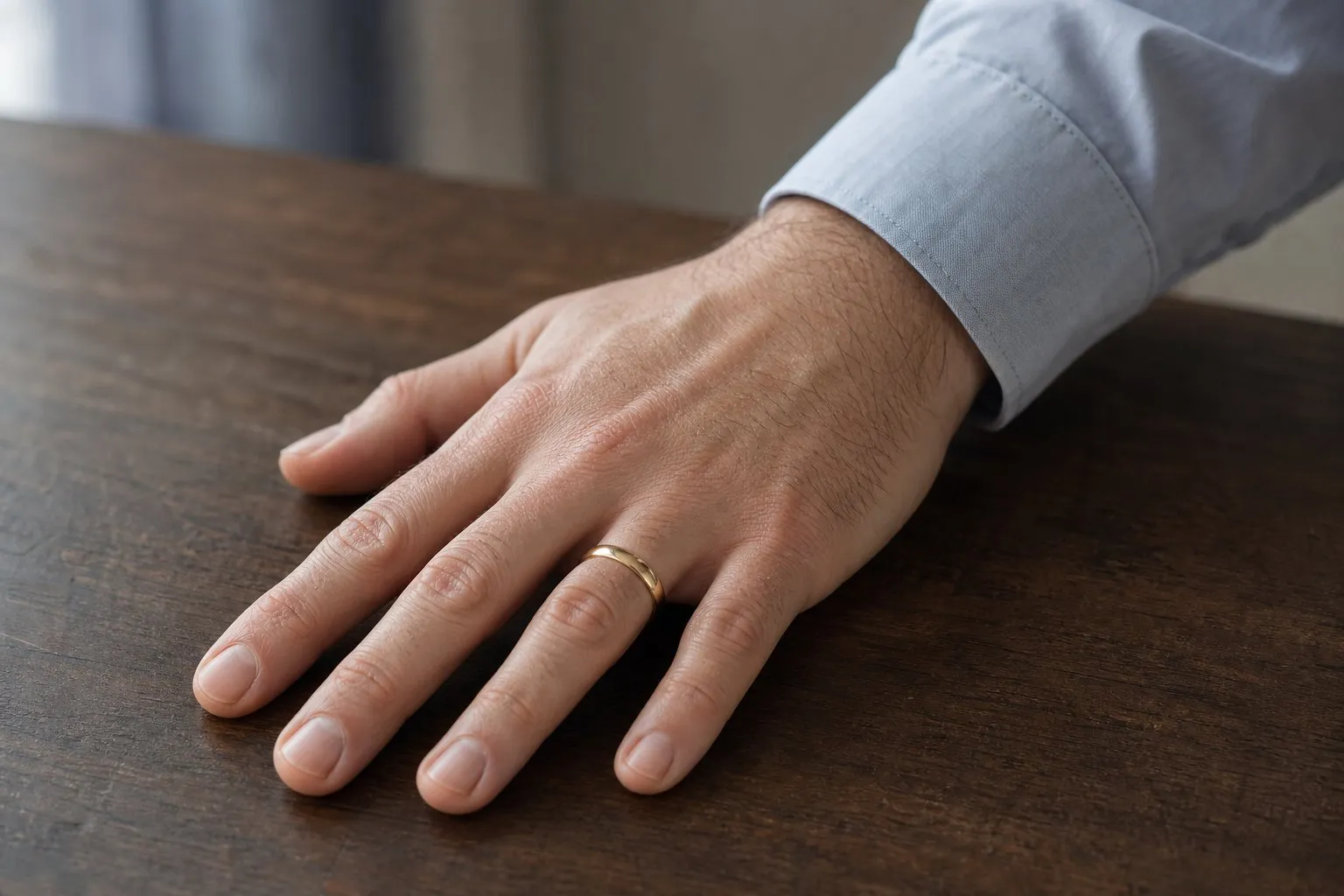
Readers who type “do men wear engagement rings” meet a percentage in the first line of almost every result. The honest answer needs no percentage: yes, some men wear one, mainstream jewelers sell them, and nothing about it is unusual. What nobody says out loud is that no survey, trade body or study publishes a checkable figure for how many men do, so this guide says that plainly instead. In its place goes what can be traced: an industry attempt to sell engagement rings to men that failed, the men’s wedding band that succeeded instead, and the practical questions that follow from wearing a ring daily from the proposal onward.
What is on this page8 sections
Key Takeaways
- Some men wear an engagement ring, and no authority publishes a rule either way. Brilliant Earth’s 2026 guide says there are no strict rules about which finger or hand a ring goes on.
- A statistic credited to a Jewelers of America market report circulates widely, and we could not verify it: the pages named as its source were opened and it was not on them.
- In 1926 jewelry manufacturers and retailers ran an industry-wide push to make male engagement rings a thing, and JSTOR Daily (2017) calls it a “colossal failure.”
- The men’s wedding band took hold instead, in the 1940s, so wearing an engagement ring today means doing something the trade never standardized.
- Resizability matters most: GIA (2025) reports gold resizes up to two sizes while tungsten cannot be resized.
The Short Answer, and the Number Nobody Has
Yes, and the answer has two halves: men do wear engagement rings, and how many is not something published data can tell you.
What Can Be Said Without a Statistic
Men wear engagement rings, large jewelers sell them, and nothing in the etiquette record forbids it. Brilliant Earth’s 2026 guide to ring rules tells its own readers there are no strict rules about which finger or hand the wedding ring should be worn on, a seller saying the convention is open. What counts as normal cannot be settled with a number.
The Figure Circulating Online That We Could Not Verify
A statistic credited to a Jewelers of America market report turns up constantly on jewelry blogs and inside search summaries, presented as the adoption rate for men’s engagement rings. When the pages the search engine named as its source were opened and read, the statistic was not on them and neither was the citation. We could not verify it, so it appears nowhere here, and nor do the blogs that repeat it. A reader working out whether a men’s engagement ring is normal is being handed a figure nobody can trace.
Why No Reliable Number Exists
The wedding industry’s ring surveys are built around spend and purchase behavior, not around who wears a second ring. One survey figure often quoted here found that most ring buyers were men, which measures who paid and answers a different question. No trade body publishes a wearing rate, and an absence of data is not evidence that few men wear one.
What Is Actually Documented About Men and Engagement Rings
The record has a clear shape once trend claims are set aside: an attempt to create this market failed, a different men’s ring succeeded twenty years later, and the older betrothal record runs one way.
The 1926 Campaign That Failed
According to JSTOR Daily (2017), jewelry manufacturers and retailers launched an industry-wide push in 1926, using radio ads, newspaper ads and window displays, to make male engagement rings a thing, and the effort was a “colossal failure.” The point is not that the idea is doomed but that it is old, and that it did not fail for want of marketing money or shelf space.
How the Men’s Wedding Ring Won Instead
The same JSTOR Daily article, drawing on a 2003 paper by the historian Vicki Howard, describes how the jewelry industry and changing cultural norms created the two-ring ceremony in the 1940s. Double ring ceremonies were not unknown before World War II but were uncommon, and when men went to fight, wedding rings offered a tangible link to their wives back home. That is the payload: the men’s wedding band became standard inside one generation while the men’s engagement ring never did. See how an engagement ring differs from a wedding ring.
What the Older Betrothal Record Shows
Further back, the documented betrothal ring runs one way. Pliny the Elder records that an iron ring, with no stone in it, was sent to a woman when she was betrothed. Pope Nicholas I, writing in 866, describes the betrothed man joining the bride to himself through the finger he has marked with the ring of faith. Annie Randall White’s Twentieth Century Etiquette of 1900, the most detailed American ring etiquette of its day, assigns both rings to the bride, down to the bridegroom removing hers at the altar. So there is no old tradition of a man wearing one to appeal to, and nothing there says whether he should. Hand and finger: what hand a wedding ring goes on.
What Men Who Want One Actually Buy
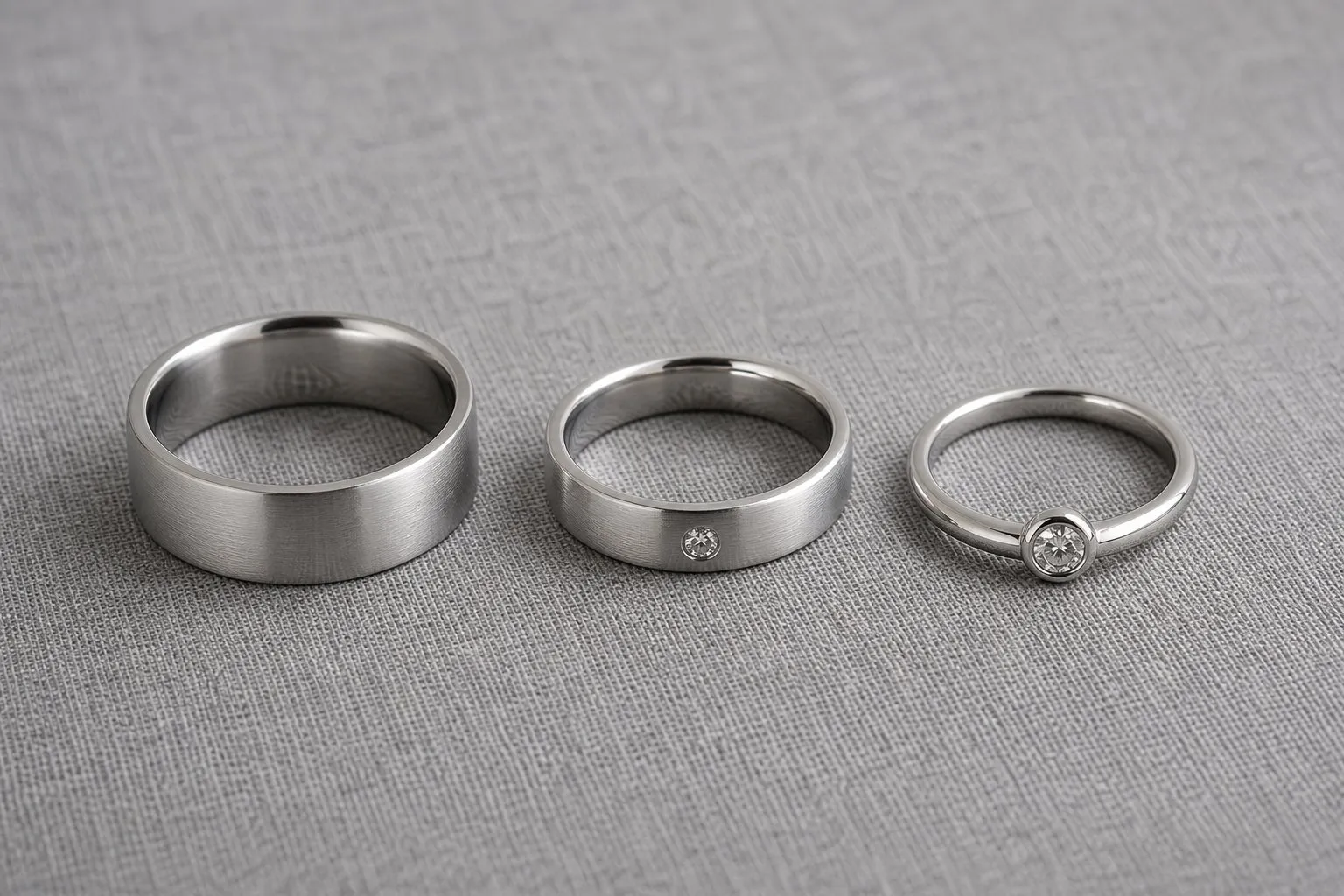
In practice the choice is a plain band or a set stone, and then how high that stone sits. No published price belongs to a men’s engagement ring.
| What he buys | What it is | The practical consequence | Source |
|---|---|---|---|
| Plain band, no stone | The same object most men wear as a wedding band | Reads as a wedding band to most people, and keeps the later choice open | This page’s framing |
| Flush or inset stone | The stone sits down inside the band | Highly durable and unlikely to catch on clothing or gloves, but admits less light than a bezel or prong | GIA 4Cs, 2026 |
| Bezel set stone | Metal wraps the stone’s perimeter | Smooth edges are less likely to catch, which GIA calls practical for people who work with their hands | GIA 4Cs, 2026 |
| Prong set stone | Metal claws hold the stone above the band | Maximum light into the stone, and raised edges that can sometimes catch on fabrics | GIA 4Cs, 2026 |
| Channel set row | Small stones in a groove between two metal walls | Durable and less likely to catch than prong-set accents, but difficult to resize if the stones run far around the band | GIA 4Cs, 2026 |
| Wide band, 5mm or more | The usual men’s width range | Feels tighter than a narrow band in the same size, so it may need half a size up | Brilliant Earth, 2026 |
A Plain Band, Worn From the Proposal
The common choice is a plain band with no stone, the same object most men wear as a wedding band, and that raises the one real question behind the purchase: whether this ring becomes the wedding band or is joined by a second one. Neither route is better, and a plain gold band keeps both open, for the resize reason below.
A Set Stone, and Which Settings Sit Low
For a man who wants a stone, setting height is the decision, and GIA’s 2026 guide to ring settings answers it. A flush setting’s low profile makes it highly durable and unlikely to catch on clothing or gloves, though it admits less light than a bezel or a prong. A bezel’s smooth edges are less likely to catch, which GIA calls practical for people who work with their hands. Prong edges can sometimes catch on fabrics, and channel-set rings can be difficult to resize where the stones run far around the band. Blue Nile’s 2026 bezel guide, describing its own catalog, mentions bezel set center stones on men’s engagement rings. See what a bezel setting protects.
Width, and Why It Changes the Size
Brilliant Earth’s 2026 ring width guide reports that men’s wedding bands are generally 5mm and wider, and that a wider band feels tighter than a narrower band in the same ring size, so a wider style may need sizing up by half a size. That is easy to walk into: a first ring is often sized on a thin plastic sizer, then ordered much heavier. See how wide a men’s band usually runs and finding his ring size.
What the One Dated Spending Figure Covers
One named, dated figure is worth quoting here, and it is not an engagement ring figure. National Jeweler, reporting The Knot’s 2019 Jewelry & Engagement Study, put the average men’s band at $510, with tungsten at 23 percent and white gold at 21 percent as the top materials. That is a wedding band figure, and no equivalent exists for a men’s engagement ring. See what people actually spend.
The Practical Questions Nobody Answers
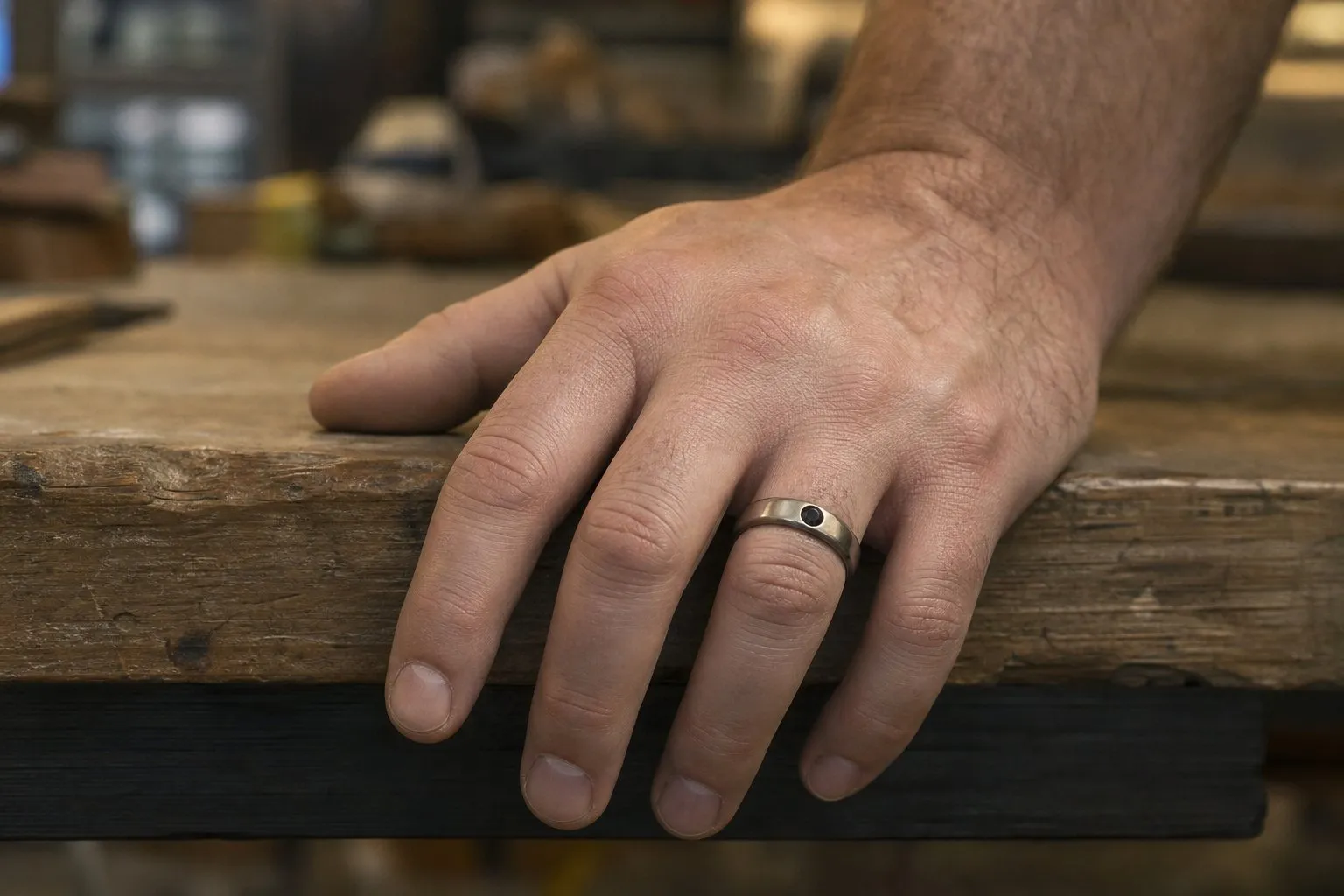
A ring worn from the proposal is worn years longer than one put on at a ceremony, which changes what matters: resizing, the band that arrives later, stone height at work, and skin.
| Metal | Can it be resized? | What the source says |
|---|---|---|
| Gold | Yesup to two sizes | GIA 4Cs, 2025: gold rings can be resized if necessary, offering flexibility for long-term wear |
| Platinum | Yesbut expensive to resize | GIA 4Cs, 2025, everyday-wear table |
| Titanium | Limited to about half a size | GIA 4Cs, 2025: the metal’s hardness makes resizing challenging if your finger size changes |
| Tungsten carbide | No | GIA 4Cs, 2025: due to their brittleness, tungsten rings cannot be resized |
| Black zirconium, Damascus steel | Usually a full remake | Staghead Designs, 2026: these cannot be cut and re-soldered, so most size changes require a remake |
Can It Be Resized Later?
This comes first because fingers change over decades. GIA’s 2025 guide to everyday-wear ring materials is the authority: gold rings can be resized if necessary, platinum is expensive to resize, titanium resizing is challenging because of the metal’s hardness, and tungsten cannot be resized at all because of its brittleness. Staghead Designs states in its 2026 FAQs that black zirconium, Damascus steel, tungsten and titanium cannot be cut and re-soldered, so most size changes require a full remake. One caution belongs with that: in a 2024 JBJS Case Connector report by Quinto and Dowbak, a man who cut a tungsten carbide ring off his own finger with a high-speed metal burr developed wet gangrene and needed an amputation. See getting a ring off a swollen finger and what a resize costs.
Wearing It With a Wedding Band Afterward
The question the competitors skip is what happens when the wedding band arrives. Three routes exist: the engagement ring becomes the wedding band, both are worn on one finger, or they go on different hands. GIA (2025) describes wearing the engagement ring on the right hand with the wedding band on the left as one option. Order and stacking belong to their own guide.
When a Raised Stone Is Wrong for the Job
This is where setting height stops being a style question. On GIA’s account, prong edges can sometimes catch on fabrics, while flush and bezel profiles are less likely to catch on clothing or gloves. Plenty of people wear a plain band through the working day and add the ring afterward, which is an answer rather than a compromise. Trades with hand hazards of their own have their own pages.
Skin, Metal and All-Day Wear
A ring worn daily from the proposal sits against skin far longer than one first put on at a ceremony, so the metal deserves more thought than its color: see the metals compared side by side, and if you have reacted to jewelry before, rings for skin that reacts to metal. Brilliant Earth’s 2026 rules guide notes that both rings are traditionally made from the same metal but do not have to be.
Choosing One Without a Rule to Follow
Because no authority sets a rule, this is a purchase decision rather than an etiquette question, and it turns on trade-offs you can actually check before you order.
| Your situation | What fits | What to check first |
|---|---|---|
| You want one ring for the engagement and the marriage | A plain band you would be happy wearing for decades | Whether the metal can be resized later |
| You want a stone but work with your hands | A flush or bezel profile | How far the stone stands off the band when you make a fist |
| You expect your finger size to change | Gold or platinum rather than tungsten | That the jeweler will resize what they sell you |
| You want it invisible as an engagement ring | A narrow plain band | How it looks beside the band you may add later |
| Both of you want to wear one from the proposal | Two rings chosen separately, matching or not | That each ring has its own resize future |
| You have reacted to jewelry before | A metal chosen for skin contact, not for looks | The alloy, not just the color, before ordering |
If Both of You Want to Wear One
Some couples want a ring each from the engagement, and treating that as a purchasing decision makes it easier. Two consequences follow. The pair does not have to match in metal or width, since Brilliant Earth’s 2026 guide says as much about wedding rings. And each ring has its own resize future, so one decision need not cover both.
If You Want a Ring That Reads as Everyday
If the goal is a ring that prompts no questions, the answers are a low profile and a narrower width than the usual men’s range, on the GIA settings material already quoted. Said plainly: a plain band reads as a wedding band to almost everyone who sees it.
The Conversation Before the Purchase
With no rule to follow, what settles this is the two of you agreeing what the ring is for, and whether it becomes the wedding band later or sits alongside a second one. That answer decides the metal, the width and whether a stone makes sense, and it is worth having before you order.
Frequently Asked Questions
Is It Normal for Guys to Wear Engagement Rings?
Yes. Men wear them, jewelers sell them, and no authority publishes a rule against it. How common it is cannot be answered with a number, because no survey or trade body publishes a wearing rate, and the figures circulating online do not trace to the reports credited.
Do Men Get Engagement Rings If They Propose?
Proposing changes nothing. Some men who propose get a ring of their own and some do not, because nothing in the published record attaches a ring to whoever asked the question. If you wanted a convention that settles it either way, there is none.
Are You Supposed to Get Your Man an Engagement Ring?
No obligation is published anywhere. The most detailed American ring etiquette of its day, Annie Randall White’s Twentieth Century Etiquette of 1900, put both rings on the bride, but that is what one writer prescribed then, not what anyone owes now. It is a gift decision.
Do You Get Engagement Rings for Men?
Yes, mainstream jewelers sell them, and the choices that matter are setting height and metal. Flush and bezel profiles are the ones GIA (2026) describes as least likely to catch on clothing or gloves, and the metal decides whether the ring can ever be resized.
What Is the 3 Month Ring Rule?
Two different claims circulate under that name, one about how long to date before proposing and one about months of salary spent on the ring. No named, dated authority publishes either as a rule. For what dated sources say, see what people actually spend.
How Much Should I Spend on an Engagement Ring if I Make $100,000 a Year?
No authority publishes a salary multiple, so there is no share of income to apply. Published averages describe what buyers spent, not what anyone should spend at a given income. The dated figures, and what each measures, are set out in what people actually spend.
Sources
- JSTOR Daily, Selling the Men’s Wedding Ring, 2017.
- Pliny the Elder, translated by John Bostock and H. T. Riley (Perseus Digital Library), The Natural History, Book XXXIII, Chap. 4: The Origin of Gold Rings, undated.
- Pope Nicholas I, translated by W. L. North (Internet History Sourcebooks, Fordham University), The Responses of Pope Nicholas I to the Questions of the Bulgars A.D. 866 (Letter 99), 866.
- Annie Randall White (Internet Archive), Twentieth Century Etiquette, 1900.
- National Jeweler, reporting The Knot 2019 Jewelry & Engagement Study, The Average Amount Spent on an Engagement Ring Is …, 2019.
- Brilliant Earth, Ring Width Guide, 2026.
- Brilliant Earth, Engagement Ring & Wedding Band Rules: 18 Traditions Worth Breaking, 2026.
- GIA 4Cs, The Best Ring Material for Everyday Wear, 2025.
- GIA 4Cs, Guide to Ring Settings, 2026.
- GIA 4Cs, How to Wear Your Engagement Ring and Wedding Band, 2025.
- Staghead Designs, Frequently Asked Questions, 2026.
- Blue Nile, Guide to Bezel Settings, 2026.
- Quinto ES Jr, Dowbak JM, Digital Thermal Necrosis Resulting in Amputation After Removing a Tungsten Carbide Ring With a High-Speed Metal Burr, JBJS Case Connector, 2024.