

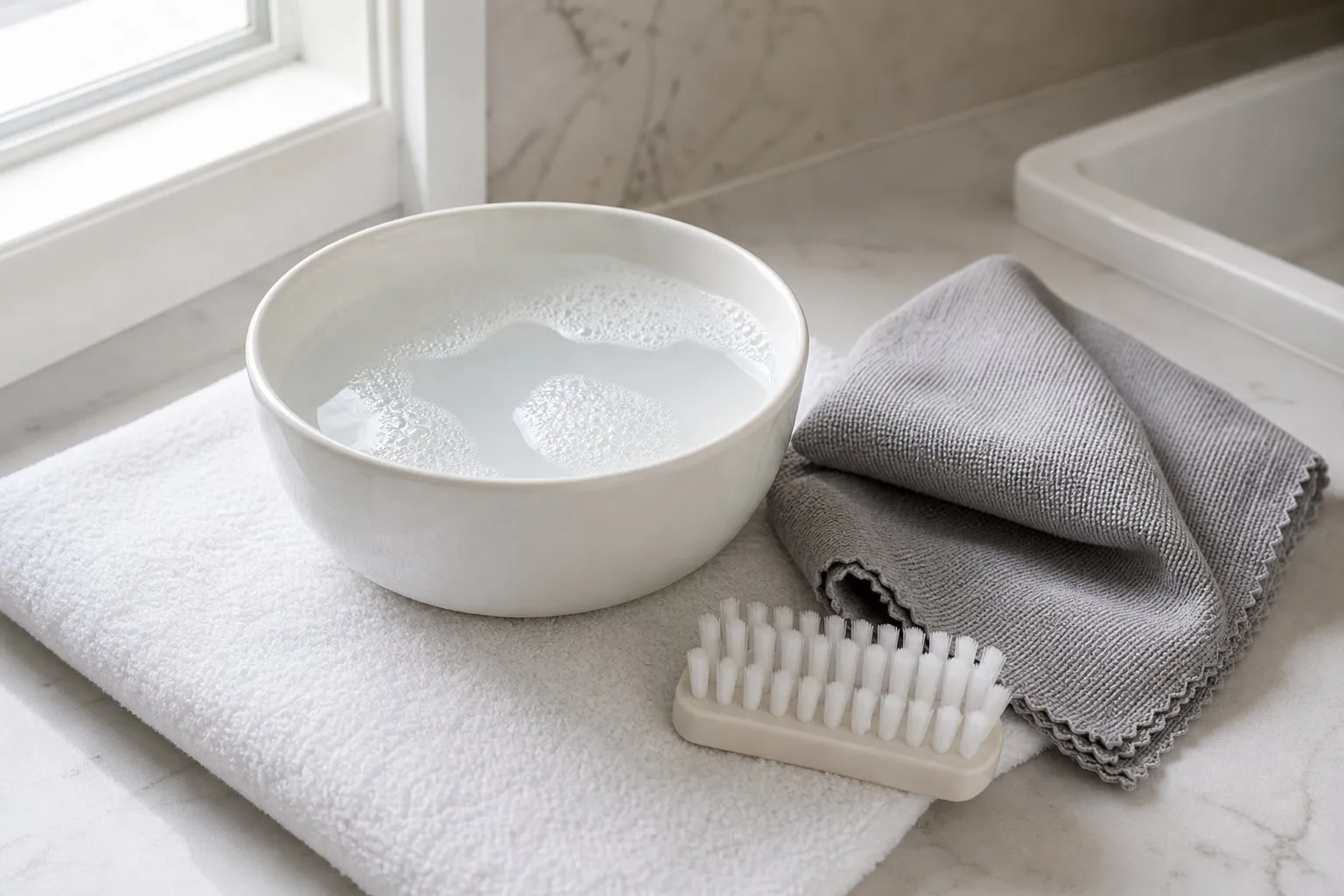
The standard answer to how to clean an engagement ring is warm water, a mild dish soap and a soft brush, the published starting point for most rings. Whether it is safe for yours is decided by three things that instruction assumes: that the stone is hard enough to brush, that the finish is the metal rather than a coating, and that no second ring is soldered to it.
GIA’s published method, step by step lives on our diamond ring guide, and this page does not repeat it. It takes up a line from GIA’s own cleaning guide instead: not all gemstones are as hard as diamonds, and some can easily be scratched with a toothbrush. Almost every guide on this subject is written as though the stone in front of you were a diamond.
What is on this page7 sections
Key Takeaways
- GIA writes that not all gemstones are as hard as diamonds and some can easily be scratched with a toothbrush, so the brush is a hazard before the soap is.
- GIA puts sapphire and ruby at Mohs 9, emerald and morganite at 7.5 to 8, and says colorless zircon at 6 to 7.5 requires more care.
- Emerald fractures are commonly filled with oil, resin or wax (GIA, 2015), and no source we found publishes an at-home method for a filled stone.
- GIA says rhodium plating wears away and needs replating, and that soaps and shampoos dull it, so a dull white gold ring may need a jeweler.
- A soldered pair cannot be worn or cleaned separately, says Brilliant Earth, which makes the seam bench work.
Before You Clean It, Work Out What You Own
The method is short and already published. The risk sits in what the ring is made of, and four things decide whether the generic instruction applies to yours. All four can be settled before anything gets wet.
A Center Stone Is Not Automatically a Diamond
GIA describes diamond as typically about 99.95% carbon, a material that can only be scratched by another diamond. That is why a diamond tolerates a toothbrush, and why the standard advice was written around diamond. GIA’s cleaning guide then adds the caution nothing else on this topic quotes: “Not all gemstones are as hard as diamonds, and some can easily be scratched with a toothbrush.” The first question is therefore what the ring holds. The answer lives on the grading report, on the receipt, or with the jeweler who sold it.
A Treated Stone Behaves Like the Treatment, Not the Stone
GIA, writing in 2015, says emeralds’ fractures are commonly filled with oil, resin or wax. The surface being cleaned is then partly filler rather than gem. The published warning about filled and impregnated stones is a warning about machines, and no source we found publishes whether a filled emerald tolerates a warm soapy soak at home. The honest instruction is to ask the jeweler who sold it, or a graduate gemologist, not to soak it and hope. Nobody writing that it is unsafe is not the same as somebody writing that it is safe.
A Plated Finish Is Not the Metal Underneath
GIA said in 2015 that rhodium plating wears away gradually over time and the ring must be replated occasionally, and added in 2025 that some manufacturers rhodium plate platinum rings too. Settle this before cleaning, not after: you cannot tell a plated surface from a solid one by looking, and a coating changes what the word clean can achieve. Our guide on why white gold needs replating covers the finish itself.
When You Cannot Find Out What You Have
If the ring was inherited or given without a report or a receipt, three things are unknown at once: the species of the stone, whether it was treated, and whether the metal is plated. Warm water, a mild soap and a soft cloth are the least aggressive thing anyone publishes; a brush on a soft or filled stone is not, and a bench jeweler will identify the mounting for little or nothing. GIA adds that “fragile settings and older estate jewelry may not respond well to the scrubbing of a toothbrush.”
When the Stone Is Softer Than a Diamond
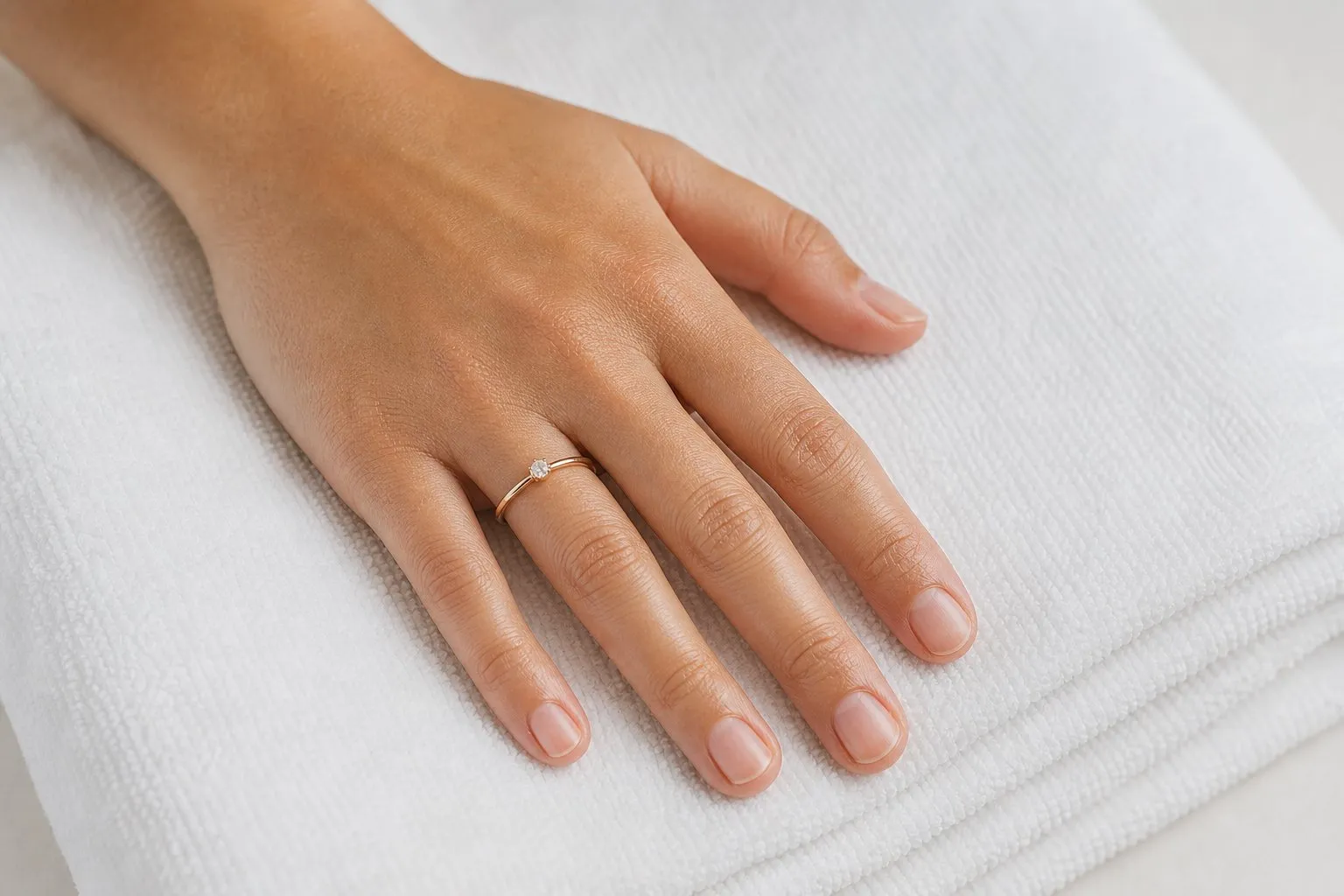
The only figure that changes what you may touch a stone with is its published hardness, and GIA publishes one for every common center stone except the organic materials. A hardness figure describes the gem species, though, not a treated surface or a mounted ring.
| Center stone | Published hardness (Mohs) | What a named source says about care | Source |
|---|---|---|---|
| Diamond | 10 | Typically about 99.95% carbon and can only be scratched by another diamond, which is why the standard advice was written around it | GIA, Diamond Description |
| Ruby and sapphire, including colorless sapphire | 9 | Among the hardest gemstones available behind only diamond and moissanite, and well suited to everyday wear | GIA, Diamond Alternatives: Engagement Rings |
| Moissanite | 9 1/4 | Silicon carbide, with brilliance only slightly less than a natural diamond | GIA, Jewelry Buyers Guide to Diamond Alternatives |
| Cubic zirconia | 8 to 8.5 | Durable and suitable for everyday wear but more prone to scratches and abrasions over time, and a colorless CZ has been shown to yellow over time. Both are durability statements, not cleaning instructions | GIA, Diamond Alternatives: Engagement Rings; GIA, Jewelry Buyers Guide to Diamond Alternatives |
| Emerald | 7.5 to 8 | Softer than diamond, and its fractures are commonly filled with oil, resin or wax. No at-home method for a filled stone published by any source we found | GIA, Diamond Alternatives; GIA, Ultrasonic Cleaners for Gems, 2015 |
| Morganite | 7.5 to 8 | Fairly durable and suitable for everyday wear. No cleaning-specific instruction published | GIA, Diamond Alternatives: Engagement Rings |
| Colorless zircon, which is not cubic zirconia | 6 to 7.5 | Requires more care and should never be cleaned with an ultrasonic or steam cleaner | GIA, Jewelry Buyers Guide to Diamond Alternatives |
| Pearl, coral, amber, opal, turquoise | Not published | No at-home method published by any source we found. The published guidance for these materials concerns machines and is listed on our diamond ring cleaning guide | Not published |
Every figure above belongs to a gem species, not to a filler, a solder joint or the metal holding the stone.
Published Hardness Decides Whether the Brush Is Safe
GIA’s figures: colorless sapphire at 9, colored sapphire and ruby also at 9, moissanite at about 9 1/4, cubic zirconia at 8 to 8.5, emerald and morganite at 7.5 to 8, colorless zircon at 6 to 7.5. What GIA never does is say which stones its toothbrush caution covers, so this page assigns no cutoff either. Our reasoning, and it is ours rather than GIA’s: the lower a published figure sits, the stronger the case for a soft cloth instead of a brush. See also what GIA publishes about each diamond alternative and moissanite next to a diamond.
The Stones GIA Singles Out for More Care
GIA names colorless zircon specifically, a natural gem rather than cubic zirconia: hardness 6 to 7.5, requires more care, and should never be cleaned with an ultrasonic or steam cleaner. That is a prohibition, so this page offers no machine for it under any condition. GIA also says a colorless cubic zirconia can yellow with time and can be somewhat brittle, a durability statement and not a cleaning one. The stones that must never go in a machine are listed on our diamond ring guide.
Pearl, Opal and Amber: What Nobody Publishes
No source we found publishes an at-home cleaning method for a pearl, an opal, turquoise or amber set in a ring. What the search turned up instead is GIA’s guidance on those materials, which concerns ultrasonic and steam machines rather than a bowl and a cloth. So this page gives no method for them and names the only honest route, a jeweler who can look at the material. We will not reason across from a harder stone, treat the absence of a warning as permission, or name a cleaner nobody has published.
When the Metal Is Plated
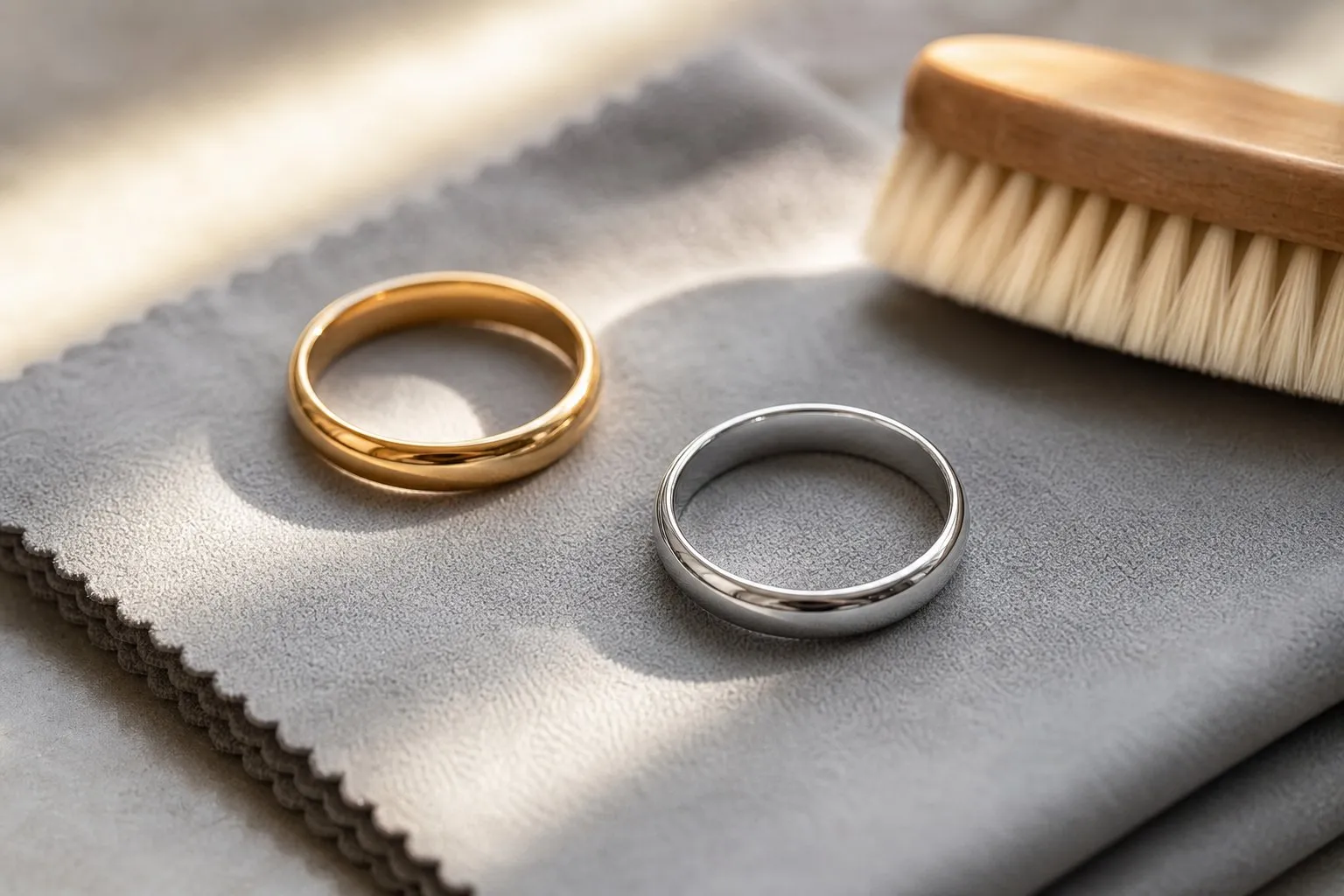
A ring can be entirely clean and still look dull, and on a plated ring that is usually the plating rather than the dirt. It is the reason many people with a white gold ring end up reading a cleaning guide at all.
Rhodium Wears Off, and Cleaning Cannot Bring It Back
GIA wrote in 2015 that rhodium plating will wear away gradually over time, requiring the ring to be replated occasionally. Its 2025 guidance adds that as the plating wears away the ring may start to appear warm in color, while yellow and rose gold typically require less frequent upkeep. The consequence, in our words rather than GIA’s: if a white gold ring reads yellowish after a clean, the clean worked and the finish is what has gone. We publish no replating price, having no dated figure for one. For the metals either side of it, see rose gold and yellow gold upkeep compared.
Water, Soap and Shampoo
This is the one habit change on the page with a named authority behind it. GIA, in 2025: “It is not recommended to wear white gold in the shower. Although water alone will not harm the metal, regular exposure to water and chemicals in some soaps and shampoos can dull the rhodium finish.” Note how GIA frames it, as maintenance of the finish and of the need for re-plating, not as damage to the gold. We do not extend it to unplated yellow gold or platinum, because GIA does not.
Plated Platinum, and What a Gold Plate Stamp Means
GIA said in 2025 that some manufacturers rhodium plate platinum rings to enhance shine and increase scratch resistance, and that such a ring will need re-plating from time to time just as white gold does. A platinum stamp therefore does not rule out a plated surface. The label question has a regulator behind it: the Federal Trade Commission’s jewelry guides require that a gold-plated product be qualified to indicate it is only surface-plated, so wording on a tag or inside a shank is where a plate gets disclosed. That rule is about disclosure and says nothing about cleaning.
When the Second Ring Is the Problem
An engagement ring is usually worn against a wedding band, and that changes both where the dirt sits and what you are allowed to take apart. Nobody writing about cleaning seems to write about the pair.
| What is true of your ring | What to do before anything touches it | Who published the reason |
|---|---|---|
| You do not know what the center stone is | Do not use a brush. Use a soft cloth and have the stone and mounting identified before the first proper clean | GIA: not all gemstones are as hard as diamonds, and some can easily be scratched with a toothbrush |
| The stone is an emerald, or you were told it was oiled or treated | Ask the seller or a graduate gemologist for the safe method. This page publishes none, because no source we found does | GIA, 2015, on filled fractures |
| The stone is a pearl, opal, turquoise or amber | Nothing on this page applies. Take it to a jeweler | Not published |
| The shank is rhodium-plated white gold | Clean gently, and treat a warm or yellowish cast as worn plating rather than dirt. Replating is bench work | GIA, 2015 and 2025, on rhodium plating |
| It is a platinum ring with a plated finish | Same as white gold. GIA says plated platinum needs re-plating from time to time | GIA, 2025 |
| The tag or the shank says gold plate, gold filled or gold electroplate | Treat the surface as a coating. The FTC requires that wording precisely so a plate is not read as solid gold | FTC, 16 CFR 23.3(b)(3) |
| The engagement ring is soldered to a wedding band | Do not try to reach or separate the seam. Cleaning inside a soldered pair is a jeweler’s job | Brilliant Earth on soldered rings |
| You can see a gap between the two rings, or between stone and metal | Clean the seam and the underside first, and have the setting checked before cleaning if a stone moves at all | With Clarity on flush fit; GIA on intricate settings |
Dirt Collects in the Gap, Not on the Diamond
With Clarity, writing in 2025, says a good fit prevents gaps that could cause discomfort, snagging or damage over time, and that a flush design minimizes friction while reducing the accumulation of dirt. The place to work is the seam between the two rings and the underside of the shank, not the table of the stone. GIA adds that periodic professional cleaning is recommended, especially for rings with intricate settings, and that GIA-trained jewelers are trained to identify and correct prongs that may catch or snag. A setting that covers the edge of the stone leaves less seam to reach.
A Soldered Pair Does Not Come Apart
Brilliant Earth says soldered rings cannot be worn individually, that separating them can be challenging and potentially damaging to the original pieces, and that a resize means separating the rings, resizing them individually and re-soldering them. Said plainly, the consequence for cleaning is that the seam is permanent and reaching inside it is a jeweler’s job. For anyone not yet committed, Brilliant Earth names three alternatives that do come apart: ring guards, spacer bands and ring jackets. Our page on soldering a band to a solitaire covers that decision.
Two Metals, Two Rates of Wear
Brilliant Earth also says different metal types and karat weights wear at different rates, that harder metals can scratch softer ones, and that platinum is denser than gold and can scratch a gold band over time regardless of karat; mixing metals means planning for slightly more maintenance. Framed correctly those marks stop being a cleaning problem: they sit under the surface rather than on it. In our view this is the one thing a stack does that no soap addresses, alongside melee upkeep on a halo, which GIA says can collect dirt more easily.
Frequently Asked Questions
How Do I Clean My Engagement Ring at Home?
Begin by identifying the ring rather than the dirt. Warm water, a mild soap and a soft cloth are the gentlest option anyone publishes, and the full routine sits on our diamond ring guide. What changes it is the stone’s published hardness and whether the shank carries a plated finish.
How Do I Make My Engagement Ring Shine?
Work the underside and the seam where two rings meet, because oil and dirt settle there rather than on top of the stone. If a white gold ring still reads warm or yellowish once clean, the finish and not the dirt is what you are looking at, and worn rhodium is bench work no household routine reverses.
Is Dawn Dish Soap Safe for Engagement Rings?
No authority we can cite names Dawn or any other brand; GIA specifies mild soap as a category and leaves the product to you. The brand is the wrong variable anyway. A mild soap on an unidentified soft stone, or on a plated shank that soaps and shampoos dull, is the risk worth settling first.
Can I Shower With My Engagement Ring On?
Not if it is white gold, on GIA’s advice. GIA says wearing white gold in the shower is not recommended, because although water alone will not harm the metal, regular exposure to water and chemicals in some soaps and shampoos can dull the rhodium finish. GIA frames that as luster and re-plating rather than damage to the gold.
What Are 10 Things I Should Avoid Doing While Wearing My Engagement Ring?
Fewer than ten are actually published, so here are the five with a source behind them: showering in white gold (GIA), taking a brush to a stone you have not identified (GIA), assuming a filled emerald tolerates a soak (nobody publishes one), scrubbing a fragile or older estate setting (GIA), and stacking platinum against gold (Brilliant Earth).
Sources
- GIA, How to Clean Your Diamond Jewelry, undated, accessed 11/09/2026.
- GIA, Diamond Description, undated, accessed 10/09/2026.
- GIA, Diamond Alternatives: Engagement Rings, undated, accessed 11/09/2026.
- GIA, Jewelry Buyers Guide to Diamond Alternatives, undated, accessed 11/09/2026.
- GIA 4Cs, Ultrasonic Cleaners for Gems: What You Need to Know, 2015.
- GIA 4Cs, White Gold vs. Silver: What is the Difference?, 2025.
- GIA 4Cs, Choosing Between White Gold, Platinum, Palladium, and Silver, 2015.
- GIA 4Cs, The Best Ring Material for Everyday Wear, 2025.
- GIA 4Cs, Complete Guide to Engagement Ring Settings: Types vs. Styles, 2026.
- Federal Trade Commission, 16 CFR Part 23, Guides for the Jewelry, Precious Metals, and Pewter Industries, current eCFR text, accessed 10/09/2026.
- With Clarity, How do you find a flushed-fit wedding band for your hidden halo engagement ring?, 2025.
- Brilliant Earth, Soldered Rings: Pros, Cons, and Alternatives, 2026.
- Brilliant Earth, How to Choose a Wedding Band, 2026.